I can’t explain why, but it took Bina and me more than a year of living in Tavira before we ever got around to visiting Estoi. I can’t plead ignorance. We had learned, very shortly after arriving here, that this small town contained some important Roman ruins. Furthermore, Estoi is located less than a half hour drive from our house; we pass the exit every time we take the A-22 motorway to the western Algarve, which is frequently.
Still, it wasn’t until January 2022 that we finally roused ourselves to go take a look. One day, casting about for a convenient day-trip, we said to ourselves, “Let’s go to Estoi.” So, we hopped in the car, took the motorway west, towards Faro, and got off at Exit 14, labelled “Estoi.” The Roman site, called “Milreu,” is located on the western outskirts of town.
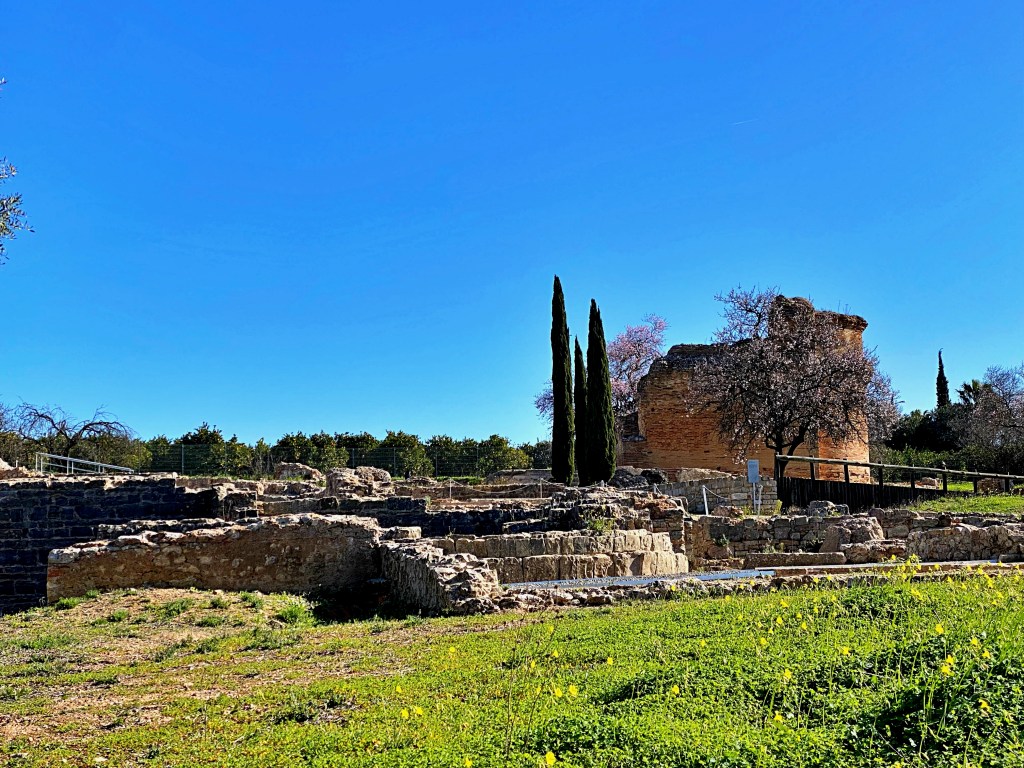
Keep your eyes peeled because there’s no grand entrance to the site, just a small parking lot enclosed by a chain link fence. The museum on site charges a few euros to enter the excavated area. Before doing that, we spent 20 minutes browsing through the exhibits that explain, in Portuguese and English, the history of Milreu and the archaeological work conducted there.
Milreu was a large villa/estate, continuously inhabited from the 1st to the 10th centuries. Its largest expansions occurred during the 3rd and 4th centuries, when the farm acquired its own baths and temple, like a small town. The site’s first excavator, Estácio da Veiga, in 1877, was convinced he was looking at part of Ossonoba, a city mentioned in Roman texts as existing on the southeastern Algarve coast. Later scholars determined that Ossonoba actually lies buried under the modern city of Faro, about 10 km south of Estoi.
From 1971 to 1998, the German Archaeological Institute conducted a major scientific excavation to uncover most of the ruins we see today. And these are impressive, which you realize as soon as you climb the steps behind the museum and view the brick and stone foundations spread out over the top of the hill.
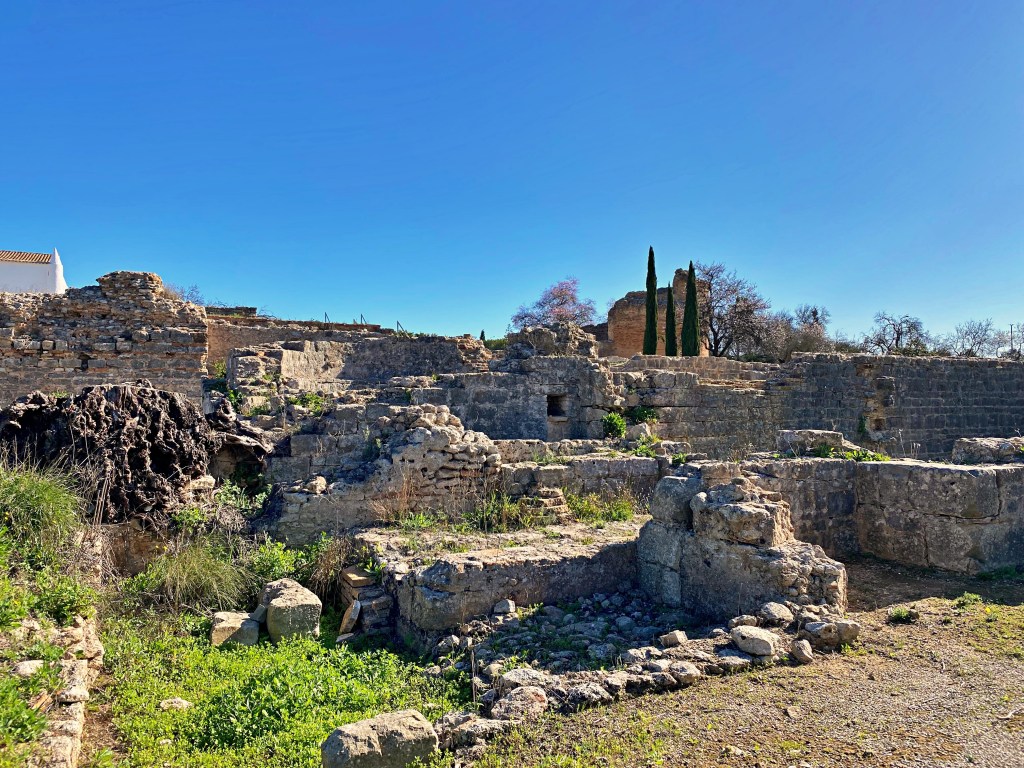
Gravel and dirt paths wind through these ruins with information signs detailing the floor plans and purpose of the various structures as they developed over the centuries. This may prompt questions from visitors without any grounding in Roman architecture, like, “What the heck is a triclinium?” Answer: A formal dining room outfitted with couches for reclining during your meal.
The Algarve today is one of the driest parts of Europe, with average rainfall only 20.3 inches (515 millimeters) a year, most of that falling between October and January. So, why put such a large farm here? Because groundwater accessible from springs and wells enables Algarve farmers to keep their fields irrigated in the dry season. At Milreu, the owners laid down channels made of lead, earthenware and stone, to transport the water from nearby springs located at higher elevations. (Unfortunately for them, the Romans were not aware of the dangers of lead poisoning.) They may also have drawn some water from a small river nearby.
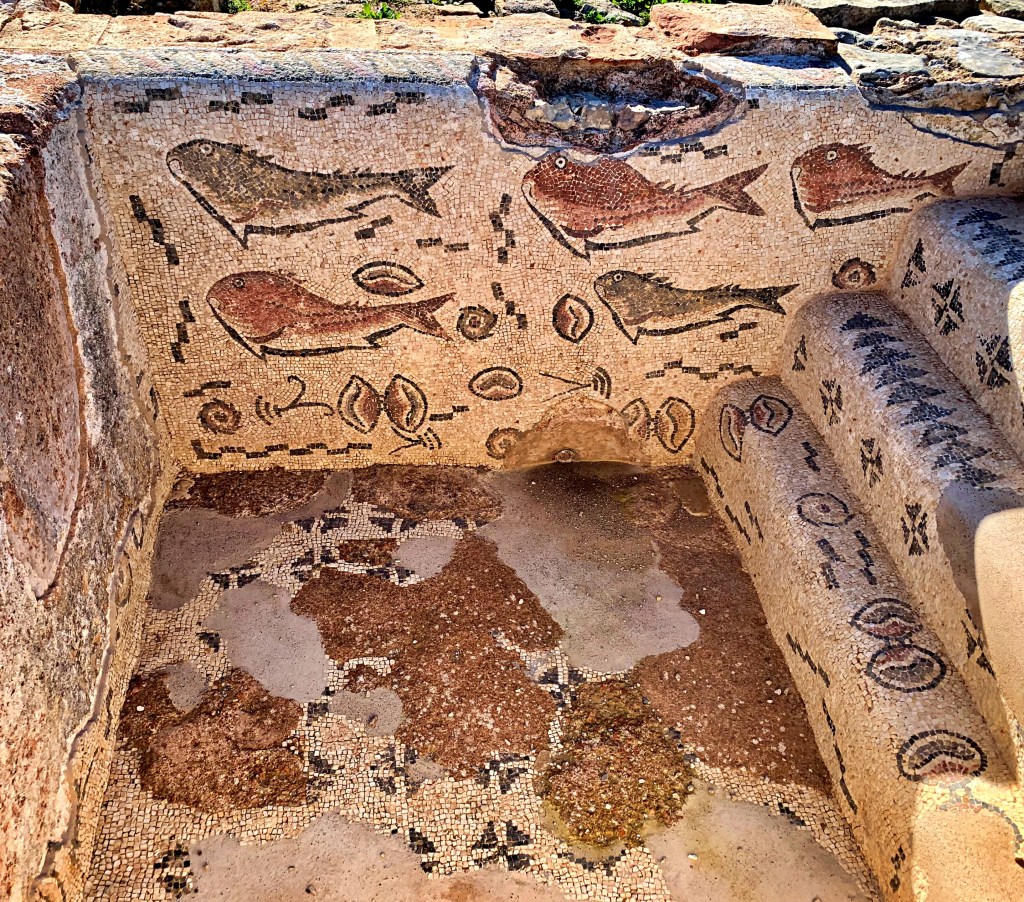
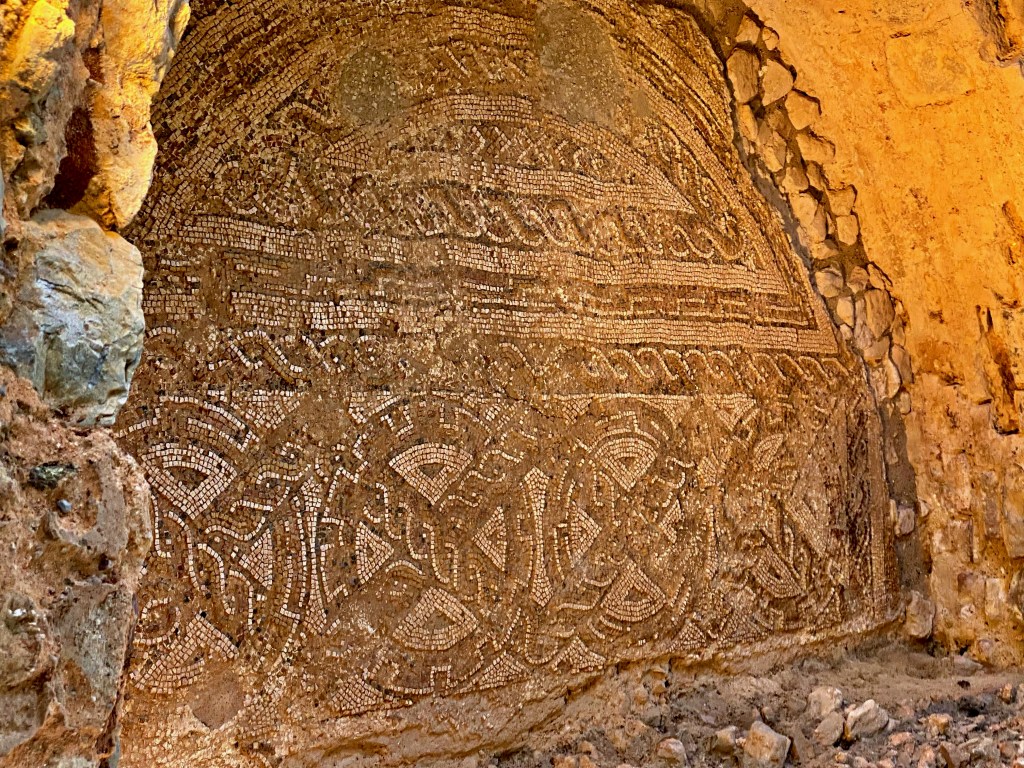
In constructing the buildings at Milreu, the Romans used kiln-fired bricks bound by opus caementitium, a mixture of lime, sand, rubble and small stones. Think of it as an early version of concrete. The most prestigious structures, like the main house and temple, included white marble facing and mosaic decorations. These mosaics are of a quality you wouldn’t expect from the farthest western fringe of the empire. Some scholars speculate that a team of craftsmen from larger Roman cities in north Africa came over to do the job.
The artists took their inspiration from what has always been one of the Algarve’s major industries — fishing. During Roman times, some of the major Algarve towns like Ossonoba and Balsa (near modern Luz de Tavira) derived their wealth from the mass production of garum, or fermented fish sauce. This Roman staple for flavoring food was very much needed in an era that lacked the spices we take for granted. On the mosaic panels, these fish take on a stylized, often fanciful appearance.
Milreu began in the 1st century as a simple farmhouse. A new and larger building with a peristyle (columned porch framing a garden) and atrium followed in the next century, along with servants’ quarters and olive and grape presses. We can assume the owners sold their wine and olive oil to merchants in Ossonoba; the road between Ossonoba and Pax Julia (modern Beja) passed by Milreu.
Extensive remodeling in the 3rd century included an interior garden with a water tank in the middle overlooked by an elaborate triclinium and some formal Roman baths, with heated water flowing underneath. Further embellishments in the 4th century included those wonderful fish mosaics we enjoy so much today and a pagan temple, which also featured mosaics of marine life. The temple was converted into a church 200 years later, as can be seen from the addition of a baptismal font.
Until the 10th century, Christians, and later, Muslims, buried their dead next to the church. Then the vaults collapsed and the site seems to have been abandoned until the 16th century, when a wealthy family built a large farmhouse on the top of the hill overlooking the ruins of the church.
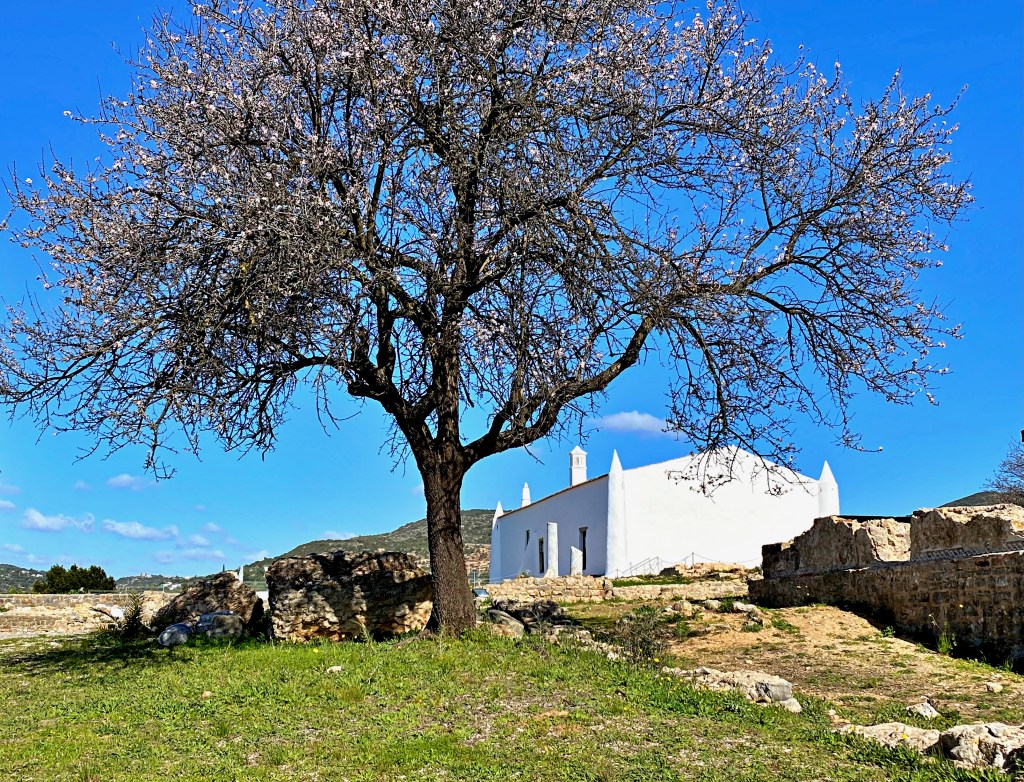
While the restored farmhouse struck me as incongruous amid all the Roman ruins, a walk-through does provide insight into life in rural Portugal before electricity and modern plumbing. Through gaps in the floor, you can also peer at the Roman mosaics underneath.
A visit to Estoi wouldn’t be complete without driving into the town center and visiting the Jardim do Palácio de Estói. We parked in a side street off the main square (centered on the Igreja Matriz de Estói) and walked up the hill to the garden. This was originally part of a 19th century estate. The manor house was converted into a hotel in 2009 and was off limits to tourists during Covid times. Part of the garden, however, remained open to the general public.
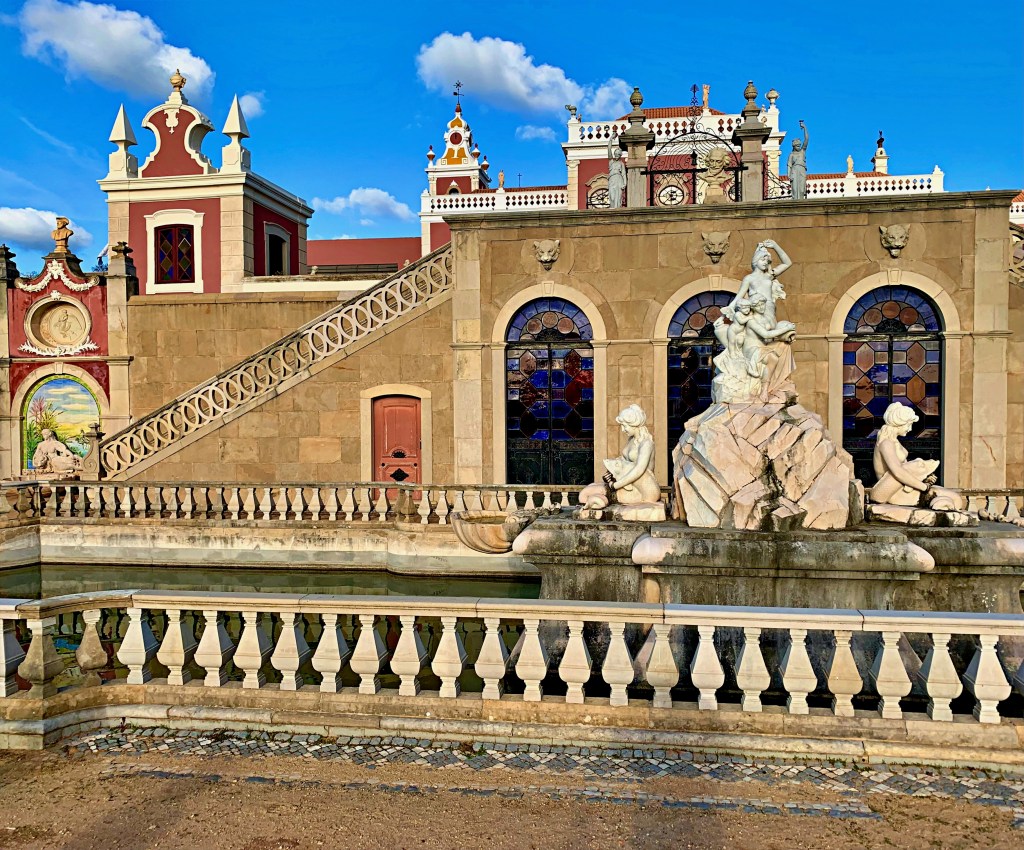
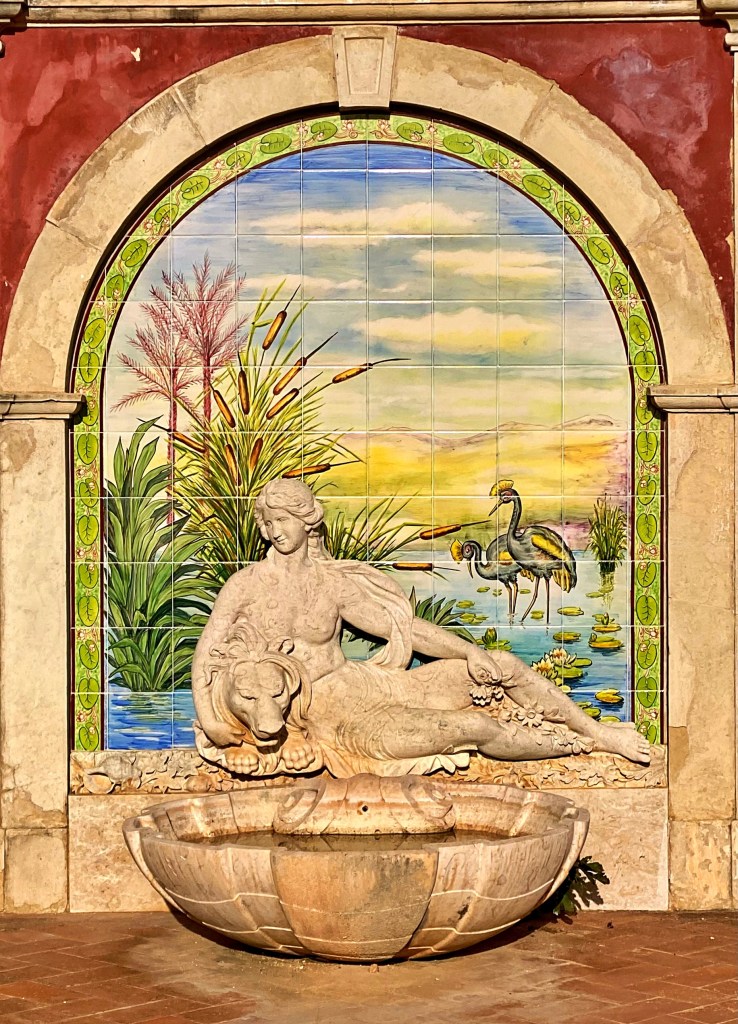
While it’s not particularly interesting or well maintained, consisting mostly of an orange grove, the garden’s stairs and promenades do display an interesting array of architectural styles — a grab-bag of Baroque, Rococo, Neoclassical and Romantic motifs, including some of the elaborate tile work for which Portugal is famous.
Finishing up our visit to the garden and palace in the late afternoon, Bina and I took a short walk back to Estoi’s central square, where we had parked our car. There, we sipped coffee at a cafe (Snack Bar Com Tradiçoes), enjoying a nice view of the square and main church. For an impromptu day trip, this had worked out pretty well!
Note: If you fancy a robust lunch during your trip to Estoi, we can recommend Casa De Pasto Do Carmo in the village of Quelfes, a 10 minute drive away. This family-run restaurant in a converted farmhouse specializes in steak-on-a-stone. Hat tip to Sam and Annette McGuire for suggesting this to us.

 Two Clines Traveling
So interesting! Thank you for sharing.
Abraços
LikeLike
Thank you, Flavia!
LikeLike
You live in and on history. The mosaics are spectacular. Thanks for the look.
LikeLike
Have History — Will Travel, that’s my motto. Thanks, Clint.
LikeLike
Beautiful mosaics! Wonder why it was abandoned for so many years.
LikeLike
Hi Peggy. Can’t answer your question but can offer a guess. Algarve was fought over by the Muslims and Christians from the 8th to 13th centuries. So maybe rural populations moved to the larger towns, which offered more security.
LikeLike
Sounds like such an interesting place! Ken’s descriptions are so wonderful I can almost visualize it’s beauty. Take pictures. And thanks for sharing your journey. Jan.
LikeLike
Thanks for your nice comments, Jan.
LikeLike