We woke this morning to a light drizzle and mist, with a cooler temperature of 18 C. (64 F.), supposed to reach only one degree higher by the afternoon. Not ideal walking weather, but doable as long as the wetness didn’t turn into a downpour.
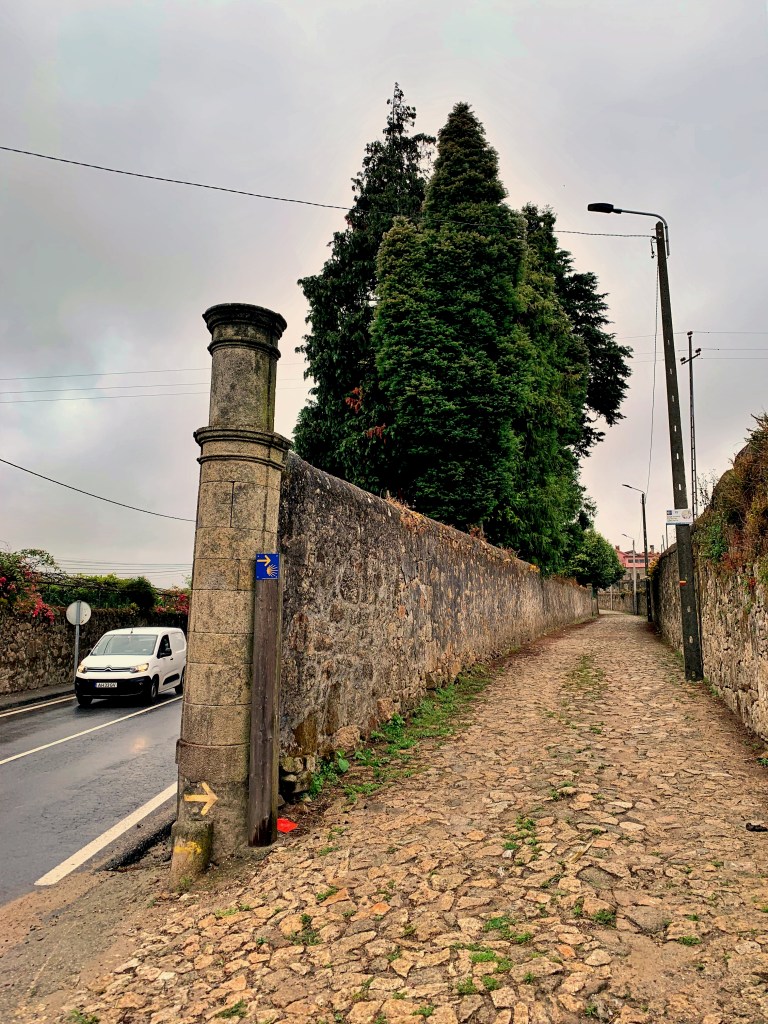
After breakfast, Helena showed us a shortcut to the Camino path that avoided the highway. We were on our way by 10 a.m., wearing plastic ponchos that would remain with us for the rest of the day’s walk. As Helena had promised, today’s Camino mostly avoided major highways in favor of cobblestoned, country lanes. We passed through numerous small towns, separated by cornfields, vineyards and vegetable gardens.

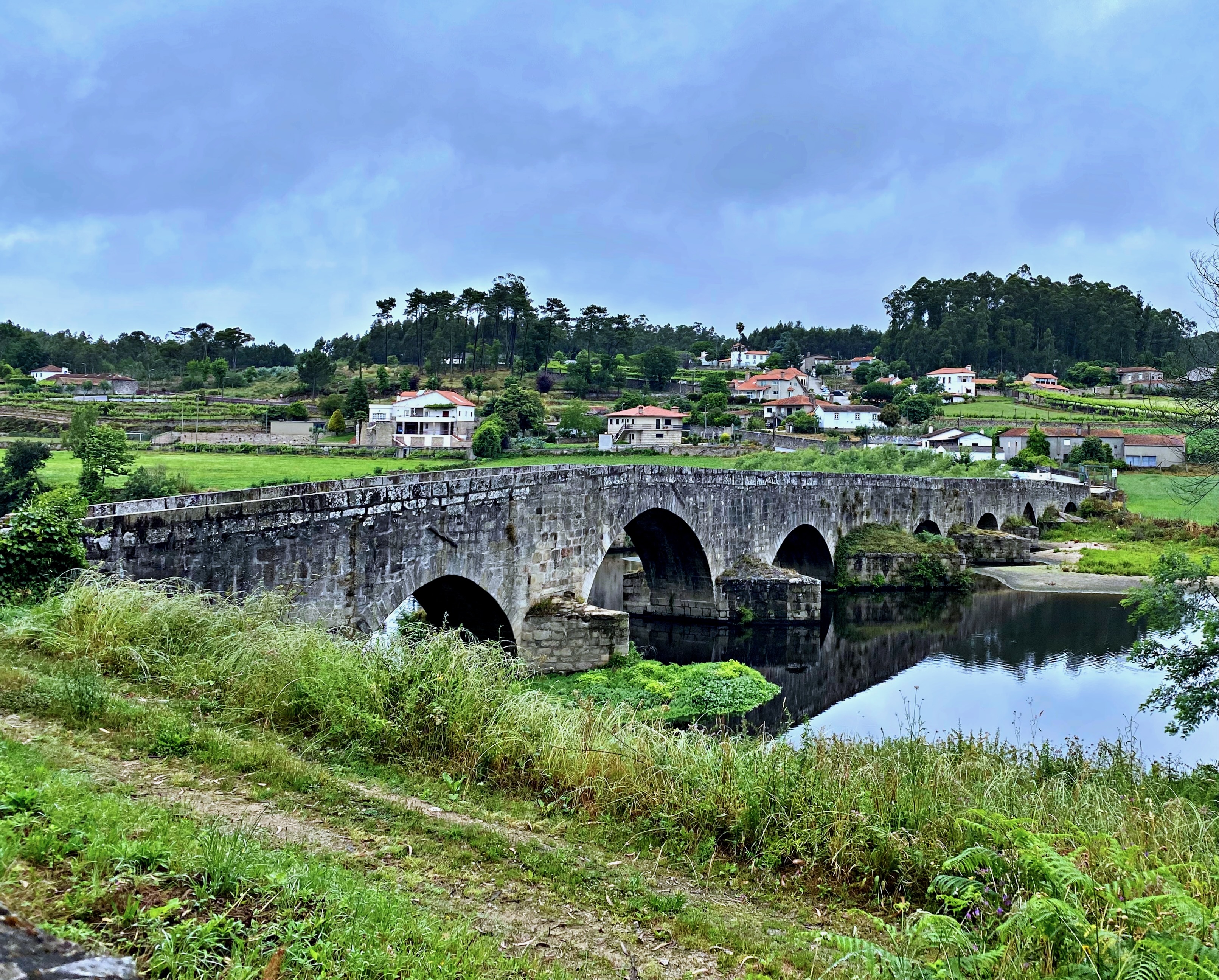
At the Ave River, we crossed the 12th century D. Zameiro bridge, which features eight arches, seven in the rounded Romanesque style and one of a more pointed Gothic design, which suggests a repair in that later era. A stone weir built on the other bank served to divert water to watermills that once operated downstream.
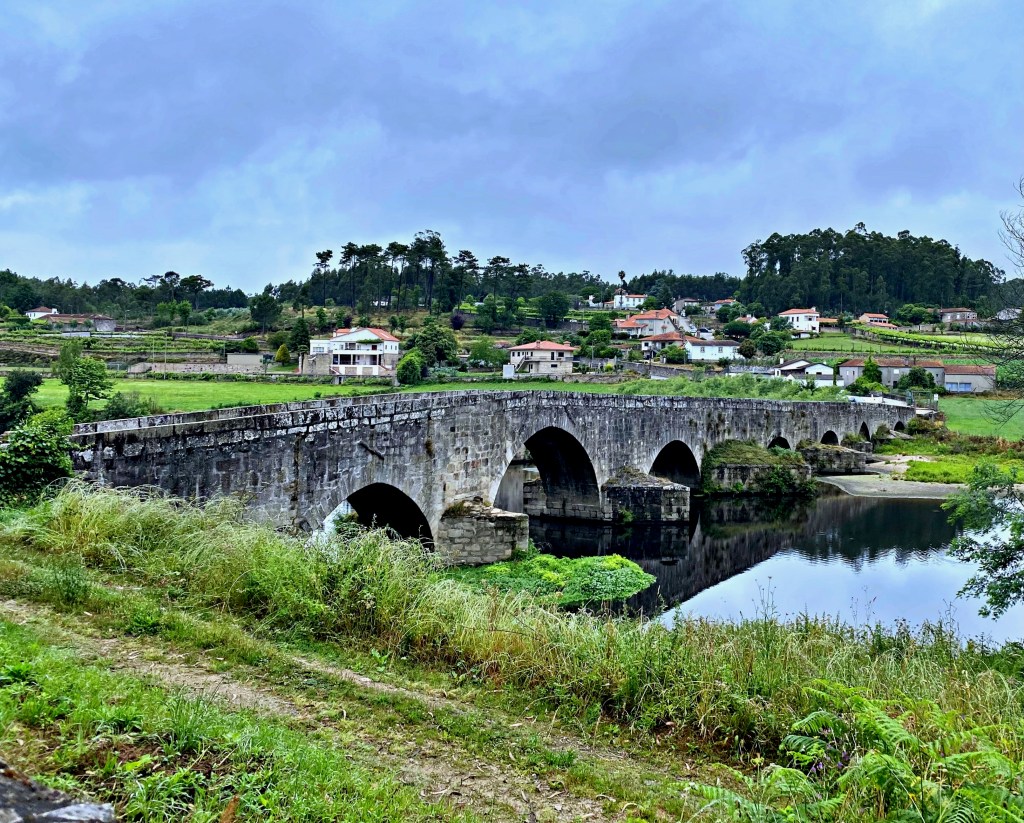
The bridge marks the spot where Roman travelers on the road linking Lisbon to Braga forded the Ave. By the 12th century, the economy of the region had revived enough for the bishop of Porto to sponsor the building of a bridge on the site, improving connections between Porto and Barcelo. Two Portuguese kings, D. Alfonso Henriques and D. Sancho I, also helped fund the project. Up until the 1970s, the bridge remained in heavy use but now handles local traffic only.
At the Este River, just outside the village of São Miguel de Arcos, we crossed another 12th century bridge, this one funded entirely by King Henriques. Like the D. Zameiro bridge, this one is also in the Romanesque style, with three rounded arches.

The day we arrived, the entrance to the bridge featured a cross draped in white cloth to commemorate the Festival of São João (St. John), scheduled for that weekend. We had seen several similar crosses by the side of the road since leaving Porto.
Soon after crossing the bridge, around 3 p.m., we entered the village of São Miguel de Arcos and found our lodging for the night, a B&B known as Villa d’Arcos. Conveniently for us, this two-story home was located steps away from the Camino path. It felt good to shed our wet ponchos and dry out in a heated room. Bina was also grateful for the opportunity to take a nap, since her back had been paining her since about the middle of the walk.
The owner, a woman named Belmira, proved friendly and hospitable. While her English was basic, we communicated well in a mixture of Portuguese and English. At 7 p.m., we walked down the stairs to the dining room where she had prepared a home-cooked meal for us: a cold plate of presunto ham and melon, followed by vegetable soup and roasted chicken, chocolate mousse for dessert, all washed down by a good Alentejo wine.
We were joined by another guest, a young, blond-haired German man named Jan. He had just completed his studies for a law degree in Munich and was considering switching from criminal to corporate law law but couldn’t decide on a specific niche. He was using his time on the trail “to clear my head.”
Bina and I admired Jan for having walked the entire 35 km from Porto to Arcos that very day, dreary weather and all. “By the time I got here,” he said, “I could only focus on putting one foot in front of the other.”
Not our style, for sure.


Totally enjoying your comments and beautiful photos.!
LikeLiked by 1 person
Thanks, Sandy, glad you enjoyed it!
LikeLike
Enjoying your trip in the evenings, after a tourist’s day in Germany. Thanks!
LikeLike
Good to hear from you Clint. I’m looking forward to reading about your trip to Germany!
LikeLike
Bom Caminho, my friends.
LikeLiked by 1 person
Thanks, Simao. It was good seeing you again in Tavira.
LikeLike