We woke up to another warm, sunny day, with the afternoon high expected to reach 29 C. (84 F.). Our Camino was getting hotter, day by day.
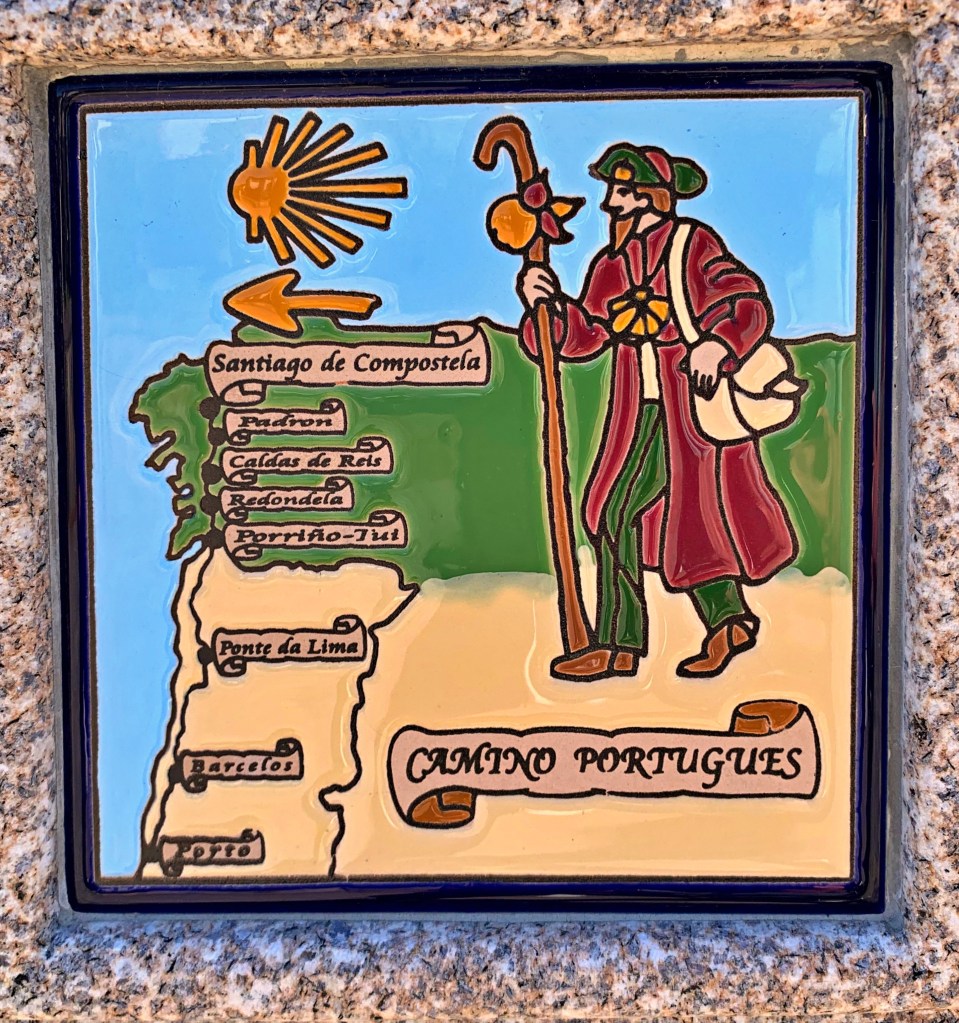
We had a slow start leaving town because we needed to stop in a padaria (bakery/cafe) to buy some coffee and bread to eat with the eggs we had boiled the afternoon before in the albergue. It was 10 a.m. before we finally resumed our journey, passing through a succession of villages, with intervening countryside between them. Most of the journey involved trails, although we did encounter a few stretches of road walking.
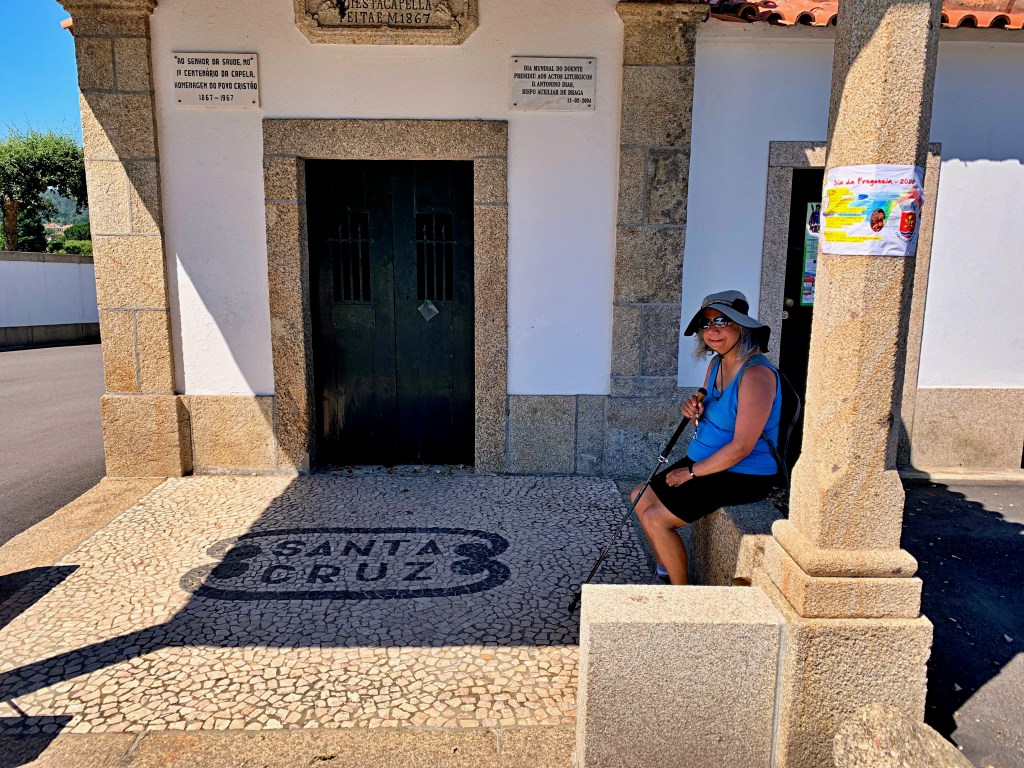
In the town of Cavalhal, we stopped at the 19th century Chapel of Santa Cruz. The building was closed but we were able to take a rest on the sheltered portico.
From this point on, we began entering a more urban environment as we got closer to Barcelos, even passing a “big box” Staples store, with a U.S.-size suburban parking lot.
In the Barcelo suburb of Barcelinhos, around noon, we came upon the 14th century Ponte de Barcelos. On the other side of the two-lane bridge, which spans the blue and wide Cávado River, loomed what is known as the Conjunto Monumental, or Monumental Ensemble.
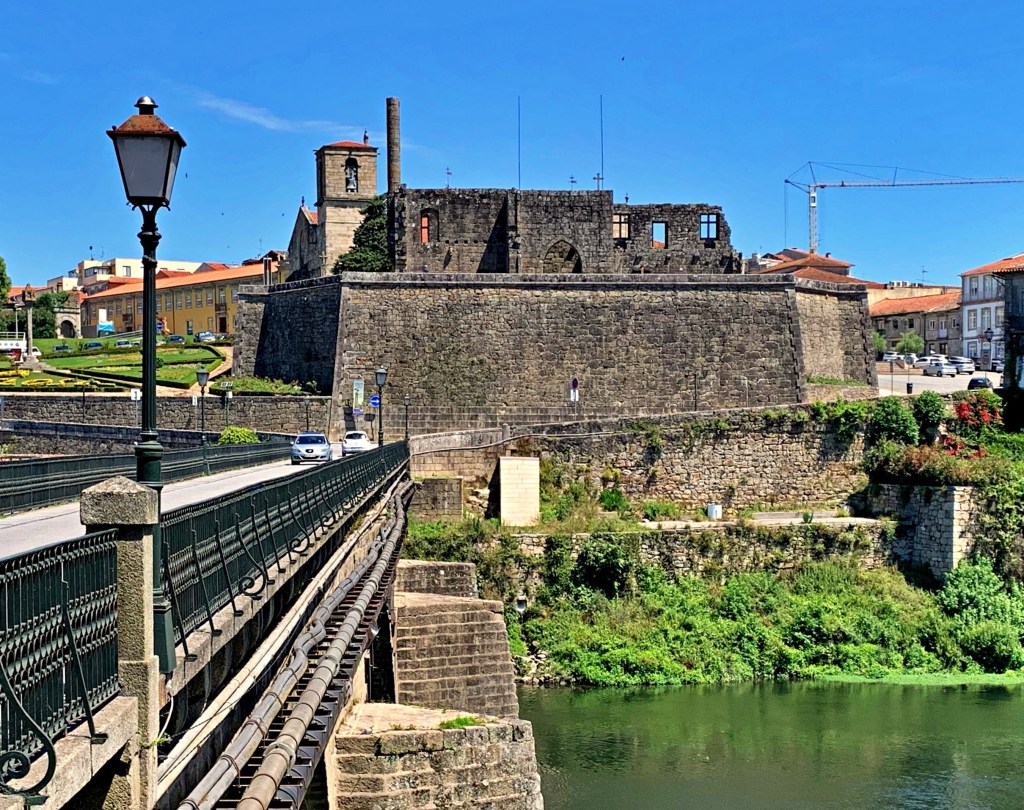
This is a collection of stone structures including a palace, manor house, church, town hall and pillory. Most of these buildings date back to the 14th and 15th centuries, when Barcelos was a stronghold of the powerful Bragança family, which provided the Portuguese throne with 15 kings between the 17th and 20th centuries.
Reaching the opposite bank, we climbed some stairs to the complex. While Bina stopped to examine a large statue of the Barcelos Rooster, I walked over to the ruins of the palace for a quick look-see. A man at the entrance with an laminated ID around his neck spoke to me in Portuguese that I had difficulty following. At first I thought he was asking for some kind of admission charge but gradually understood he was offering to stamp my Camino credencials booklet.
Afterward, he guided me to a stone cross carved with an image of a man with a rope around his neck as another figure underneath supports his feet with one hand, holding a walking staff in the other. This brings us back to the Barcelos Rooster story.
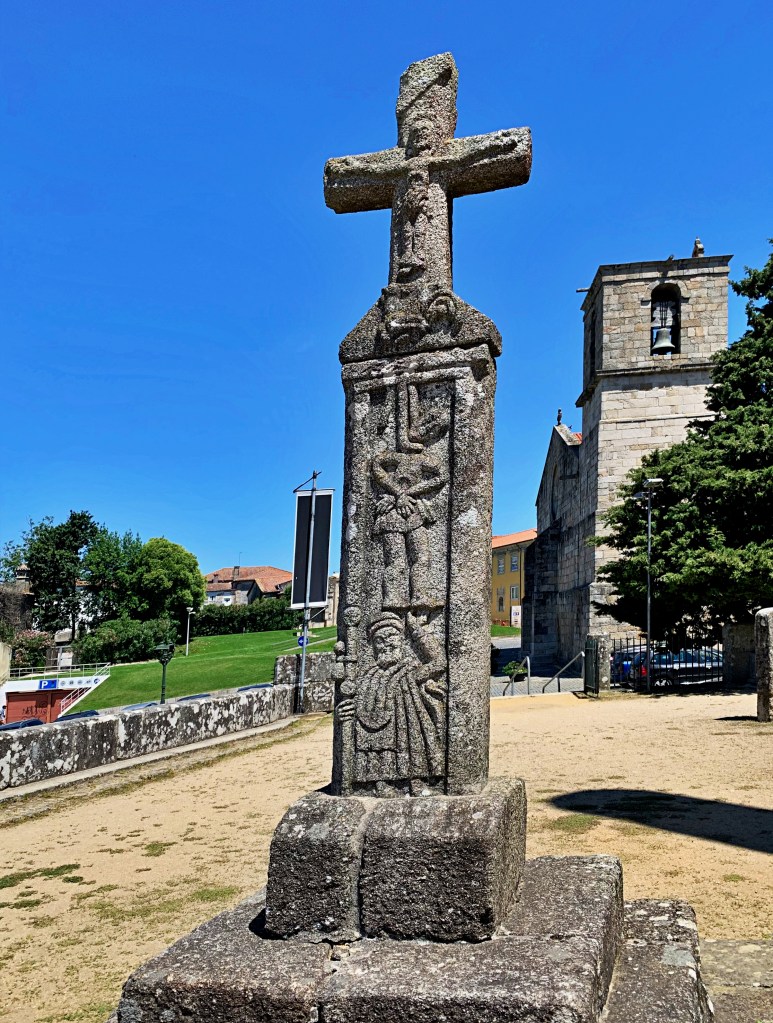
The figure holding up the man on the gallows is none other than the Apostle St. James himself, who keeps the condemned man alive long enough for the rooster to crow and send the judge to rescue him so that he could continue his pilgrimage to Santiago de Compostela. According to tradition, the pilgrim who was saved in this manner later returned to the city to commemorate his deliverance by erecting this monument, known as the Cruzeiro do Galo.
And there you have, as radio commentator Paul Harvey used to say, “the rest of the story.”
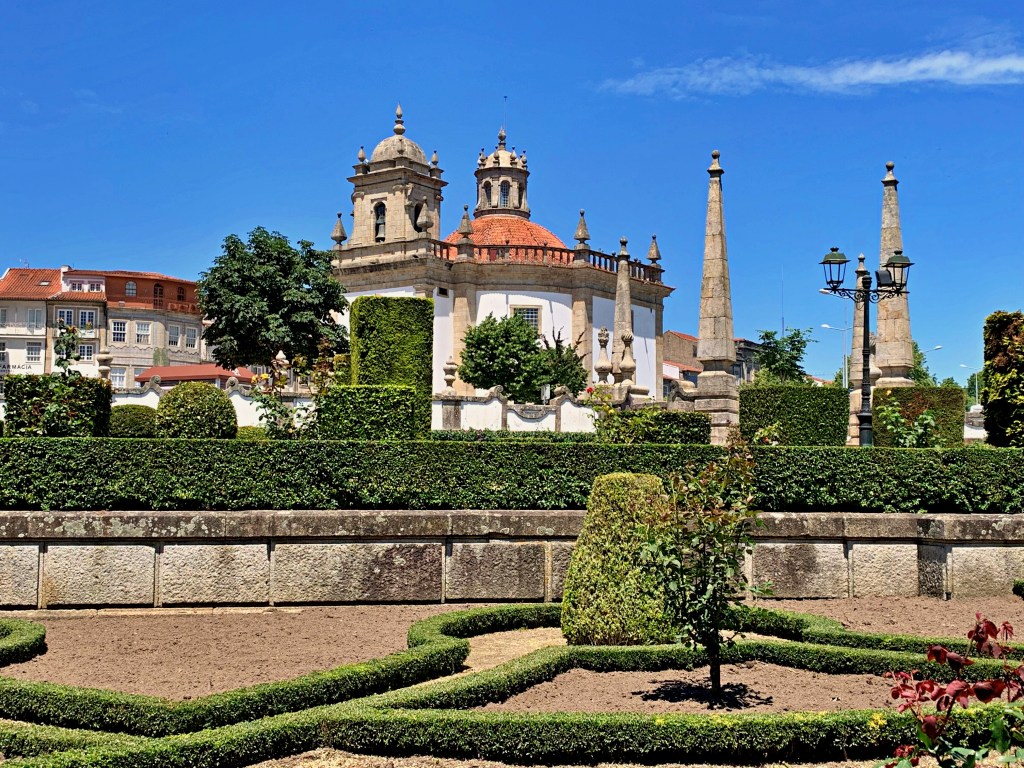
Next, Bina and I walked a bit around Barcelos and obtained some brochures at the tourist office. We learned that northern Portugal was chock full of upcoming festivals for the next week, one for St. Anthony (Barcelos’ patron saint) on the weekend, and then St. John right afterward. Our Camino trail was becoming a kind of festival alley.
From there, we covered the last couple of kilometers to our lodging, the Alojamento Flora, a three-story house that had been converted into an albergue. Marco, a member of the family that owned the property, took us upstairs to our small room, which featured a bunkbed, a small plastic end table and a chair. For ventilation we had only a small upper window, with no cross breeze unless you kept the door open, not ideal for a hot summer night in a place full of other lodgers.
Marco, a friendly and helpful fellow, did his best to make us comfortable, bringing us a fan and dismantling the bunkbed so we could have two single beds side by side. But as the evening wore on, the heat and noise level from other guests made us realize our original plan of staying here for two nights to enjoy Barcelos was not going to work.
We searched various apps to find another place for the following night, but Barclelos was all booked up for the St. Anthony holiday. In the wee hours, during a very restless night, Bina finally snagged a place in the town of Balugães, a half day’s walk up the trail.
We grabbed this room with some regret at missing more time in Barcelos, one of the most interesting towns on the Central Portuguese Camino. In addition to the 14th century bridge and the “Monumental Ensemble” mentioned earlier, Barcelos is known for its ceramic and handicrafts industries. You can check out the pottery museum (Museu de Olaria) and shop for handicrafts every Thursday at an open air market — and at every turn, statues and images of the immortal cockerel!

 Two Clines Traveling
Another great post of your continuing adventure!
LikeLiked by 1 person
Thanks, Ed.
LikeLiked by 1 person
I am enjoying your adventures.
LikeLiked by 1 person
Thanks, Carlos. Hope you and Tricia are doing well.
LikeLiked by 1 person
This story brought me some memories. It was also very hot when I stayed in Barcelos. It was nice to visit but I had to keep on going also to seek a cooler place for the next night.
LikeLiked by 1 person