The next morning, checking my weather app, I could see that we faced temperatures of 32 (nearly 90 F.) by mid-afternoon. With the wind predicted to be “calm,” we were in for a sweltering day.
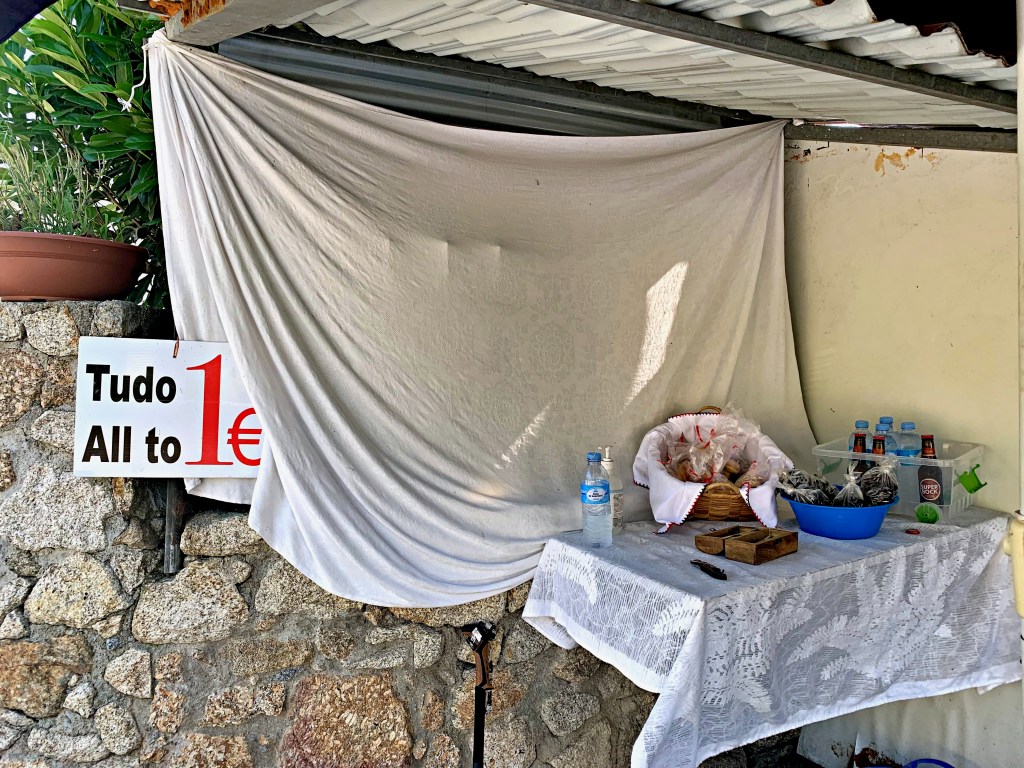
We started out with a full breakfast at the Casas da Quinta de Cancela and then hit the trail by 9 a.m. We hadn’t gone far when we encountered a table displaying items for sale — all for 1 euro each. Didn’t matter whether it was a bottle of water, a beer or a bag of cookies. The thing we found interesting was the lack of anyone to take the money; all you had to do was leave the proper amount in a small wooden box. We went for the water and cookies, being careful to deposit the requisite two euros!
A bit further on, we ran into another of those roadside shrines where pilgrims leave momentos of their passage. This one featured stones upon which people had written messages, in a multitude of different languages.

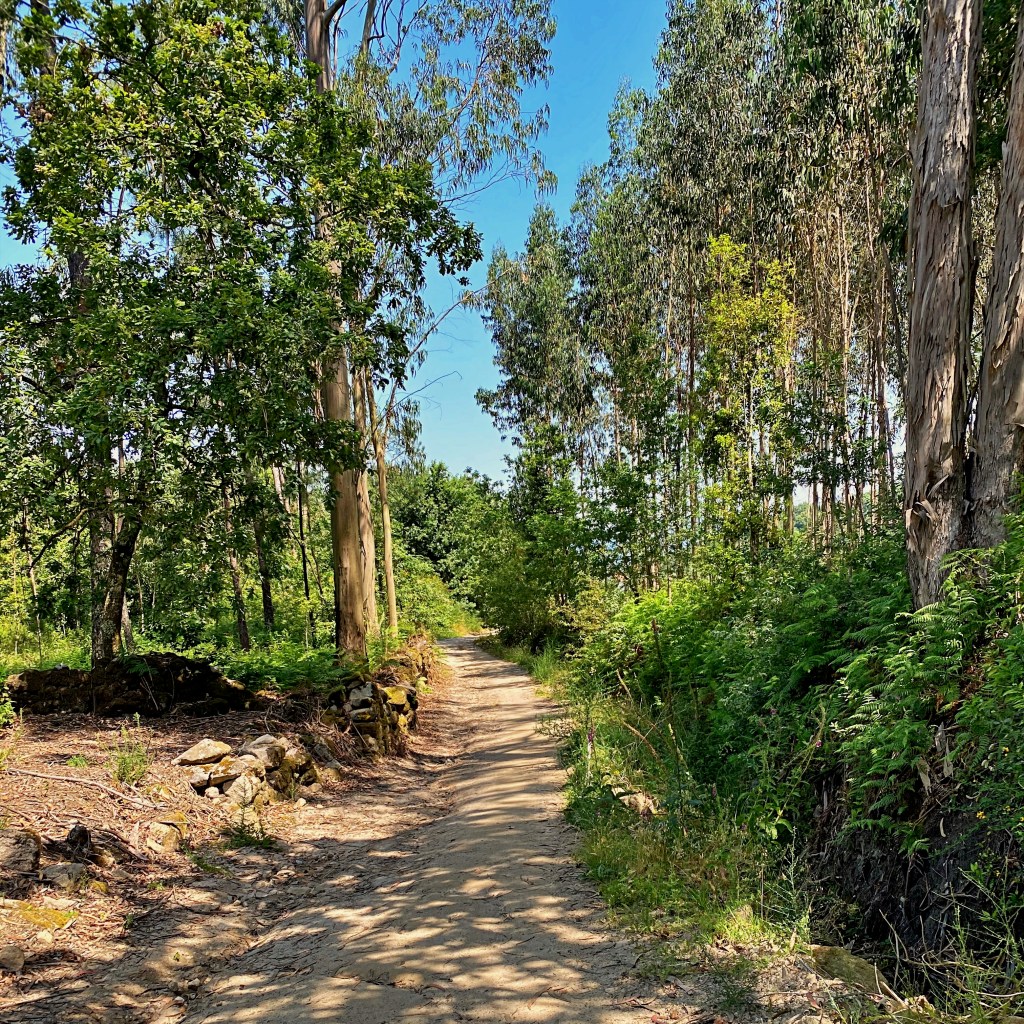
For the first half of the day, we mostly passed through one village after another. Northern Portugal doesn’t feature many large cities, except for Braga, but it is chock full of villages, probably related to all the intensive farming. Although it’s a largely rural landscape, you’re never far from people. The trees, as usual, consisted mostly of eucalyptus and pine, with open land devoted to corn.
In the village of Vitornino dos Piaes, we walked by the famous Casa Fernanda. This is an albergue that is much talked about on Camino-related forums for the excellent meals and hospitality of the hosting family. It’s located in a converted farmhouse just off the trail in a wooded area with a pretty garden. We had stopped for a rest at a bench at the entrance to the property when we noticed a young woman sitting there looking tired and disconsolate.
Bina started chatting with her and found out that she was of Russian nationality, now living in Bologna, Italy. She had started walking that morning from Barcelos at 6 a.m. expressly for the privilege of staying in Casa Fernanda that night. It was now 10:30 a.m. and the place was already completely booked for the next several nights. From what I’ve read, it’s not unusual for peregrinos to make reservations at Casa Fernanda months in advance.
Now she was uncertain about where to find lodging for the evening; the largest town, Ponte de Lima, was about 15 km further up the trail. Bina showed her how to download an app to her phone that we were using called Camino Ninja, which enables you to book in advance. This woman had no idea you could do that; her practice, so far, had been to simply start walking every day and see what was available when she was ready to stop for the evening.
This turned out to be our day for meeting women from eastern Europe. Further on, near the village of Facha, we met Misha, a blond-haired 30 year-old from the Czech Republic. We noticed her walking behind us on the trail and she caught up with us at a roadside Camino shrine, where we had paused for a break. We found out that she spoke excellent English. She told us she had recently quit her IT job and was walking the Camino to decide what to do next with her life — very similar to Jan, the German man we had met in Arcos.
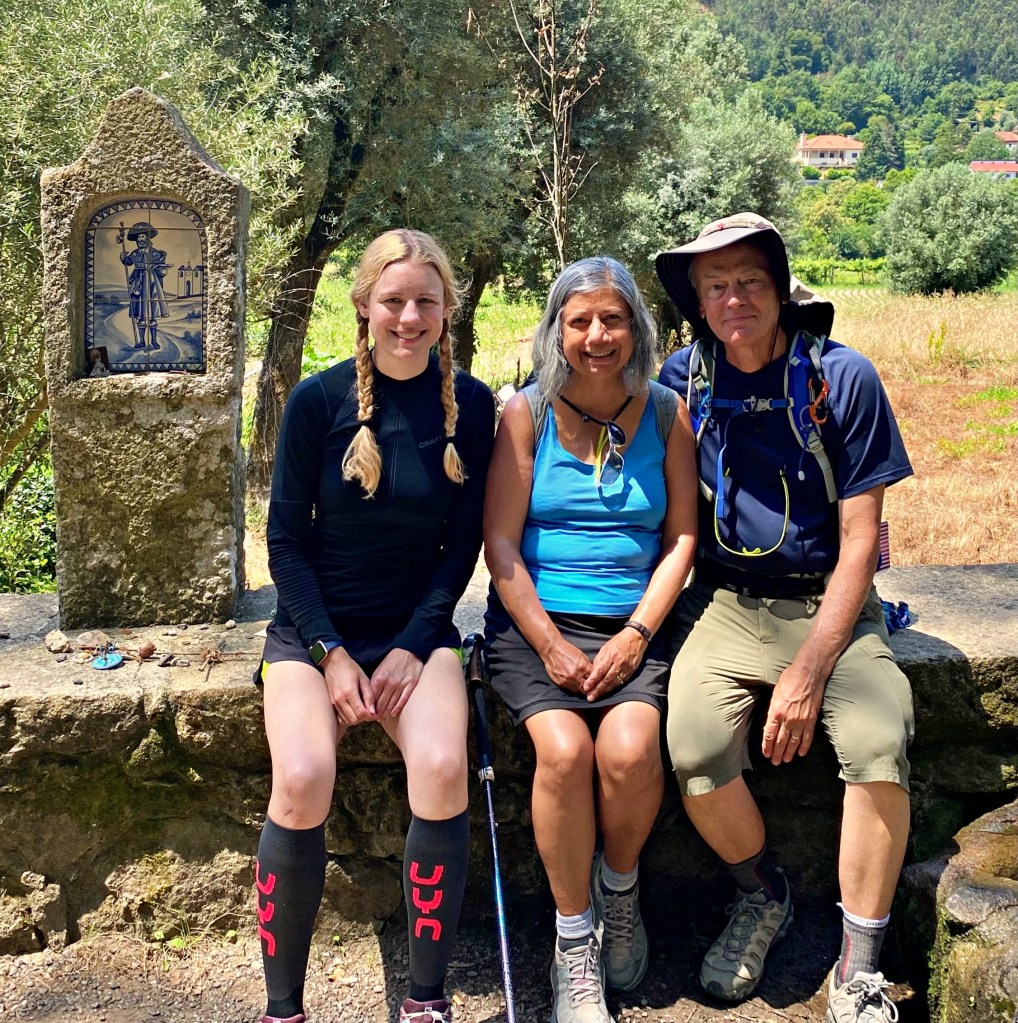
The three of us got along so well, just walking along chatting about one thing or another, that we continued walking together, without consciously planning to. And then, about an hour later, near the village of Seara, another woman fell into step with us: Isabella, a black-haired Brazilian, also in her early 30s. She was working for a judge in the city of Bahia and had recently gone to London to take a course in English. After finishing that, she had made a spur-of-the-moment decision to walk the Camino.
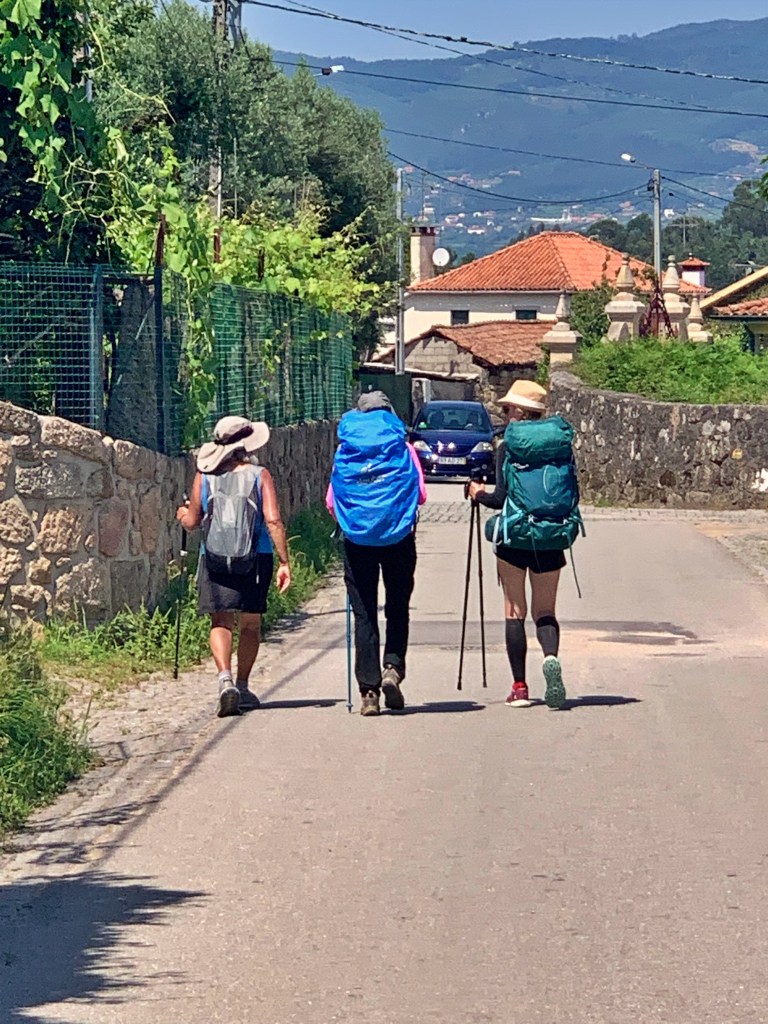
Despite the three-decade gulf in ages between these two and Bina and myself, we all got along wonderfully for the rest of the day. But this did change the dynamic of our walk. We had originally planned to cap this day’s walk at about 11 km by stopping in the village of Sobreiro and, from there, take a taxi to Ponte de Lima (PdL), another 10 km up the trail, where we had reservations for the night. Following this scenario, we would take a taxi or Uber back to Sobreiro the next morning and walk the rest of the way to PdL.
Stopping at a cafe in Sobreiro for lunch with Misha and Isabella, we calculated that continuing on to PdL meant roughly an hour and a half more walking. Because we were enjoying the company of these two girls so much, we decided to walk right on through to PdL, where they were also planning to spend the night. This proved to be a challenge because the last stage of our walk included lots of open ground under a cloudless sky. Walking as a group helped us maintain our energy and enthusiasm, but we were exhausted by the time we arrived in PdL at 4:30 p.m.
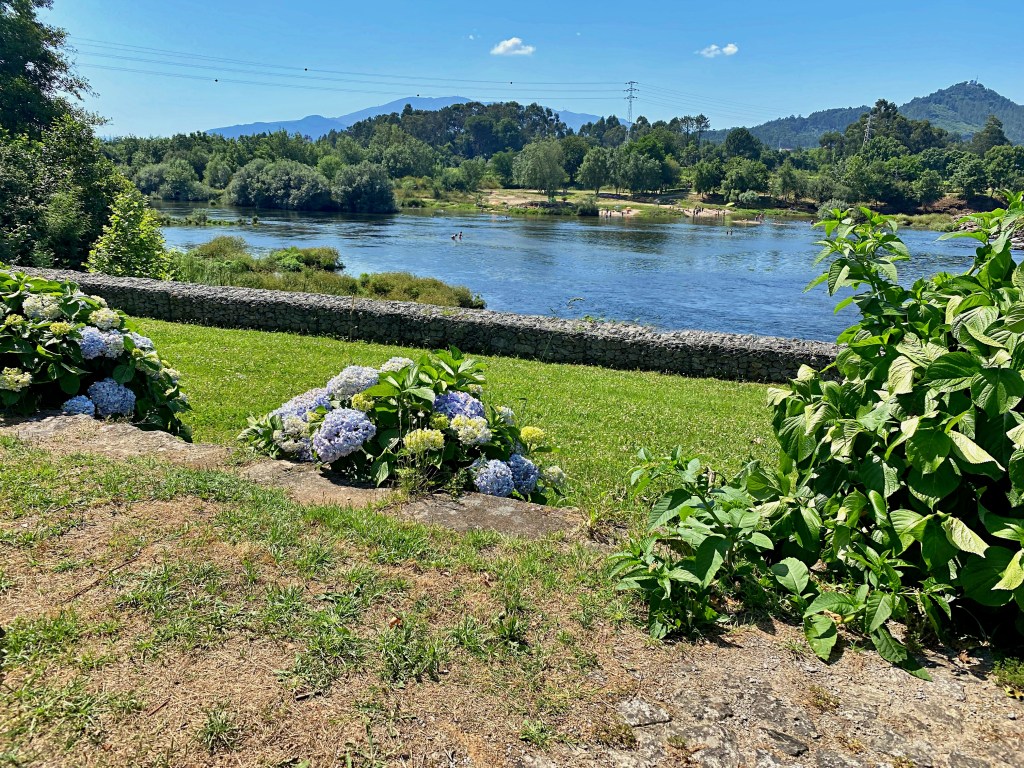
At least the walk into town was scenic, featuring a park-like area with shady trees along the River Lima.
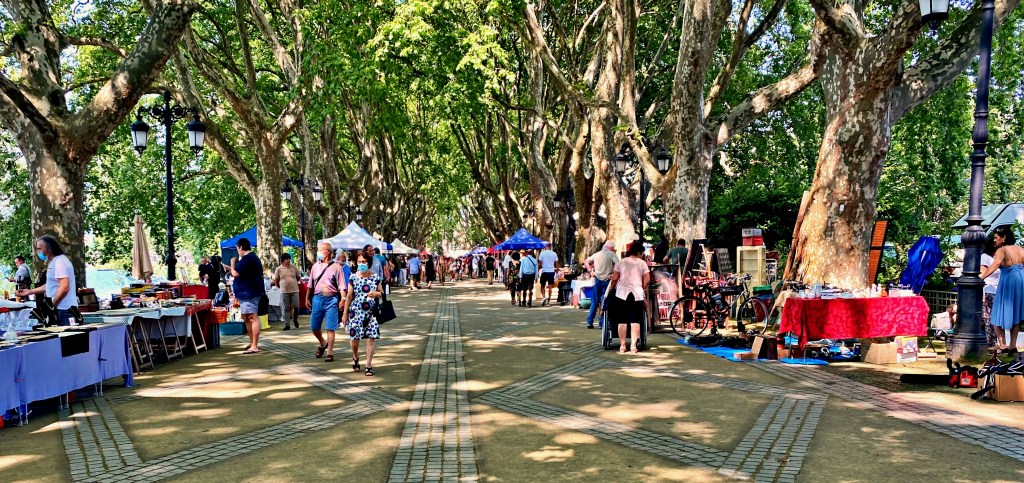
Just before the main car overpass over the river, Isabella peeled off to find her lodging and we continued on with Misha into the town itself. Past the overpass we strolled through a flea market set up along the river bank.
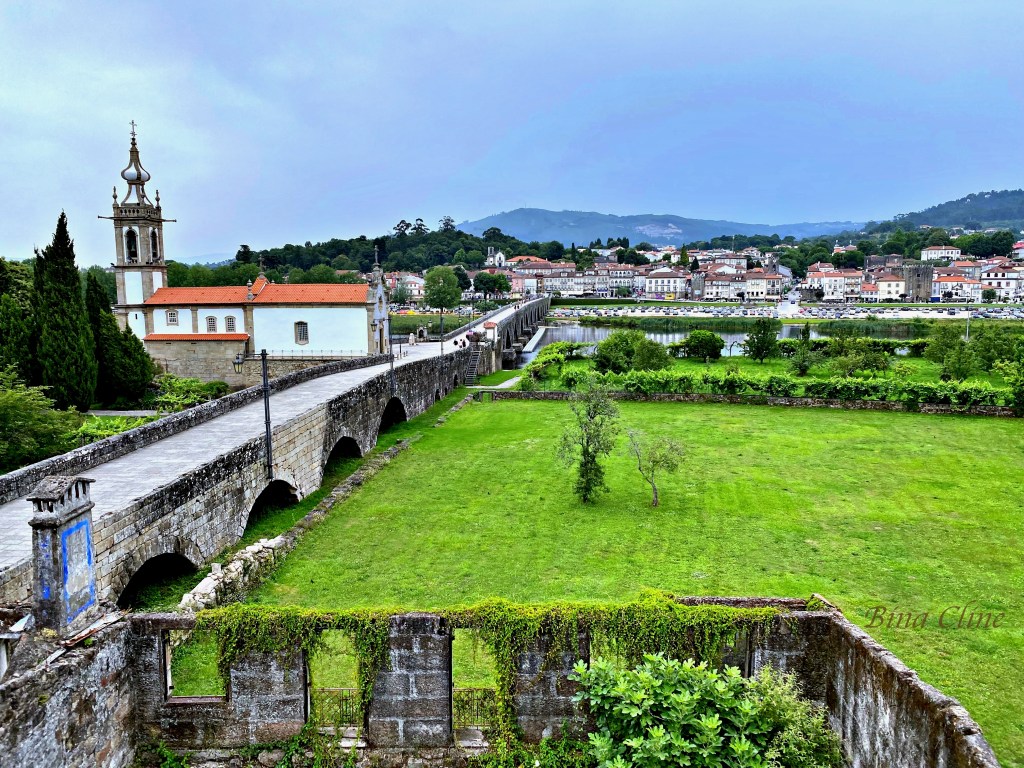
As we crossed PdL’s famous Roman bridge, I noticed loud music coming from speakers in the 13th century church on the other side, the Igreja de Santo Antonio de Torres Velhos. Again, this was related to the St. Antonio festival which had been taking place over the weekend.
On the other bank, Misha checked into the Albergue de Peregrinos de Ponte de Lima while Bina and I entered the Arc d’Otel, right across the street. Our room directly overlooked the Roman bridge, so we were pleased with the view. But mostly, we were just happy to collapse on the bed after this very long day of walking!
And that proved to be the end of our 2022 Camino. We had planned to stay two nights in PdL and then resume our journey up to Valença, on the Spanish border. Instead, we spent the next four days in PdL.
There were two reasons for that. Bina had experienced a lingering cough over the previous few days that worsened after we arrived in PdL. By the next morning, she had a sore throat and knew that she needed antibiotics, which she obtained later that day from a doctor.
The second issue was weather: rain was forecast for the next several days and the stretch of the Camino after PdL included Labruja mountain, the highest elevation on the Central Portuguese (405 meters, or 1,238 ft.). We did not feel adventurous enough to cross Labruja with a possibility of rain and mud.
So, with reluctance, we decided to hang around PdL until Bina got better and then resume our Central Portuguese Camino from this spot at a later date. Lingering in Ponte de Lima, however, did not come without its rewards, as you can see in the next post.

 Two Clines Traveling
Did you leave a memento message on a stone at the pilgrims’ pile?
LikeLiked by 1 person
Love your journal. Thank you for sharing. It was over a year already when we met in Ponte de Lima. It is such a picturesque town! Bom caminho.
LikeLiked by 1 person
Many thanks for your nice comments, Sim, and a bon caminho to you!
LikeLike
No, Clint, we neglected to do that. These blog posts constitute our momento!
LikeLike
I am so enjoying reading of your travels! Thanks for sharing.
LikeLike
Glad you enjoyed it, Beth.
LikeLike