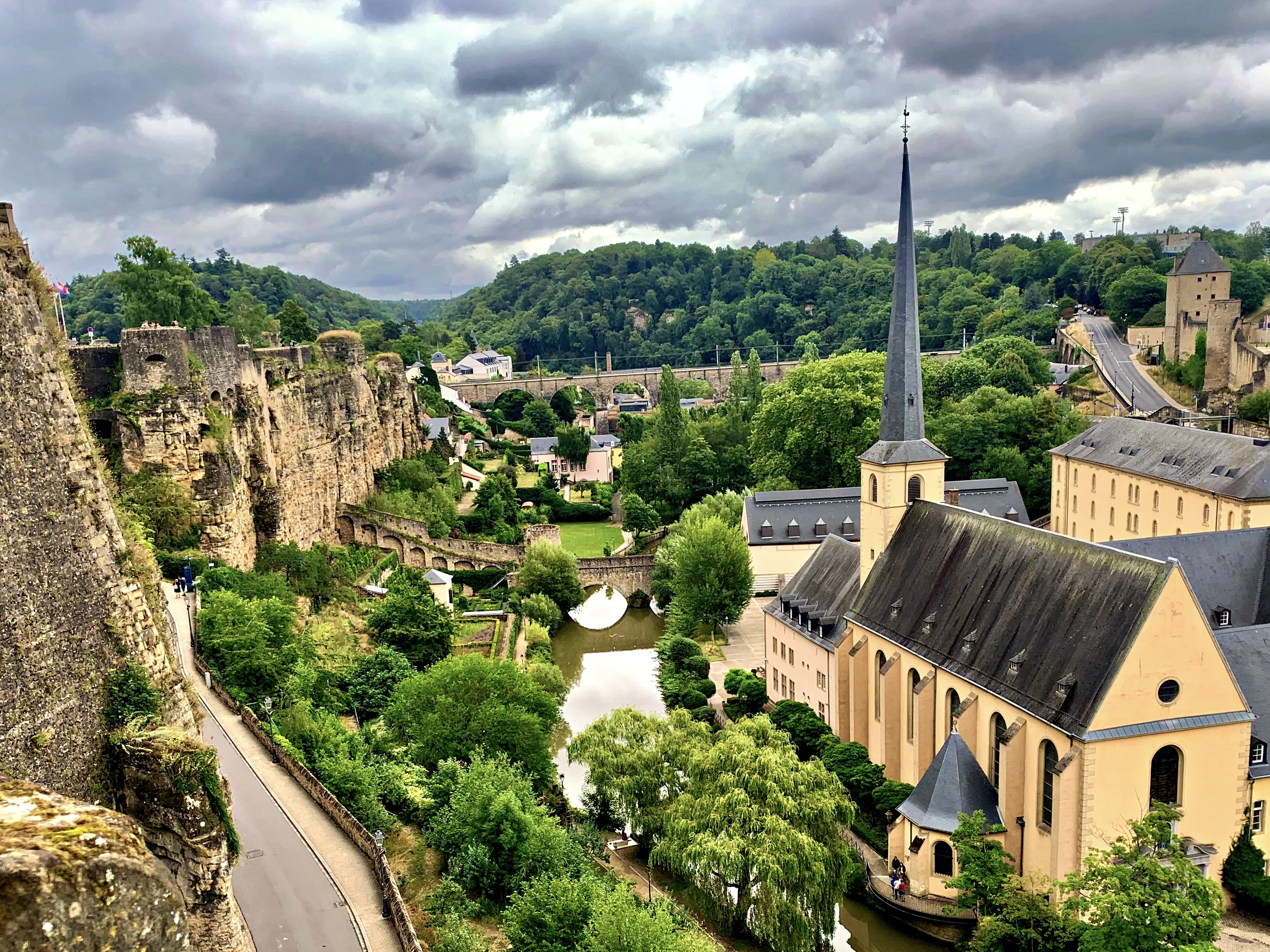
We began our visit to Luxembourg by wasting some money. Upon arrival at the airport, we took Uber into town to our hotel. We had somehow missed the memo about Luxembourg offering free public transportation to residents and non-residents alike — a luxury the country can easily afford.
Our route into Luxembourg City took us past industrial parks and gleaming office towers housing multinational corporations such as Amazon and Microsoft, which are lured here by tax advantages. As measured by gross domestic product per capita ($143,303,) Luxembourg ranks as the world’s richest country, one in which residents (all 650,000 of them) benefit from free healthcare and education, as well as public transportation.
Wonderful for them, but that’s not the Luxembourg we came to see. Despite its dazzling current prosperity, this country had a turbulent history by virtue of sitting at the intersection of Germany, France and Belgium, suffering invasions from France under Louis XIV and during the Revolutionary Wars, and from Germany during the two world wars.
To learn more about that side of Luxembourg, we had scheduled a walking tour for our first full day in the city. It helped that our lodging, the Hotel Simoncini, was located right in the heart of Luxembourg City’s old quarter, the Ville Haute (Upper Town). French is used in Luxembourg for place names and all official administration. We had only a three-minute walk to meet Ken, our guide for the morning, at the central square known as the Place d’Armes.
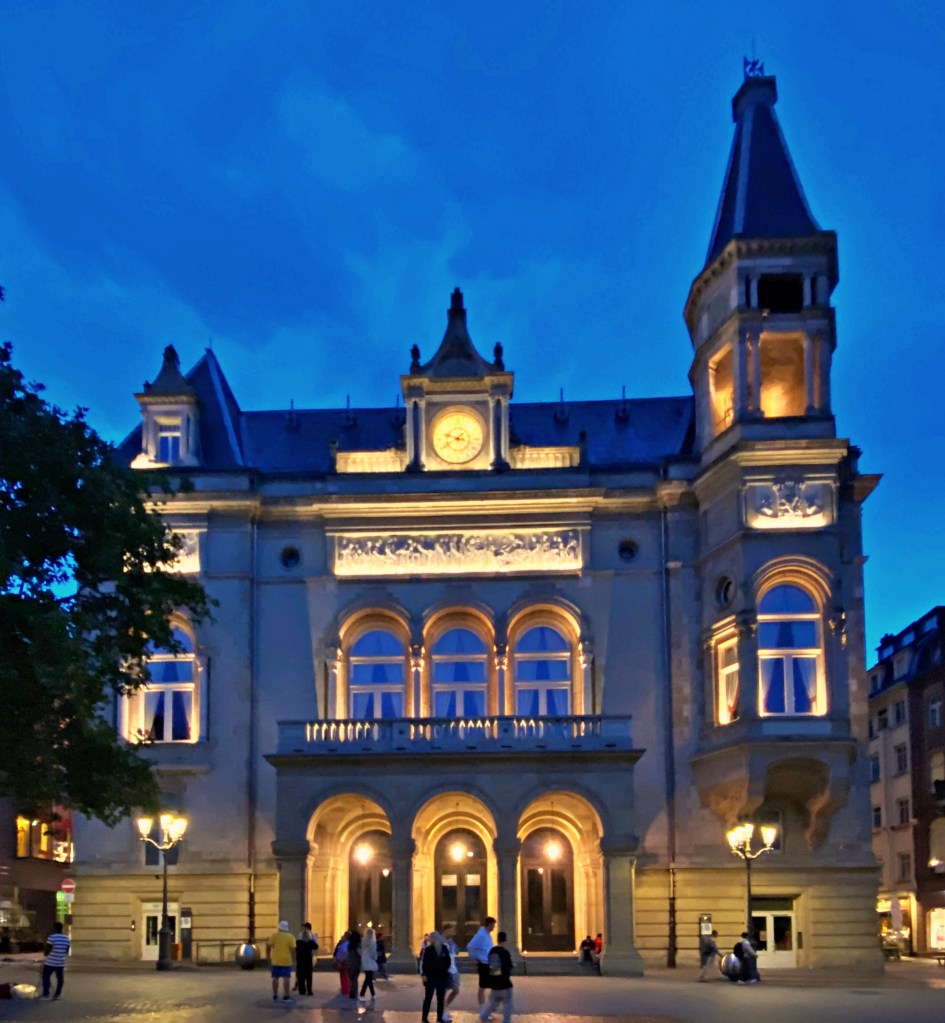
We began our tour at St. Michael’s Church, the city’s oldest building. The original structure was erected in 987 but has been rebuilt many times over the centuries. Today, it has been restored to look as it would have at the end of the 17th century. As is typical of Luxembourg, which can afford to do rehab well, the building positively gleams, despite its age.
Then, on to the ducal palace, a few blocks away. Although the basic structure dates from the late 16th century, many renovations over the years have kept this big, ornate box in spiff enough shape to serve as the official residence of Grand Duke Henri, the country’s current monarch. The country’s diplomatic receptions and ceremonies are held here. Duke Henri was not in on the day we visited, Ken explained, because the Luxembourg flag was not flying from the palace flagpole.

The monarchy is a continuing thread in Luxembourg’s history, which dates back to 963 A.D. That’s when a Count Siegfried, ruler of the the surrounding Ardenne forest region, acquired a piece of land known as Luclinburhuc, or “little castle.” Situated at the top of a steep cliff overlooking the confluence of the Alzette and Pétrusse rivers, this spot provided a superb defensive position that became known as the Bock. By the 19th century, the fortifications on the Bock had expanded into one of the greatest fortresses in Europe, sometimes called the “Gibraltar of the North.”

For most of its history, Luxembourg City’s primary function was to serve as a garrison town for soldiers stationed on the Bock. Only after the fortifications were demolished in the late 19th century — modern artillery made them obsolete — was the city able to divert its energies to business and commerce.
Meanwhile, the counts of Luxembourg had became powerful enough to be elevated to dukes by the 14th century. Today, the country is a constitutional monarchy officially known as the Grand Duchy of Luxembourg. Ken asserted that most Luxembourgers support the monarchy, in part because of the respect earned by Duke Henri’s paternal grandmother, Grand Duchess Charlotte, who held the throne during World War II.
When Germany seized Luxembourg on May 9, 1940, Charlotte had to flee abroad and used radio broadcasts to encourage her people during the harsh occupation years. She also did her best to urge Allied leaders not to forget the plight of her small country.
One thing the grand duchess could not do was protect the country’s Jewish population. Of the 3,500 pre-war Luxembourgian Jews, 1,945 died in concentration camps. In 2018, a monument to this tragic story was unveiled in Luxembourg City.

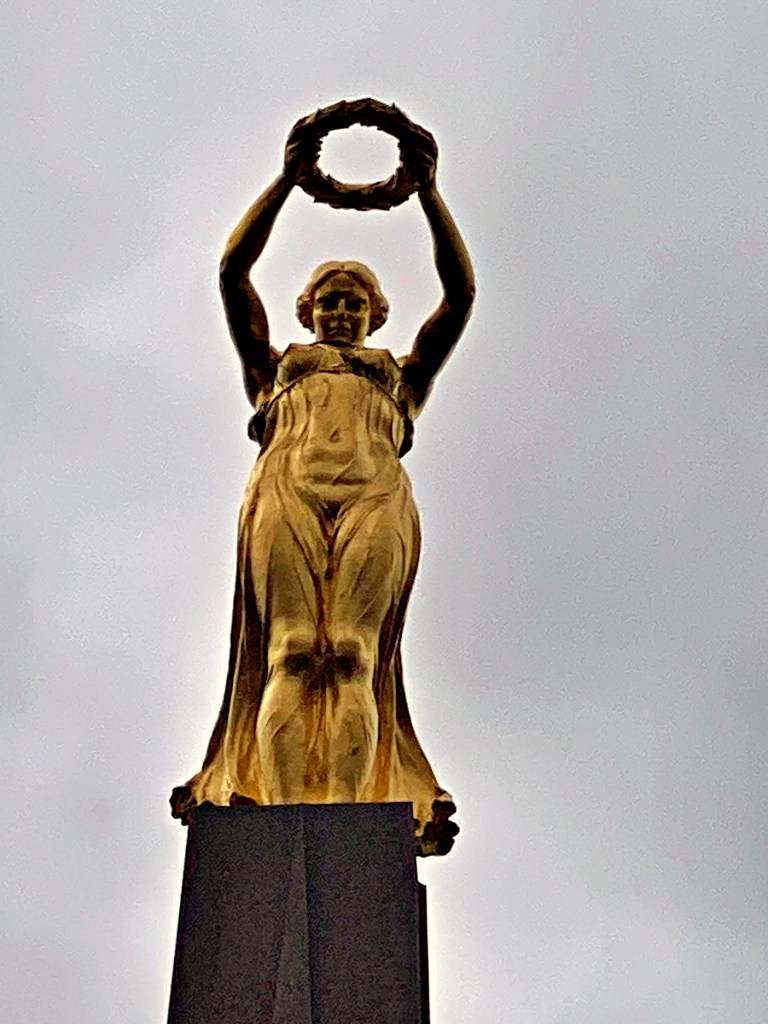
Our tour concluded on a more hopeful note at the Gëlle Fra, Luxembourgish for “golden lady,” a monument to fallen Luxembourg soldiers in the two world wars. This statue atop a massive obelisk was originally erected to honor men who had served with the French army in World War I. The Germans dismantled it during World War II and hid the golden lady herself; she was rediscovered in 1980 underneath the main stand of the national football stadium.
For those who wish to delve a bit deeper in the story of Luxembourg, consider visiting the Luxembourg City History Museum, located close to the 17th century Cathedral of Notre Dame in the Ville Haute. The collection and displays are excellent, with descriptions in French, German and English.
Those, by the way, are the three languages that most Luxembourgers speak. Given that 47% of the country’s residents come from other countries, native Luxembourgers don’t have much choice if they want to communicate with more than a few people. Their national language, Luxembourgish (an offshoot of German), is spoken by only about 400,000 people and not needed for most daily interactions here, particularly since stores and restaurants tend to be staffed by foreigners who typically default to English. In fact, I don’t recall encountering anyone in our four days here who didn’t speak passable English.


Luxembourg has long been a special place for us.
Anne’s dad, Bud, was a teen infantryman with the 5th Armored Division that liberated Luxembourg. One day, a child who never forgot found himself working for the same international financial giant as Bud’s youngest son. You can guess the rest. That man traveled to Chicago and met Bud to deliver thanks personally. He said he probably wouldn’t be alive but for the Yanks who chased the Germans out.
So thanks for the notes and photos. Speaking of photos, how come you guys never get older? 😉
Clint
LikeLiked by 1 person
Thanks for that great story, Clint. It’s always nice when a blog post resonates personally with someone. Speaking of World War II in Luxembourg, our next post, on Echternach and Vianden, contains more details on that. That teen infantryman was part of Patton’s Third Army, which liberated Luxembourg in the campaign to lift the siege of Bastogne. Patton himself is buried in the American cemetery in Luxembourg and the town of Ettelbruck — last stronghold of the Germans — has a prominent statue of him. Luxembourg is one of two areas I’ve visited in Europe that remember the Americans fondly for their World War II help, the other being Alsace Lorraine (which erected a statue to Audie Murphy!). I haven’t yet been to Normandy but I suppose that would be similar.
LikeLike
Another excellent post Ken and Bina with great photos. Wonderful information about a place that many of us “think” we know. Really appreciate the background. Keep going!
LikeLiked by 1 person
Thanks, Anonymous. Glad you enjoy our efforts to provide some context to these places.
LikeLike