The experience of traveling sometimes benefits from “dumb luck.” That was the case when Bina and I visited Guimarães, a town of medieval origins located in northern Portugal about 60 km northeast of Porto.
In planning this trip, we were anxious to avoid the annual festival associated with St. John (São João in Portuguese), which takes place on June 23 and 24. These festivals can be fun, with parades, marching bands and lots of good eating, but also crowded and hectic. We had done São João a few years before, in Braga, and wanted a quieter experience in Guimãraes. So, we targeted June 20-23 for our visit.
Little did we know that those days overlapped with the Feira Alfonsina (festival of Alfonso) on June 20-24, which commemorates the investiture of King Alfonso I, the first king of Portugal. Oops. We found the historic center of Guimarães choked with medieval re-enactors and festival goers, both locals and tourists. So, we had no choice but make the best of it — which actually turned out quite well.

At the time of Alfonso’s birth in 1109, Portugal was not an independent country but rather a territory ruled by the Kingdom of Leon, in Spain. After defeating the Leonese forces in 1128, Alfonso declared himself Prince of Portugal. Following some successful campaigns against the Moors, he felt confident enough to add the royal title in 1139.
Leon finally recognized Portugal’s independence in 1143 and a proclamation by the Pope in 1179 provided international recognition. Portugal thus enjoys a place in European history as one of the first countries to emerge as an independent entity with defined borders (more or less; the Algarve was added a hundred years later).
Guimarães was never designated the official capital of Portugal but is referred to as the “birthplace” of the country because Alfonso was born there and based himself in the town at critical times in his struggle to win Portugal’s independence.
Coimbra actually served as Portugal’s official capital from 1139 until 1255, when the royal court moved to Lisbon. Still, Guimarães is linked closely enough to Alfonso to warrant its hosting of the Feira Alfonsina every year. Our stroll through the town on June 21 occurred smack dab in the middle of the festival, which provided our guide, Arthur Silva, the perfect backdrop to explain the city’s story. We also benefited from being the only people to sign up for his tour that day.
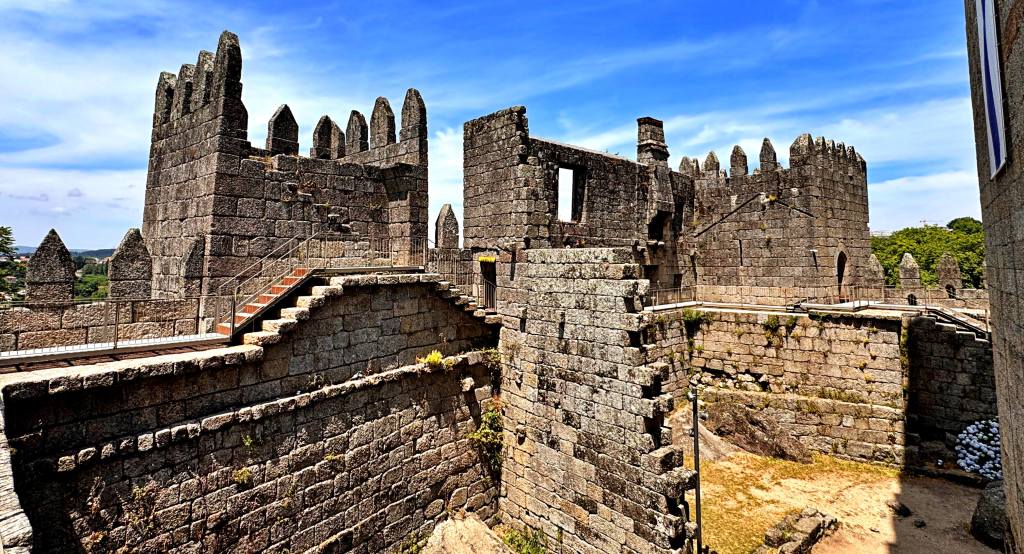
We started at the Guimarães castle which, like many castles in Portugal, was reconstructed during the Salazar dictatorship (1932-1968), when the government was eager to highlight the country’s past. The original structure had its origins in the late 10th century but didn’t attain its current form, with eight towers, until the 13th.
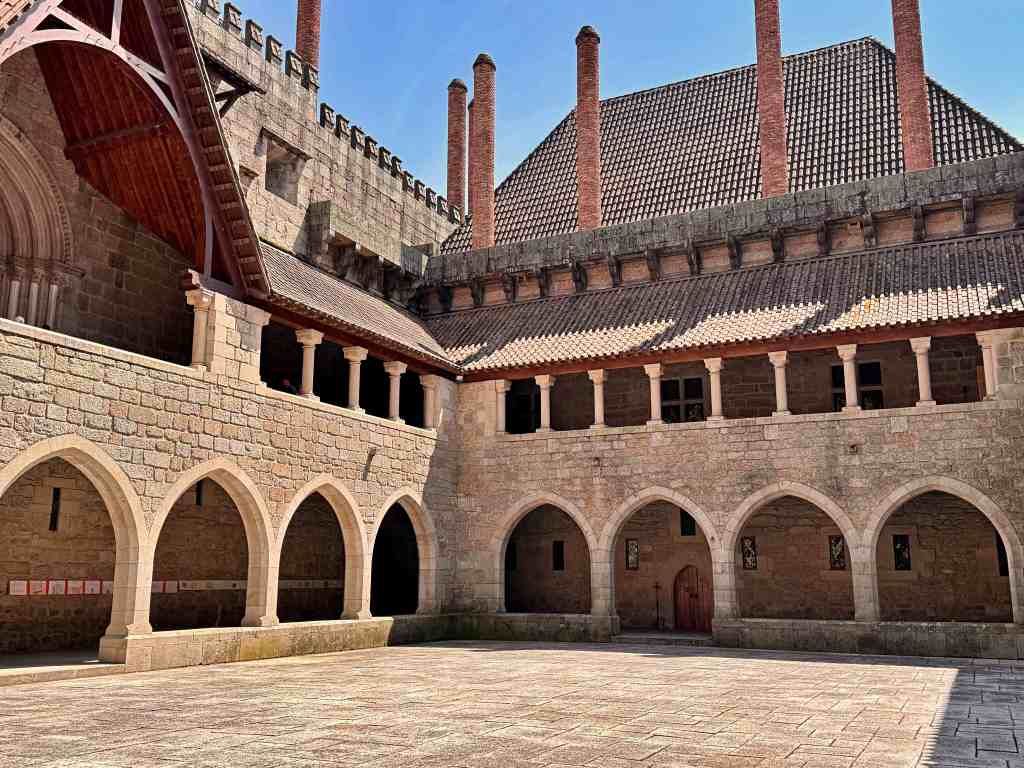
Nearly adjacent to the castle is the Palace of the Dukes of Bragança,* which dates to the 15th century and was also restored during the Salazar period. That mid-20th century restoration was controversial because it made the building look grander than it actually did in its prime. Today, the palace is worth a visit for the exhibits inside, which include Flemish tapestries, medieval weapons and porcelain ware acquired by Portuguese traders in China.
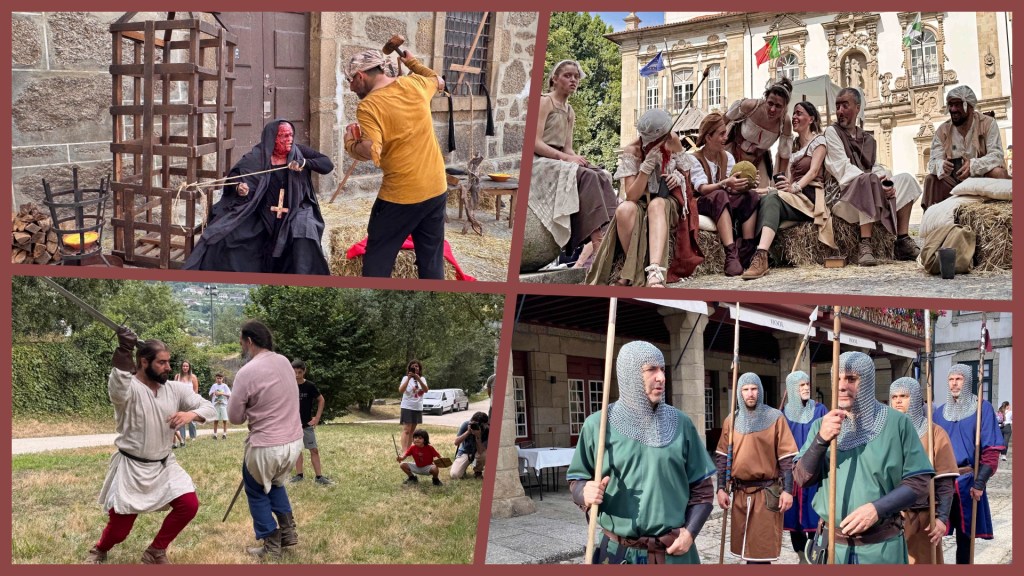
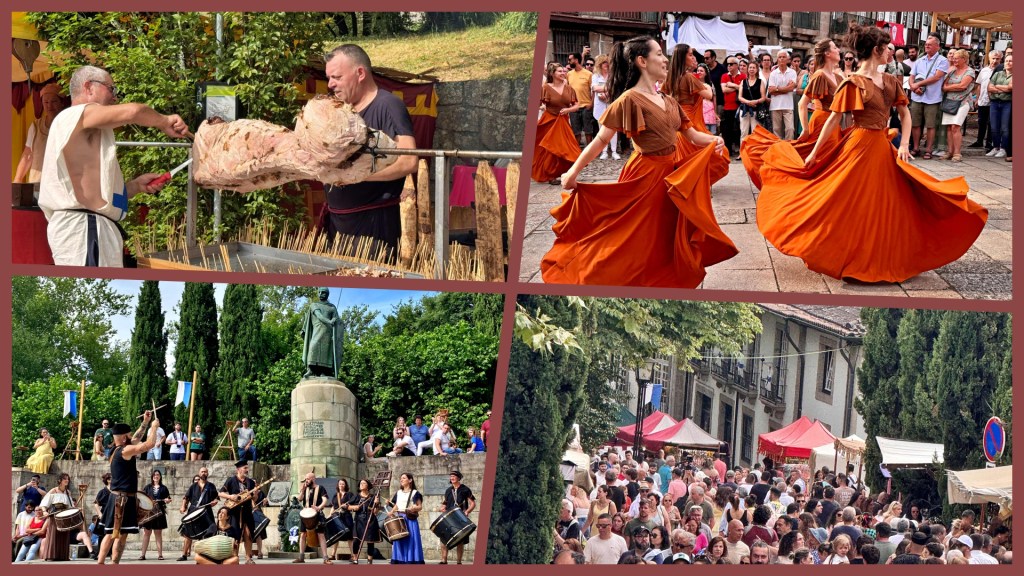
Descending the hill from the castle and palace into the town, we passed by the medieval re-enactors and crowds attracted by the festival. The re-enactors included guys practicing their sword fighting skills and artisans demonstrating medieval crafts, such as iron forging and textile spinning. Street performers added a bit of humour as woeful denizens of the “Alley of Shame,” otherwise known as the Red Light District. Food vendors got into the act by wearing vaguely medieval garments while a team of female dancers attracted a large crowd with their exuberant performance.
Along the way, we stopped in a cafe to sample two pastries for which the town is is famous: Tortas de Guimarães and Toucinho de ceu de Guimarães. Both of these feature the same ingredients for the filling: egg yolks, sugar, ground almonds, and squash. The difference is in how they’re baked and coated.
These pastries, like many in Portugal, were created by nuns, in Guimarães by those following the contemplative order of St. Clare — known as Clarissas in Portuguese, “Poor Clares” in English. Their 16th century convent still stands but has been repurposed as the town’s city hall — as elegant a structure as any municipal government could want.

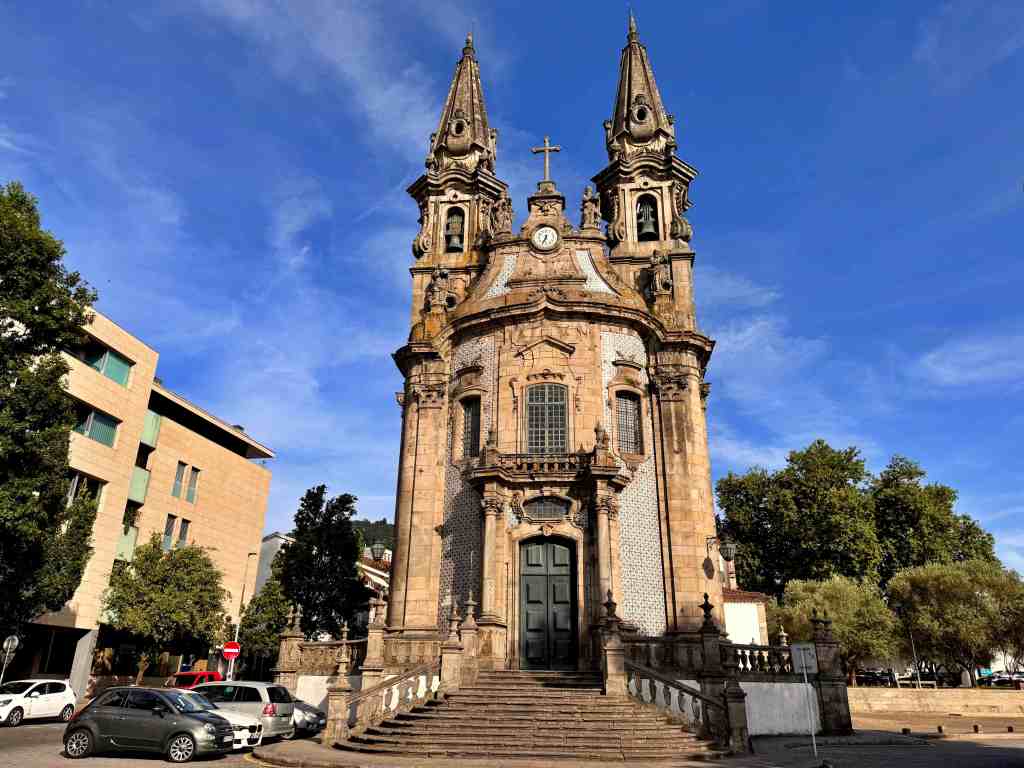
Our final stop, just outside the historic district, was the Igreja dos Santos Passos, or “Church of the Holy Steps,” a name referencing Christ’s walk bearing the cross during his crucifixion. Arthur, a student of architecture, was eager to show us the church’s distinctive 18th century Baroque design with the twin bell towers.
Travel tips: Guimarães is a fine town to walk around for a day or two and the historic center features plenty of restaurants and cafes, mostly serving traditional Portuguese food. The Tasco Nicolino restaurant, for example, provided us a good and simple lunch of pork cheeks and turnip greens. We also enjoyed the Emilia Brunch & Cocktails, located right on the edge of the historic area, which offered a more diverse menu of items such as Shakshuka, Eggs Benedict, salmon with avocado toast and hamburger with guacamole. For lodging, we selected an apartment located within a five minutes walk of the old town. That worked out perfectly because many of the streets in the historic area are pedestrian-only, particularly during festivals, and we didn’t need to use our car for the duration of our stay.
*Does that Bragança name sound familiar? The Braganças emerged from the Middle Ages as one of Portugal’s wealthiest and most powerful families, providing the country with 15 kings between the 17th and 20th centuries.

 Two Clines Traveling
Thanks for the post.
Nice to read and learn.
Enjoying the trip. I just got to Porto yesterday!
Carolyn Train
Sent from my iPhone
LikeLiked by 1 person
Hi Carolyn. Glad to hear you’re about to start your Caminho. There’s lots to do in Porto, if you have time. The Foz do Douro has a nice waterfront esplanade for walking and you can do port wine tasting across the river in Vila Nova de Gaia. Have fun!
LikeLike
You two certainly get around and I admire your energy! The world is so big that it is difficult to know where to start.
LikeLiked by 1 person
.. then dumb luck turns the opportunity into good luck for the rest of us. Nice job both. Looks even better on the website, by the way. Best, Clint
LikeLiked by 1 person
Thanks, Anonymous. If you’re looking for places to travel, you might just pick a place that interests you. It doesn’t matter where everyone else goes.
LikeLike
Thanks, Clint. Guimarães was definitely more interesting with the medieval festival as a backdrop. And I agree the photos display better on the Website than in the email (more room). Cheers.
LikeLike