
Stockholm, in nice weather, is one of the most attractive European capitals we have ever visited. Built over fourteen islands grouped together where Lake Mälaren flows into the Baltic Sea, more than half the city’s area consists of waterways, parks and green space — a touch of Venice without the impossible crowds.
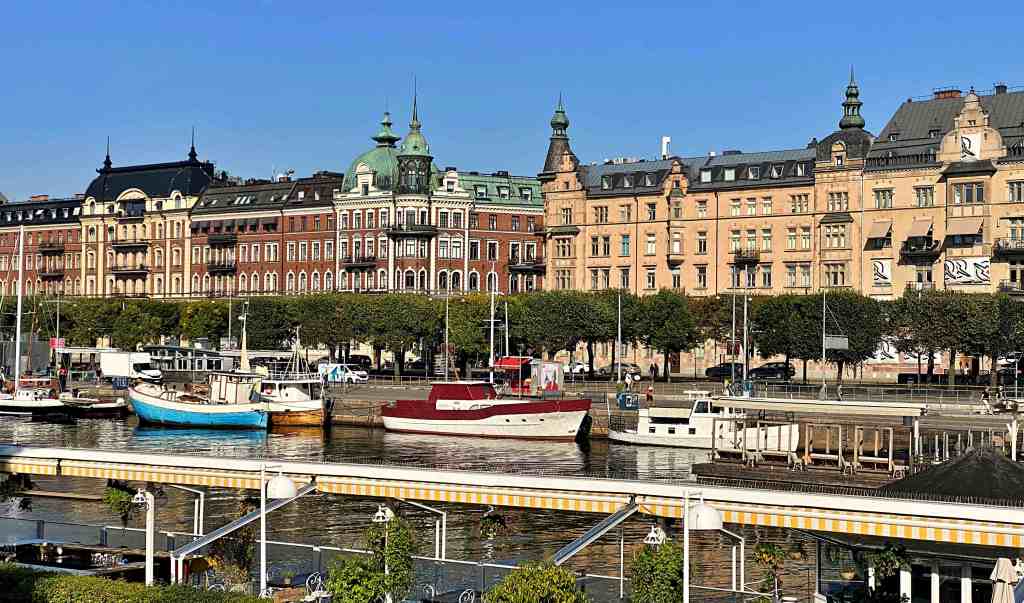
And it all functions with Nordic efficiency. Bina and I bought a 72-hour transit card that enabled us to get around easily on buses, trams and public ferries. Many of Stockholm’s core touristic areas, like Gamla Stan (old town) and Djurgården island (site of many museums), are great walking areas.
Speaking of which, we began our visit, as we often do, with a city walking tour, this one focused on Swedish cuisine. Our group met at the Östermalms Food Hall, which opened in 1888 and is considered one of Stockholm’s architectural treasures. Extensively renovated in 2020 to preserve its ornate 19th century styling, the indoor market now houses 18 counters, or mini-stores, purveying fresh fish, meat, sweets, and traditional delicacies. Some of these are still owned by the original families.

Our guide, Cotton, took us to three different counters to sample cheeses, cured meats and cooked meats. The three cheeses were Västerbottenosf; Boxholms Kryddosf and Grevé, accompanied by crackers and Hjortronmamelad (cloudberry marmalade), all quite delicious.
The cured meats included moose, reindeer and bear, the latter in the form of sausage. Contrary to expectations, the bear meat didn’t taste particularly gamy — nothing to make you think “bear.” And finally, at the third kiosk, we experienced the “crown jewel” (Cotton’s description) of Nordic cuisine — yes, the Swedish meatball. We can affirm the sauce and quality of the meatball itself was much better than what you get at your local Ikea store!

By the way, if you’re wondering how Cotton got that non-Swedish name, his father was American, from Portsmouth, N.H. During Colonial days, Cotton was a common name in New England (think Cotton Mather, the preacher). Cotton’s mother was Greek and the family lived in Italy and Sweden. So, as he said, “It’s hard for me to explain where I’m from.”
From Östermalms, we walked 20 minutes to the more modern Haymarket food hall, where we sat down at the Kajsas Fisk restaurant to try their celebrated fish soup with cheese and bread. That was tasty but Cotton did let on that we weren’t getting the “full version” in our samples.
At another kiosk, we tried varieties of licorice, including one that contained ammonium chloride. This very salty licorice, known as Saltlakrits in Sweden, is popular in Nordic countries, but definitely an acquired taste from our point of view.
Our final stop was in the Gamla Stan, or old town, where we entered a bistrot to experience a fika. This is the Swedish word for a convivial get-together, usually over coffee and danish. Cotton explained this as a long-standing tradition in Sweden for workers to alleviate stress, similar to our “coffee break” but longer and with more focus on social interaction. It definitely proved a great way to end our food tour.
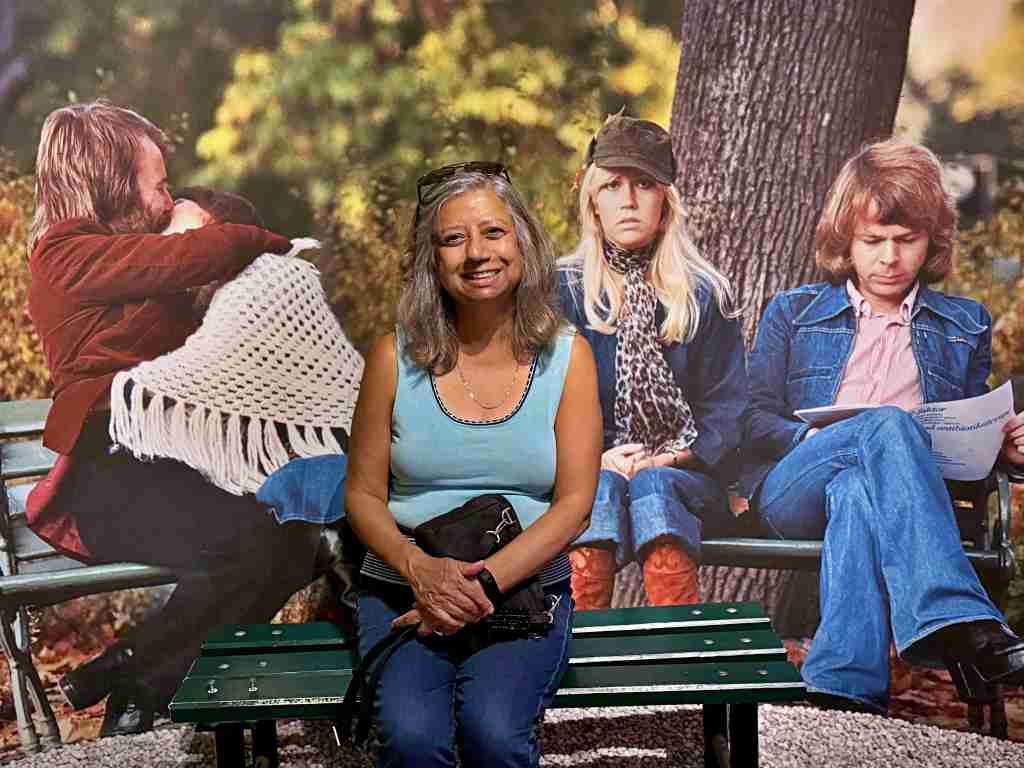
The next day, we hit the major museums on Djurgården Island, starting with the one devoted to ABBA. This turned out to be an elaborate affair, with interactive exhibits that include karaoke, opportunities to dance with the band’s music and a model of their music studio, where visitors can produce their own ABBA recordings by modulating the controls on the various vocal and instrument tracks.

While not initially an ABBA fan like Bina, I came away from the experience thoroughly impressed by the hard work and professionalism they displayed in their rise to worldwide pop music stardom; ABBA had a heck of a run between 1972 and 1982 and it didn’t happen by accident.
Another museum highlight was the one devoted to the Vasa, a Swedish naval vessel that sank on its maiden voyage in Stockholm harbour in 1628 — the builders, it seems, had made it too top-heavy. Salvaged in 1961, the Vasa now provides the world’s best and most complete example of a 17th century vessel. This is Sweden’s most popular museum, with 1.5 million visitors a year.

We also visited the Spirits Museum, where we learned that vodka is the main drink in Sweden and how bootlegging became a major industry during their version of Prohibition, which was a form of rationing rather than the total ban we experienced in the U.S. Today, public drinking and driving laws here are very strict, prompting young Swedes to cross the border into Denmark when they want to party hearty.
Speaking of which, our final visit of the day was to Stockholm’s famous Ice Bar, which is located in Hotel C in the center of the city’s business district. The interior of this establishment, which maintains a constant temperature of -5 C. (19 F.), is mostly carved of ice, as are the glasses in which you are served your drinks.
The staff hand out very heavy fur coats before you enter, but even wearing those, Bina and I lasted only a half hour. It did make for a good photo op.

 Two Clines Traveling