A few surprises awaited us as we flew into Marrakech. For someone who remembers the sprawling slums of Cairo, the orderly layout of Marrakech got my attention. We could see lots of nice villas below, roads that ran in straight lines and even a golf course. From the air, at least, it all looked fairly prosperous. The second surprise was an El Al plane parked right next to us when we landed. In contrast to most Arab countries, Morocco actually encourages and protects Israeli tourists.
Mohamed, our agency rep, met us after we emerged from the airport. He spoke English with an American accent because he had once lived in Michigan with an American wife. He came across as a friendly, helpful fellow and we felt immediately felt at ease with him.
After helping us find a shop to buy Moroccan SIM cards for our cell phones, Mohamed took us to our lodging, the Riad Alnadine. This five-room hotel in the heart of the Medina (old town) was run by a Slovenian woman, Sonia, and Drago, her Croatian husband. With Drago absent from the country at this time, we dealt with Sonia, who proved to be an excellent hostess.

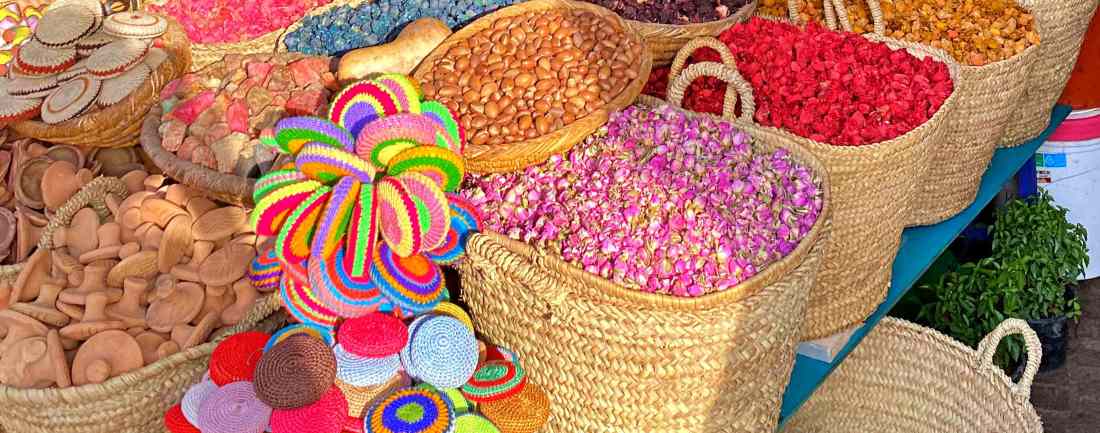
Soon after we had checked in, we embarked on a “Food Tour” with Mohamed and Mustapha, a guide that he had hired. We walked through various souks (markets for spices, silverware, shoes, etc.) in the Medina with stops for fast food and snacks.

These food stops could be messy at times. From one kiosk, we purchased cooked chick peas and foul (beans) in little plastic bags sans spoon or napkin. How can you eat that except with your fingers? We sampled some Berber soup at one shop and enjoyed an eggplant and tomato salad called zaalouk at another.
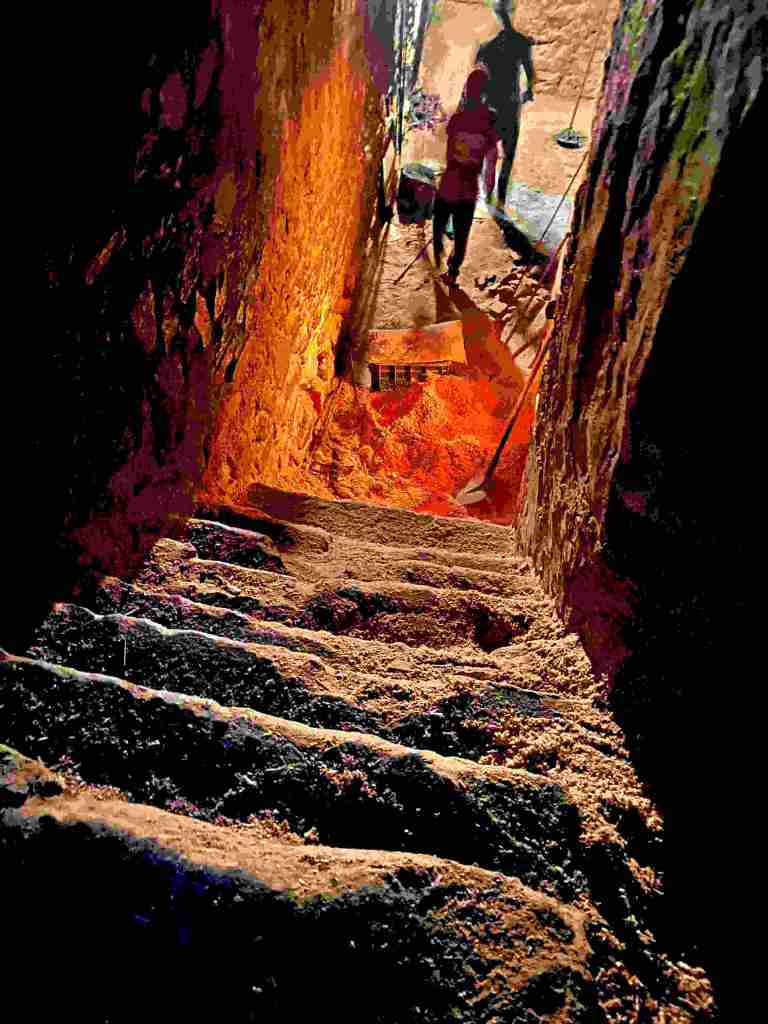
For meat, we had tangia, which is beef stew cooked in a clay pot. The interest here was in the way tangia is cooked — over a fire in the earthen basement of a hammam, or public bath. The men who tended the pots extracted coals from the furnace used to heat the water in the overhead baths. In such a confined space, this was a very hot place to work! Because tangia is often consumed by unmarried men, it is typically referred to as “bachelors’ stew.”
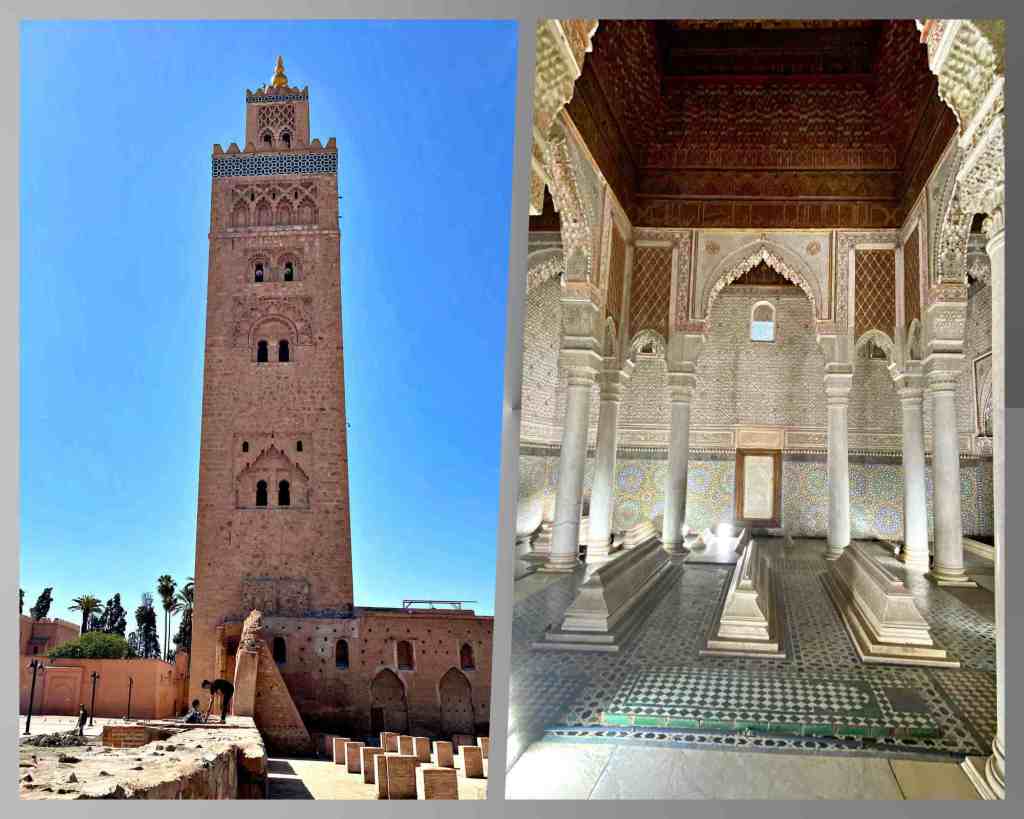
The next day, Mustapha took us on a walking tour of the historical sites in Marrakech, which served as the capital for several important rulers between the 11th and 16th centuries. Highlights included the 12th century Koutoubia mosque and minaret; the Saadian Tombs of the 16th century; the 19th century Bahia Palace, with its gardens; and the Mellah, or old Jewish quarter.
In the mellah, Bina found a shop where she loaded up on spices such as saffron that are of a higher quality and less expensive than in Europe. These ingredients later proved useful for making chicken tagine at home.
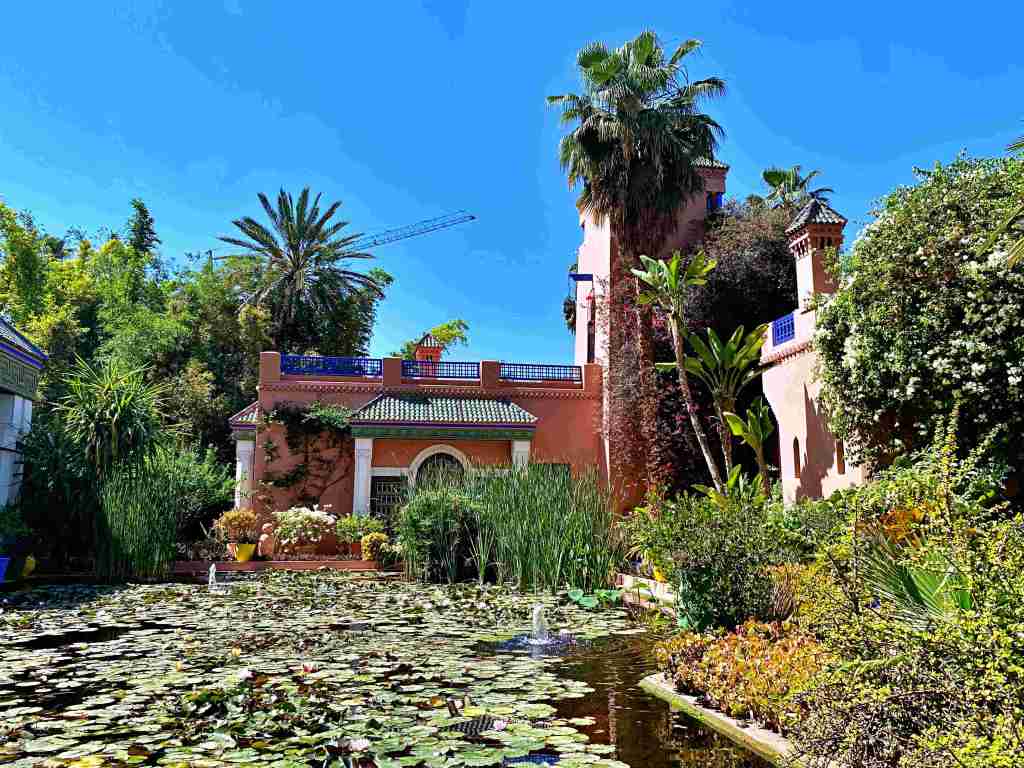
We finished up the day in the Jardin Majorelle, a one-hectare (two acre) house and garden built by the French artist Jacques Majorelle in the 1920s, when Morocco was a French Protectorate. The famous fashion designer Yves Saint-Laurent and his partner Pierre Bergé purchased and restored the property in the 1980s. After Saint-Laurent died in 2008, his ashes were scattered over the garden. A non-profit founded by Saint-Laurent and Bergé operates the garden today as a museum.
By 4 p.m., Bina and I were quite exhausted from wandering around in the relentless heat so we headed back to Riad Alnadine for a nap. That evening, we enjoyed a lamb dinner prepared by Nadira, the cook, on the riad’s roof terrace, which featured a panoramic view of Marrakech’s medina. The meal was served with a bottle of local wine known as Ksar, which was not bad for wine produced in such a hot, dry climate.
As night fell, we could hear the call to prayer sounding from minarets all over the city. These invitations occur at roughly the same time but are not synchronised with each other, so you hear one start, then another, then another, until an irregular, eerie drone envelopes you from all sides, truly an Arabian Nights moment.
The next day, we attended a cooking class at Riad Dar Zaman, which is located on the opposite side of the medina, about a 20-minute walk away. Since we were wary of getting lost in the tangled lanes of the souks, even with GPS on our phones, Sonia kindly offered to have Nadira escort us.
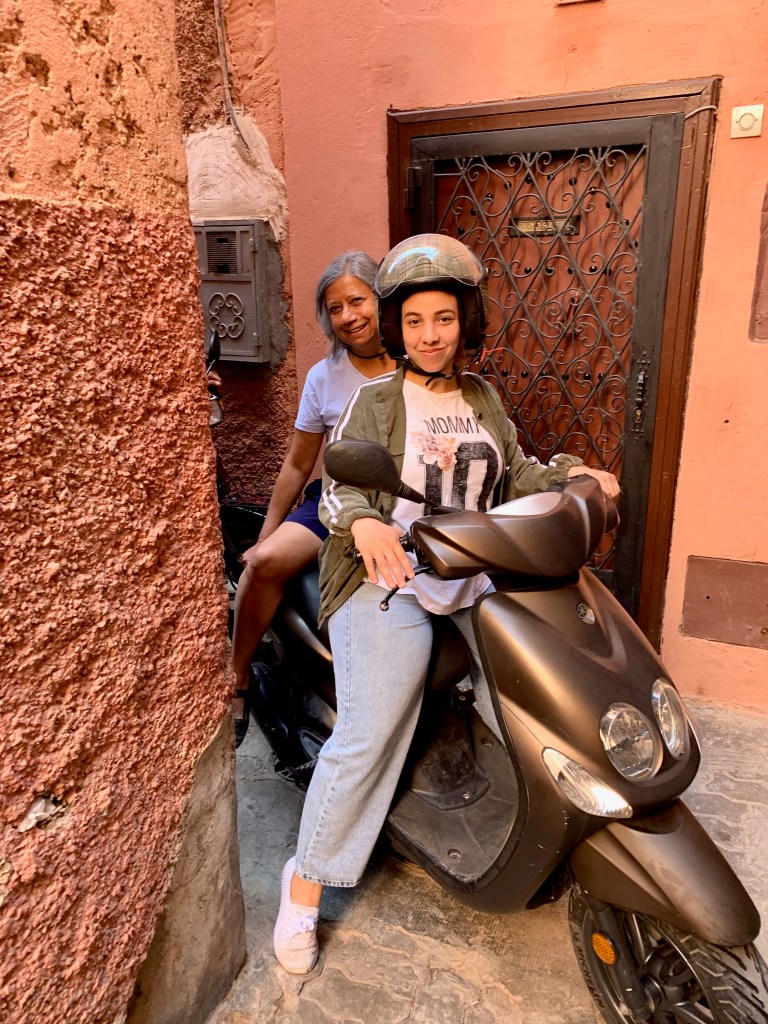
We thought Nadira would accompany us on foot but she showed up on her scooter. A boy named Mowsen, Sonia’s other helper in the riad, also arrived with his scooter. Nadira took on Bina as a passenger while I rode behind Mowsen. That ride through the medina made for an exciting start to the day, as we zipped through the twisting, narrow lanes dodging pedestrians and vendors.
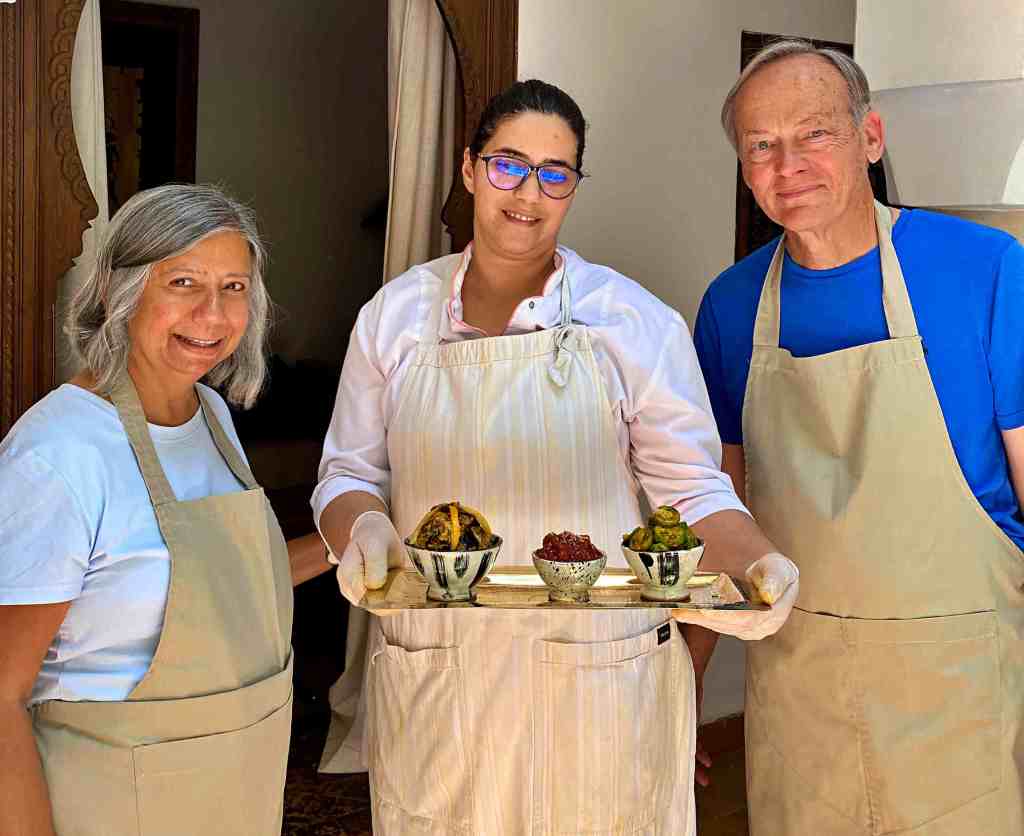
At the Riad Dar Zaman, we met the English owner, Peter Mercer, who had purchased and restored the property back in 2006. Karima, Mercer’s main cook, taught the class, with assistance from Hassan, a young man who translated her French into English for us. Under Karima’s tutelage, Bina and I made chicken tagine along with three salads: eggplant, courgette and sweet tomato. This proved to be the most delicious meal we had during our Moroccan trip.
Interacting with Karima and Hassan in the kitchen, mixing cooking lessons with friendly chit-chat, enabled us to escape the tourist role for a while, as if we were just cooking a meal with friends in their kitchen. If you want to feel “at home” in a foreign country, try taking a cooking class.
Sonia, ever mindful of our safety, turned up at 2 p.m. to walk us back to her riad. Along the way, we stopped at some of the clothing souks, where she helped Bina buy a shirt and scarf, something Bina was reluctant to attempt on her own — where would she even start? After a nap back at Riad Alnadine, we walked to the L’Midia restaurant, about seven minutes away, for dinner. This marked our first, and only, venture into the medina on our own, guided by Google Maps.
Since we were still digesting our very large cooking class lunch, we ordered only a few starters — hummus, lamb balls in yogurt sauce and a beef dish — while enjoying the view of the city from L’Midia’s roof terrace.
 Two Clines Traveling