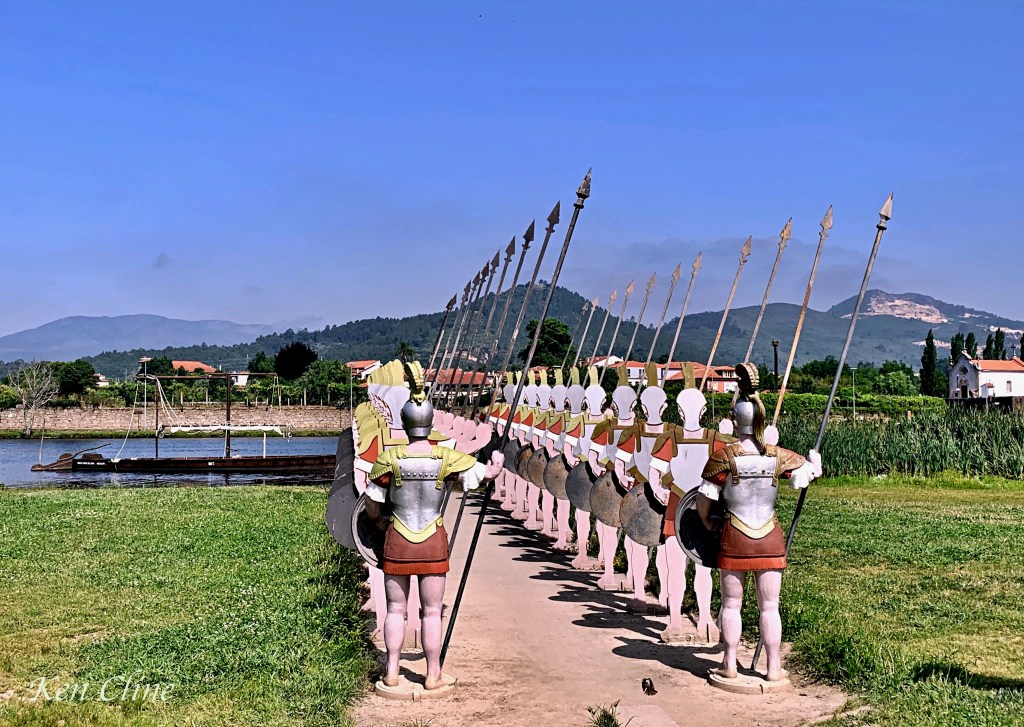
In 138 B.C., a Roman army marching through northern Portugal came to a river that the troops refused to cross. Finding themselves in the far western fringe of the known world, nearly 2,000 miles from Rome, the men took this to be the river in the Underworld known as Lethe, or “Forgetfulness” — dare to cross the Lethe and you lose all memory.
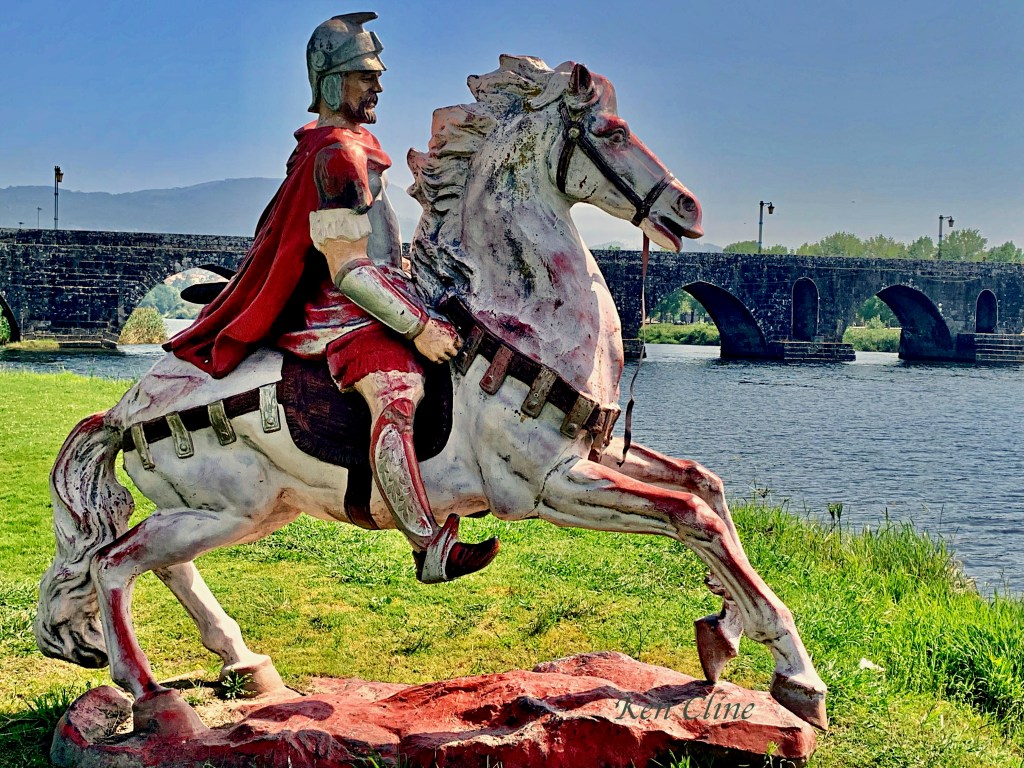
Their commander, Proconsul Decimus Junius Brutus, was having none of this; he still had a war to fight. Fording the river on his horse, he called back for the soldiers to follow, shouting their names to prove he had not left his memory behind on the other bank. Only then did the troops slosh across the river now known as the “Lima.”
The town that later rose on that celebrated spot, Ponte de Lima (PdL), has since erected statues of the equestrian proconsul on one bank and his superstitious men on the other.
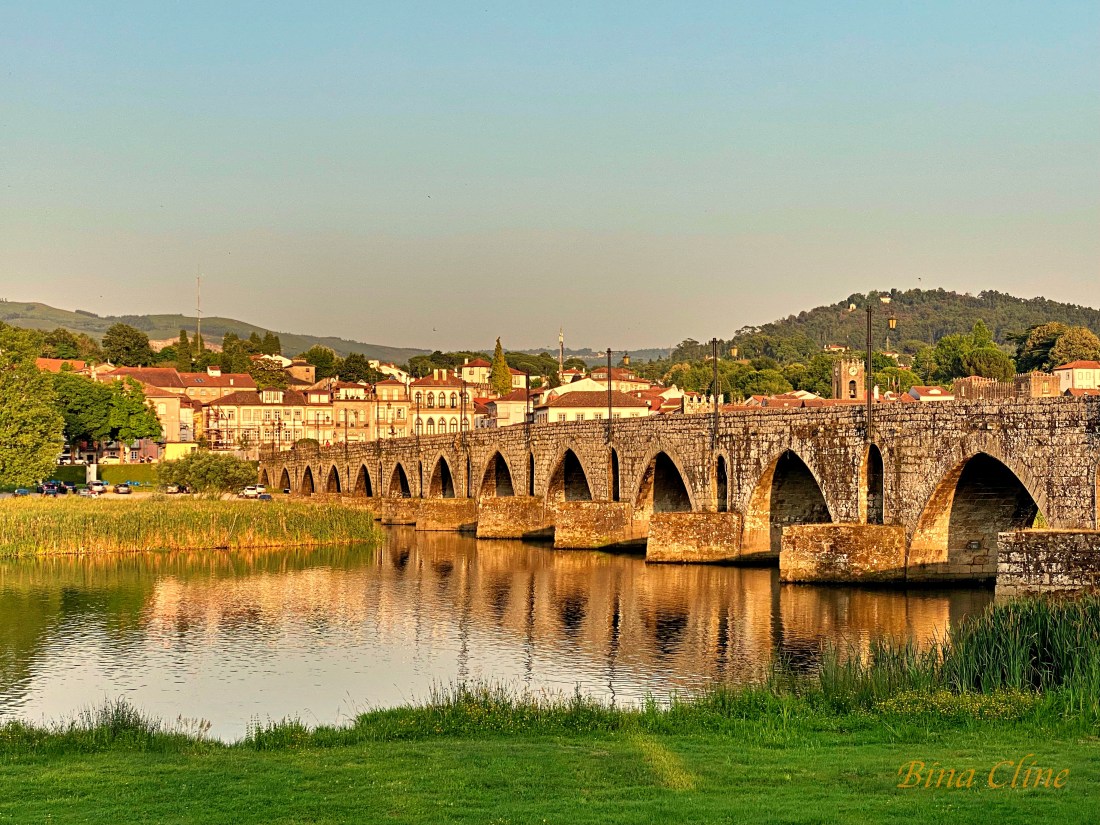
The modern town further highlights its Roman past by naming its most notable landmark the “Ponte Romana.” Most of this elegant,14-arch bridge actually dates from the 13th century. But since five of those arches were constructed in the first century, the name is appropriate.

Following their conquest of Portugal, the Romans built a road through here linking Bracara Augusta (now Braga) with Lucas Augusti (Lugo, in Spanish Galicia). At the ford where Brutus crossed the Lima River, they established a mansio, or rest house, for couriers or officials using the road. The Romans typically placed these stopping points a day’s journey from each other on their major roads.
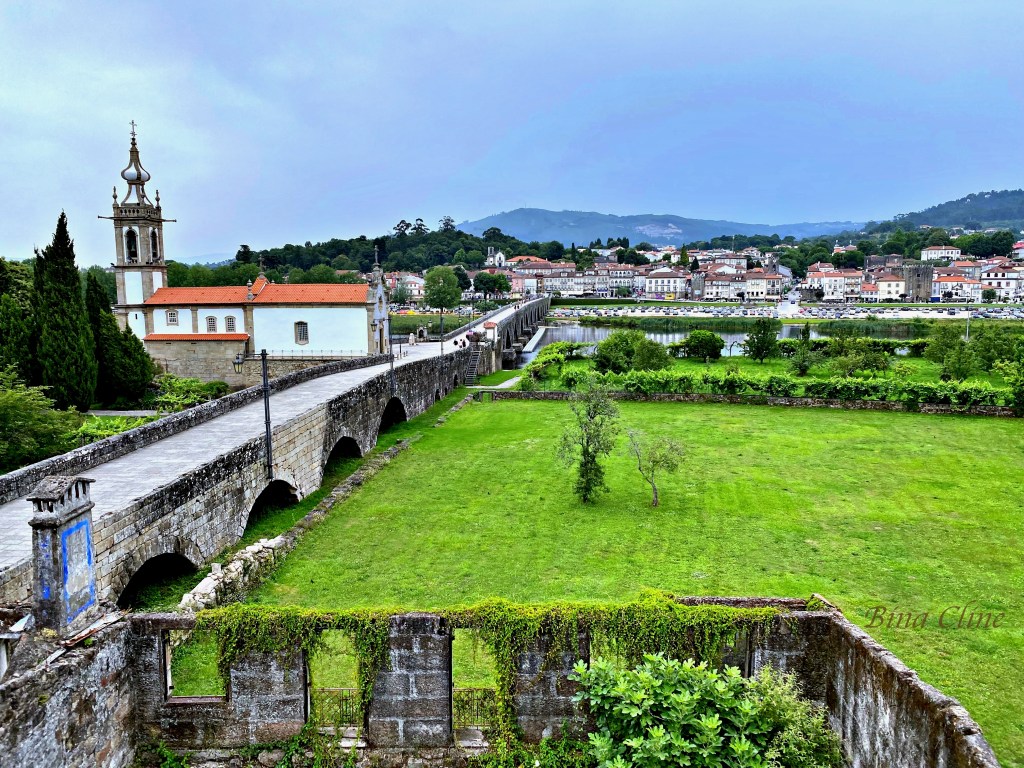
The Emperor Augustus, in the first century, subsequently ordered the construction of a stone bridge. Over the centuries, the river flow shifted a bit to the east, requiring the bridge extension in the late 13th century. That’s why the five remaining Roman arches now traverse dry land, on the western bank.
Bina and I got to know this bridge well, since our hotel (Arc My Otel) was also situated on the west bank; our second-floor room directly overlooked the bridge and the opposite bank, which comprises PdL’s historic area.
We arrived in PdL in June 2022 after walking a stretch of the Camino de Santiago from Porto. (To read about that journey, click here.) We planned to spend two nights there before continuing to Valença, on the border between Portugal and Spain. But forecasts for rainy weather, combined with Bina catching a cold, convinced us to hang around for several more days. The inconvenience came with a silver lining: an opportunity to experience the full richness of what soon became our favorite city in northern Portugal.
With a modern population of about 45,000, Ponte de Lima is the oldest chartered town in Portugal, receiving that designation in 1125 from Queen Teresa. In addition to the Roman bridge and remnants of medieval fortifications, the city houses several interesting museums.
In the Portuguese Toy Museum, right across the street from our hotel, we learned about toys produced in Portugal from the late 19th to early 20th centuries. Given Portugal’s poorer economy, the manufacturers needed to make their toys cheaper than those produced in other European countries or the U.S. — for example, hand painting designs and logos on tinplate model cars rather than lithographing them.
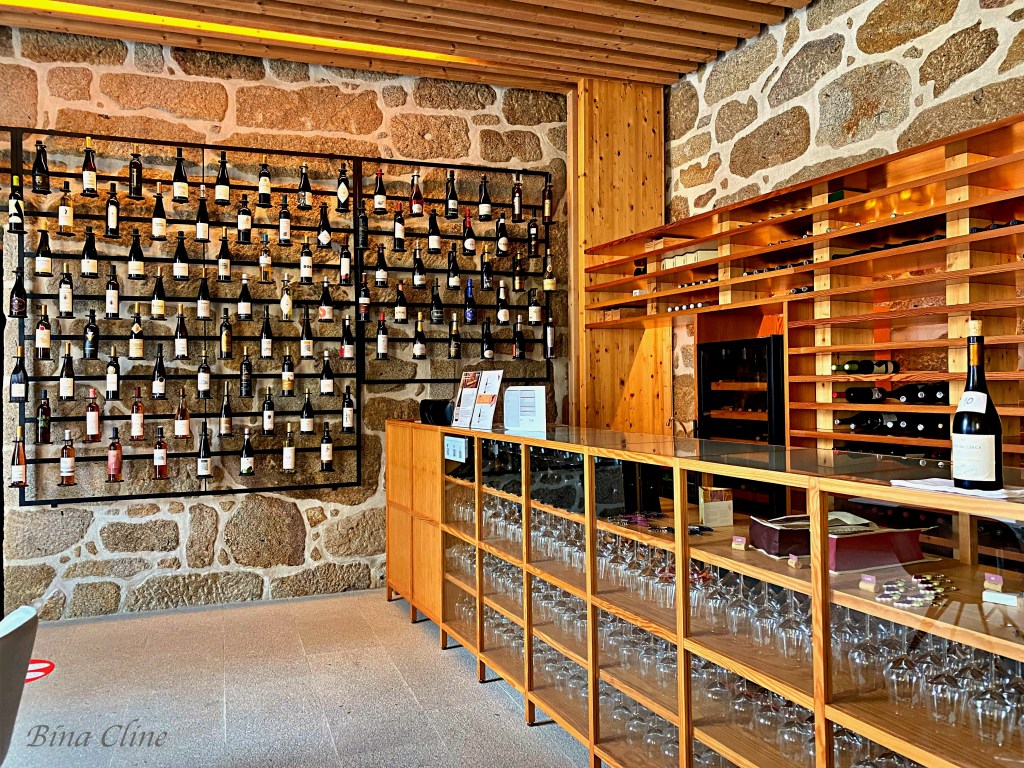
Crossing the bridge, to the town center, we visited the wine museum. Although not as well known as the Douro Valley, the wine district around the Lima River has a long history, with its products being exported to northern Europe by the 16th century. It’s now part of Portugal’s larger Vinho Verde (“Green Wine”) region.
Once you’ve perused the exhibits, you can sip samples of the the Vinho Verde produced locally. Bina and I had long thought this name designated crisp, citrus-y white wine. That’s only partially true, since “Vinho Verde” refers to the region, not the grapes or type of wine produced there. You can buy red wines under the Vinho Verde DOC label, although whites do predominate.
During the tasting session, Bina and I found we particularly liked wines made from the Loureiro (laurel) grape, which is grown right around PdL. Now, if we have a hankering for white wine, we look for a good Loureiro.
As luck would have it, our visit to PdL coincided with two major local festivals: the Vaca das Cordas (literally, “Cow of the Ropes”) and the Tapetes Floridos (“Flowering Carpets”). They occur back to back, the secular Cordas before the religious Tapetes, so it’s like Mardi Gras preceding Lent.
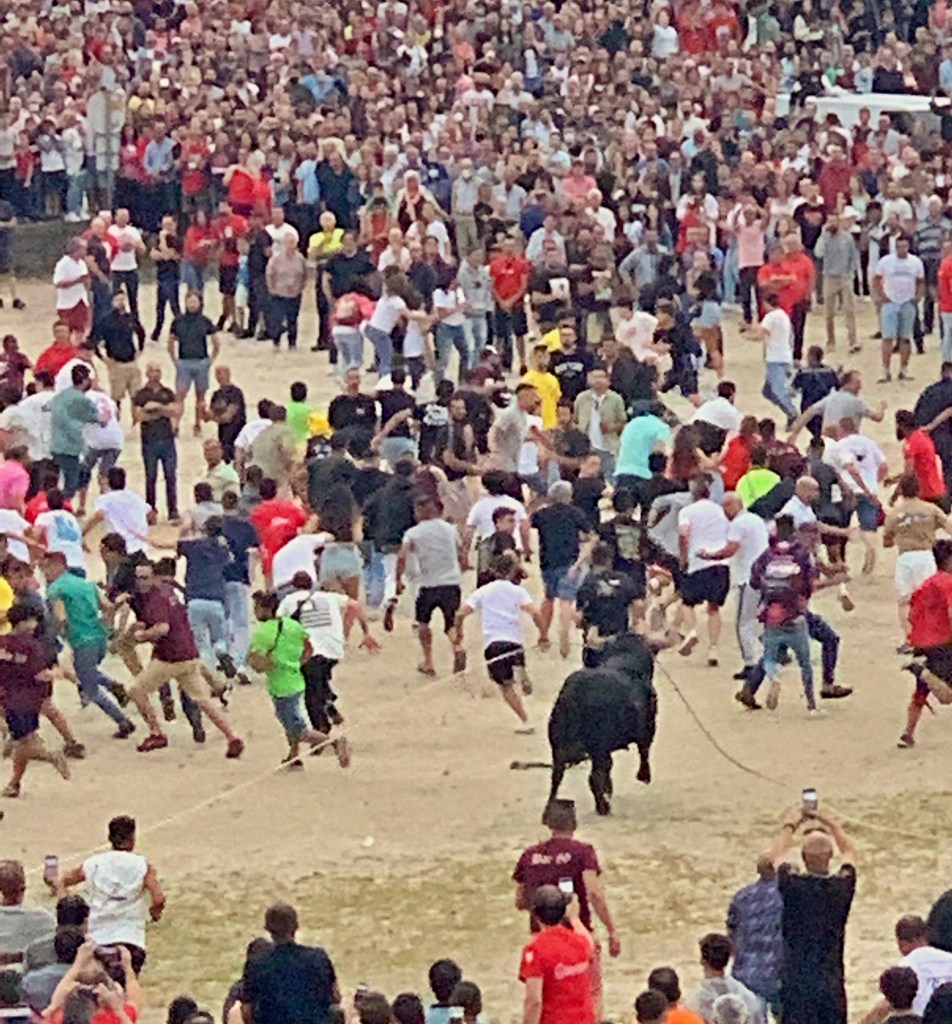
The Vaca das Cordas is similar to Pamplona’s Running of of the Bulls, except Ponte de Lima’s version features only one animal. It’s an annual ritual here dating back to the 15th century. On the eve of Corpus Christi, the Catholic feast day, a group of men tie up a bull at the city’s main church and douse him with red wine. Using ropes tied to the bull’s horns, they then steer the beast down to the large beach area alongside the Lima River, right next to the Roman Bridge.
There, cheered on by thousands of their fellow citizens, they harass and torment the poor animal for the next several hours to provoke him into charging the crowd. This creates much excitement, and some hilarity, as people scramble to get out of the way.
Bina and I had decided earlier in the day that the safest place for us to watch this display was from the bridge. So, we left our hotel around 6 p.m. to claim a spot at the farther end, right above the beach area. Crowds had been slowly gathering on the bridge and along the opposite shore for several hours so it was difficult to squeeze into a place along the railing. The people of PdL were clearly revved up for this festival, having been deprived of it the previous two years because of Covid restrictions.
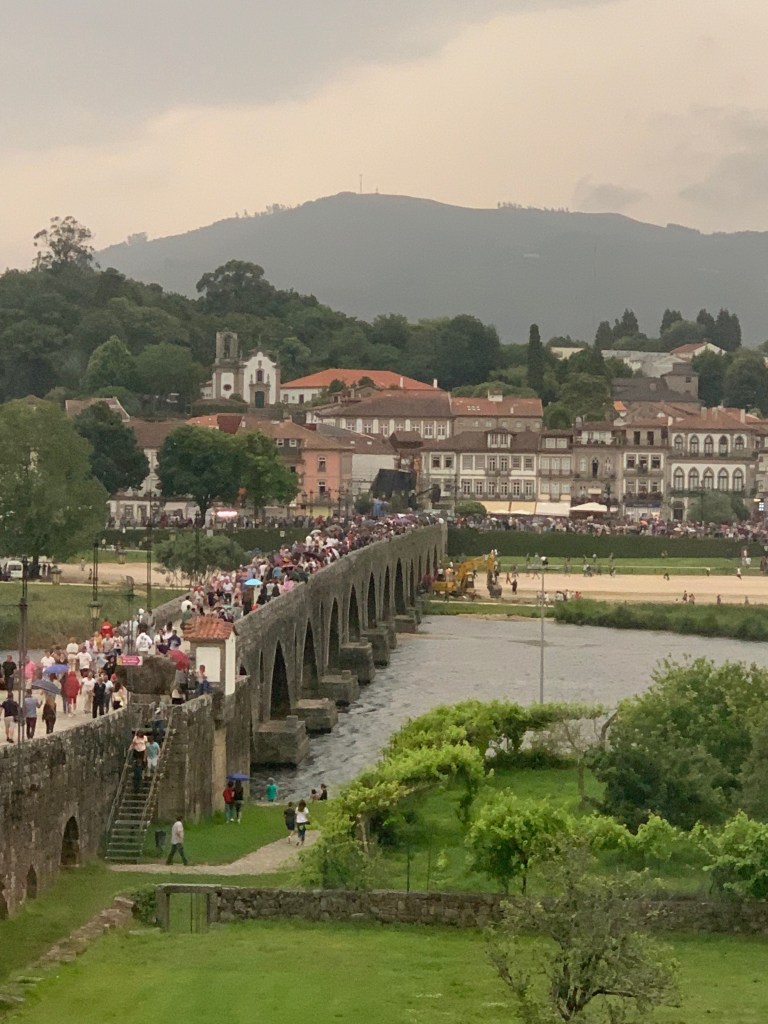
The event nearly got cancelled this year as well because of a sudden downpour at 7 p.m. that sent people scurrying for shelter. However, the rain stopped 20 minutes later and the crowds, including us, began drifting back.
From our position on the bridge, we could see men on the beach taunting the bull with shouts and sudden darts at the animal. The crowd around us contributed their own taunts, such as, “That’s not a bull, that’s a goat!” When the harassed beast responded with a charge, people scrambled in every direction, some even jumping into the river to get away.
We pulled ourselves away at 8 p.m. because we had a dinner reservation in the restaurant next to our hotel; with such huge crowds in town, we couldn’t afford to lose our place. But truly, we had seen enough of the Vaca das Cordas and it’s non-stop animal tormenting. The poor bull, by the way, was killed a few hours later and served as dinner in a restaurant across the river. The partying on the bridge and in town carried on that night into the wee hours … while the Tapetes Floridos was being prepared.
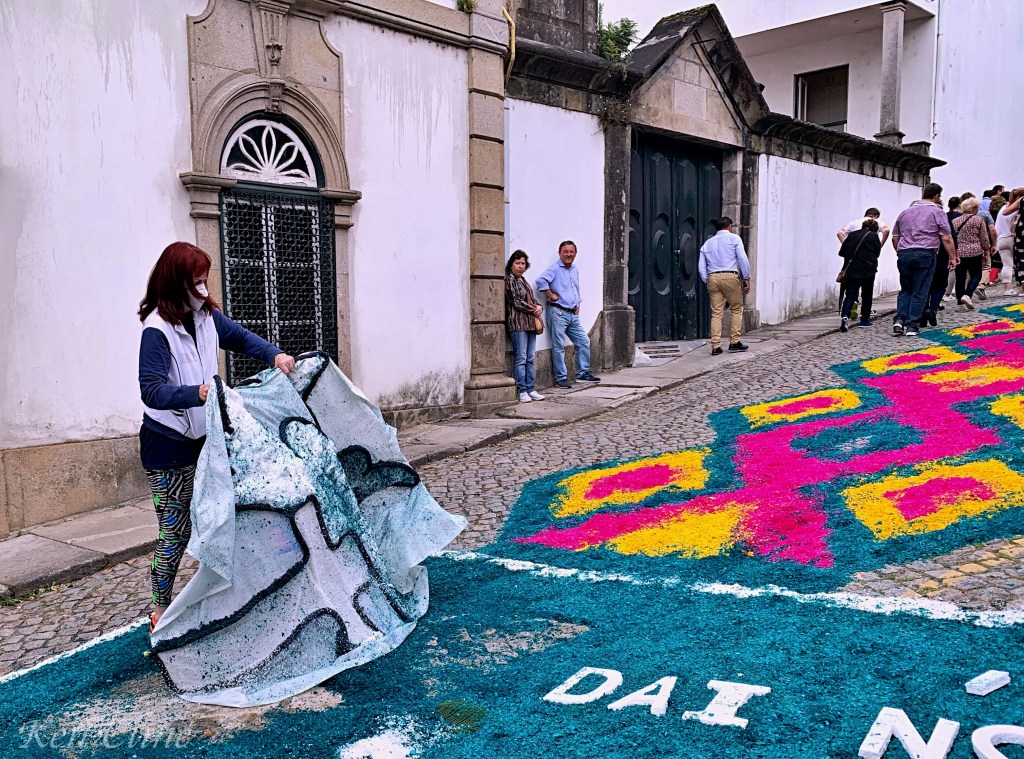
Yes, even in the midst of all the partying, more sober folk decorated many of the streets and alleys of the old town with “carpeted” designs consisting of painted sawdust and flowers. Most highlighted religious themes related to the the feast of Corpus Christi, which took place the next day, June 16.
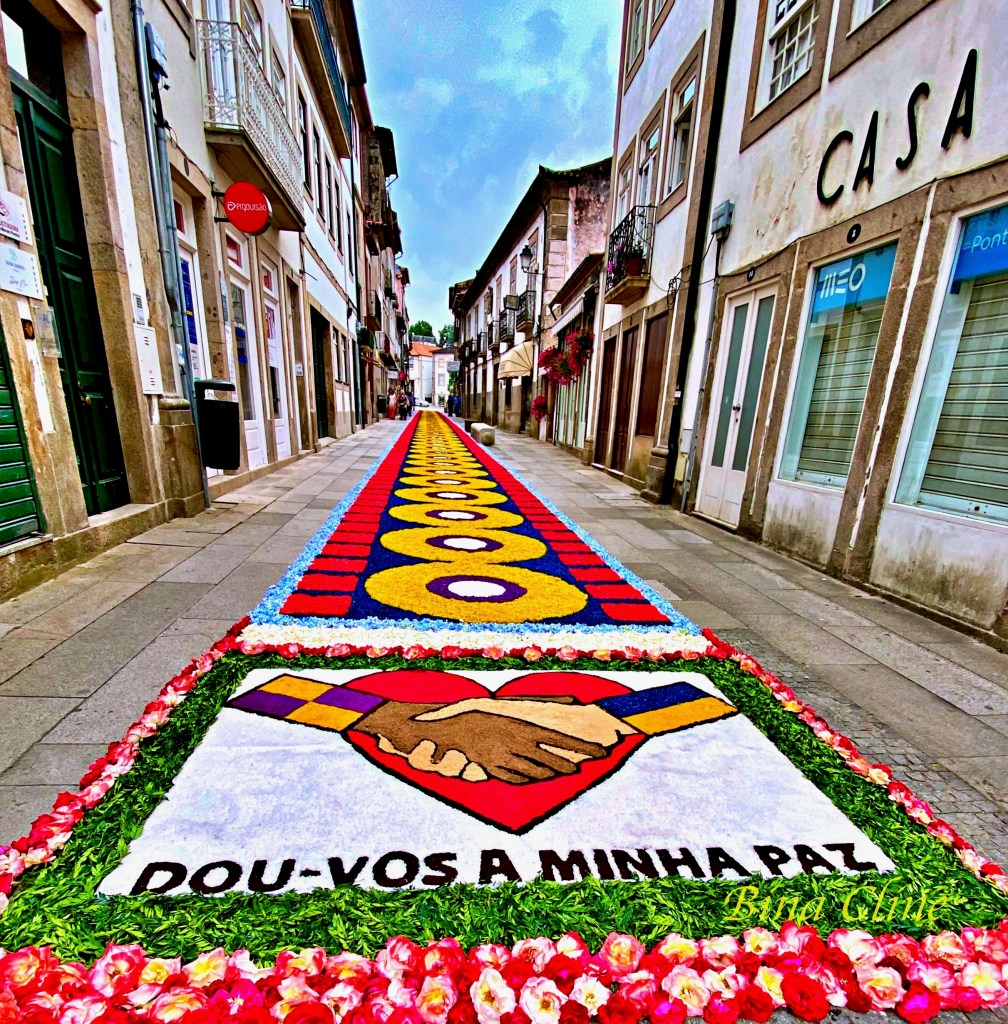
That morning, Bina and I crossed the river to view the art work, which features in a number of different festivals in both Portugal and Spain. We had previously seen it in the coastal town of Viana do Costelo, in 2018, but didn’t hang around long enough to see what happened after the flowers were laid on the streets. This time, we did.
It was about 4 p.m., and we were back in our hotel room, when we heard a marching band across the river. Running out to investigate, we found a procession forming at the main church. Groups of men and women dressed in traditional clothes carried banners and religious symbols for Corpus Christi. Led by the bands, they soon began a slow march through town on a circular route that ended at this same church.

The procession proceeded right over all the carpeted alleys and streets, thoroughly messing up the intricate designs. After they marched through one section, I saw a woman kneel down to extract a white sheet from the road; the design plan used for arranging the wood chips and flowers had been drawn on the fabric.
These two festivals, the Vaca das Cordas and the Tapetes Floridos, sealed our affection for Ponte de Lima as a place where people embrace their history and traditions with gusto. And to think, it all started with those superstitious legionaries balking at crossing the river.
 Two Clines Traveling