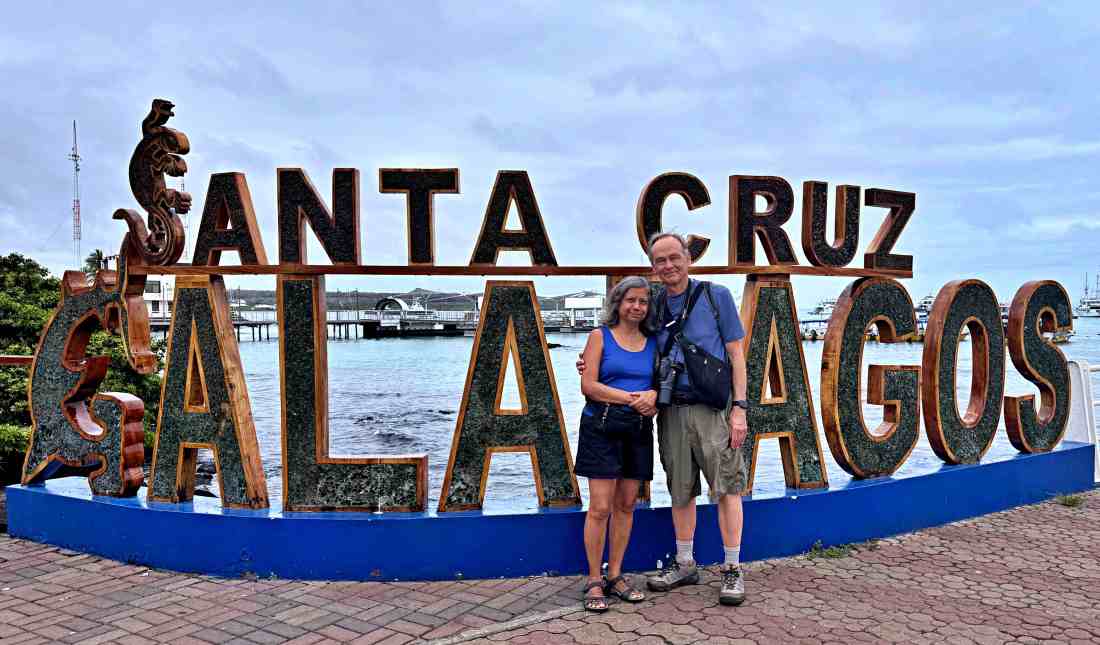
Traveling to the Galapagos Islands takes a bit of planning and financial resources. Just getting there is complicated, since the Ecuadorian government strictly controls access by air and sea. The restrictions are designed to keep the Galapagos in a more natural state, but they drive up costs across the board; transportation, lodging, food and on-site touring all come at a premium.
Yet, over 300,000 people make the trip each year because of the archipelago’s location in the Pacific Ocean at the intersection of four different ocean currents. This mix of waters with different temperatures and marine nutrients produces one of world’s unique natural environments. Ever since Charles Darwin landed there in 1835 to conduct the research that led to his theory of evolution by natural selection, many others have followed in his wake to view fauna and plant life found nowhere else.
Modern tourists must decide whether to arrive by plane or boat. You can either fly from Ecuador into one of the inhabited islands, San Cristóbal or Santa Cruz, or skip around the archipelago via a boat tour. The first option gives you a land base for exploration; the second means you mostly live on the boat.
There are pros and cons to each choice. The boat trip restricts you to a bubble of your fellow travellers but provides access to more varieties of wildlife over a wider area; the Galapagos includes 61 islands and islets scattered over 45,000 sq km (17,000 miles) of ocean. With the land-based approach, you get more contact with the locals and, likely, more comfortable living quarters and exposure to the local cuisine, but at the cost of a smaller geographical range.
We decided to focus our visit on just the two islands of San Cristóbal and Santa Cruz, with an occasional short boat excursion from those places. We figured these two islands would provide us with the highlights of the Galapagos experience. Also, we prefer managing our own trips, as opposed to joining a group, so that we can control our own schedule and pace.
Taking the do-it-yourself approach did force us to spend weeks of serious head-time to figure out the best flight schedules, lodgings, the permits needed, the amount of cash money to bring with us (Ecuador uses the U.S. dollar) and what to pack. Finally, on December 6, we flew from Lisbon to Miami on TAP (Portuguese Air); from Miami to Guayaquil, Ecuador, on American Airlines; and took Latam Airlines from Guayaquil to San Cristóbal, where we arrived at 10 a.m. on December 8.
 Two Clines Traveling