
It’s a only a three-hour flight from Singapore to Hanoi, but what a world of difference. While Vietnam has become one of Asia’s fastest growing economies in recent decades, it still ranks 109th in world GDP per-capita, compared to Singapore’s place at number four.
You notice the difference at once on the sidewalks: orderly, clean and usually a smooth flow of pedestrians in Singapore, packed, noisy and often obstructed by ramshackle vendor stalls in Hanoi. Crossing a street in Vietnam, amid the sea of motor scooters, can be a test of your nerves.
It’s all relative, to be sure. Traveling to Vietnam from neighboring Cambodia or Laos would have provided a different perspective. But then there’s this: we hardly saw the sun the entire time we were in Hanoi.
Vietnam’s capital is one of the most polluted cities in the world, a condition that worsens during the winter as the cool, damp air seals in the smog closer to the ground. While we did enjoy some of our activities in Hanoi, we mainly used the city as a base for a boat cruise of Halong Bay, about 130 km (81 miles) to the northeast, also mostly overcast but which benefited from a fresh sea breeze.
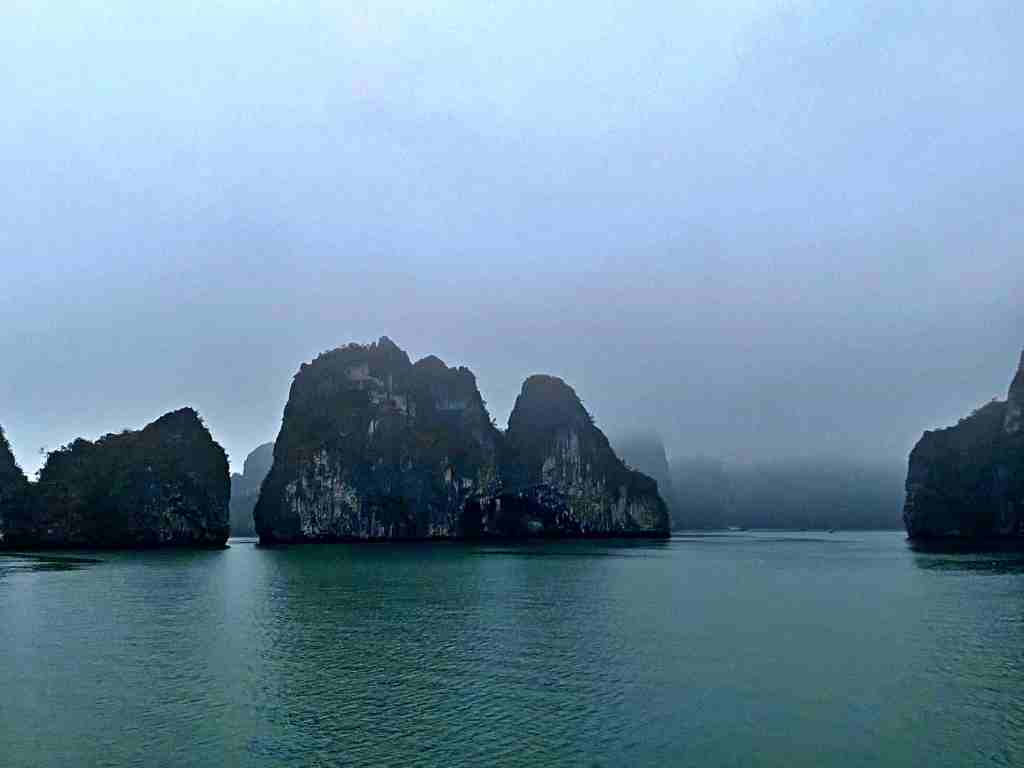
This coastal body of water (the name means “descending dragon”) covers about 1,553 sq km (600 sq mi), including nearly 2,000 rocky islets. Hundreds of millions of years of erosion on the limestone here has produced one of the world’s most beautiful “karst” landscapes, which has been designated a UNESCO World Heritage Site.
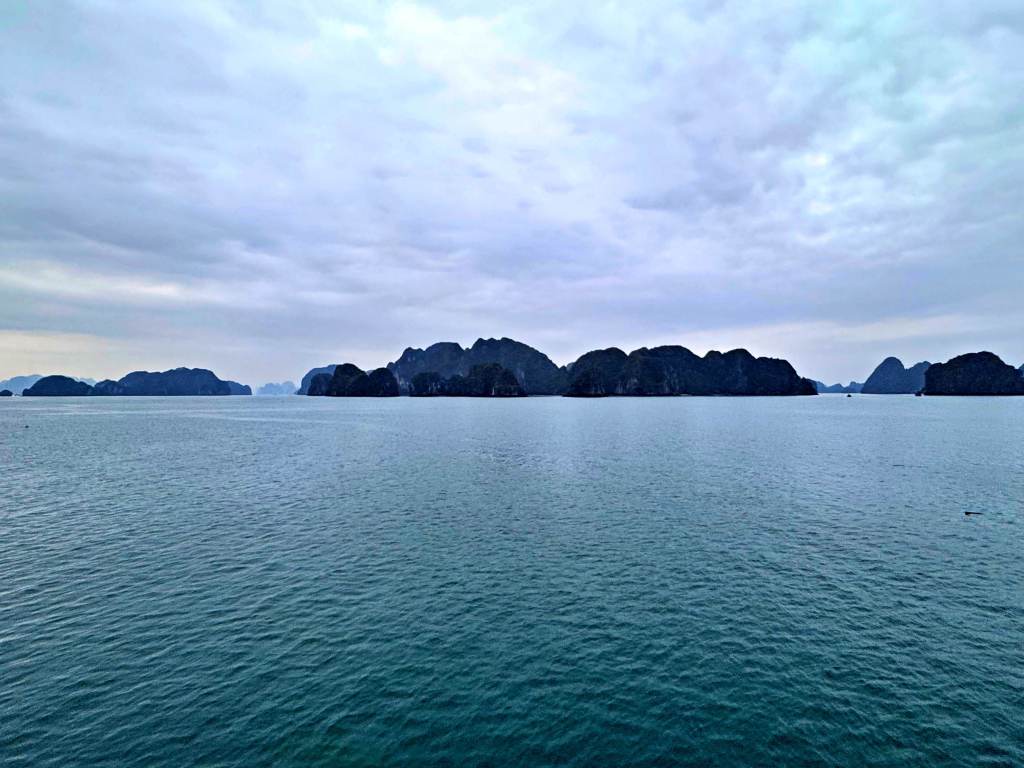
Bina deserves all the credit for diligently researching our boat trip and coming up with a cruise line that provided good service on a comfortable vessel. We couldn’t have been more pleased with our boat, the Au Co, which is named after a character in Vietnamese mythology.
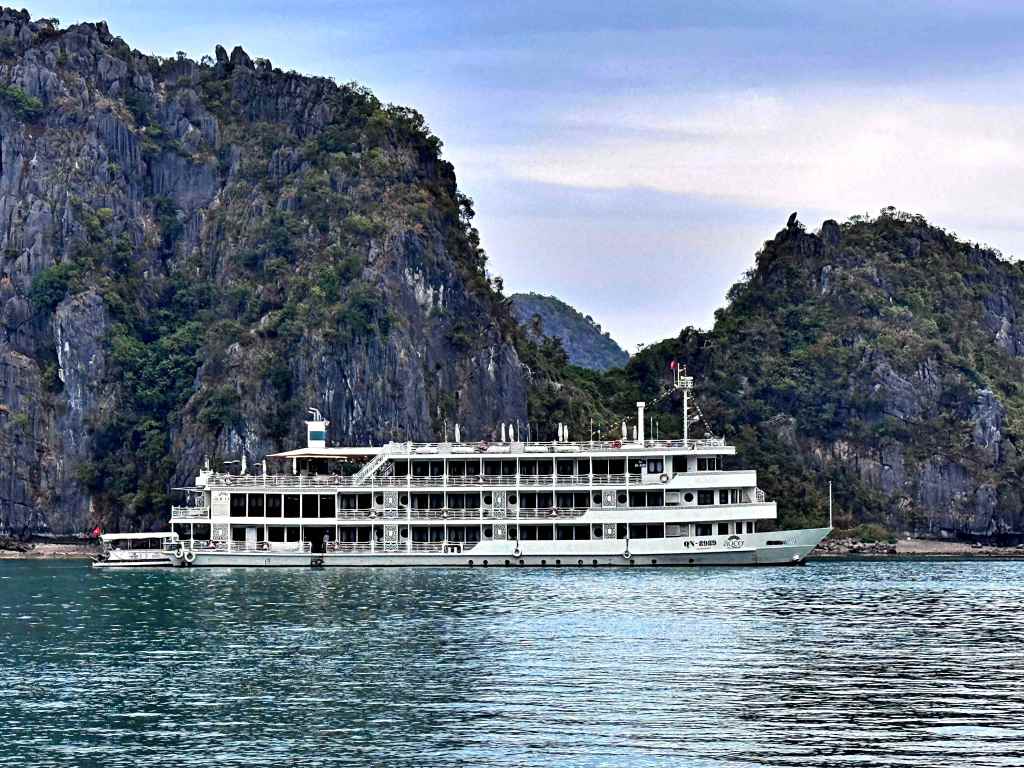
On the morning of February 13, the company’s van collected us and other passengers from our Hanoi hotels and took us to Halong, where we boarded the Au Co. Following a buffet lunch, our first excursion was at Cat Ba Island, where we disembarked for a village visit. Some of us, including me, rode bicycles to reach the village, which was four km away; Bina joined the other group in a motorized buggy.
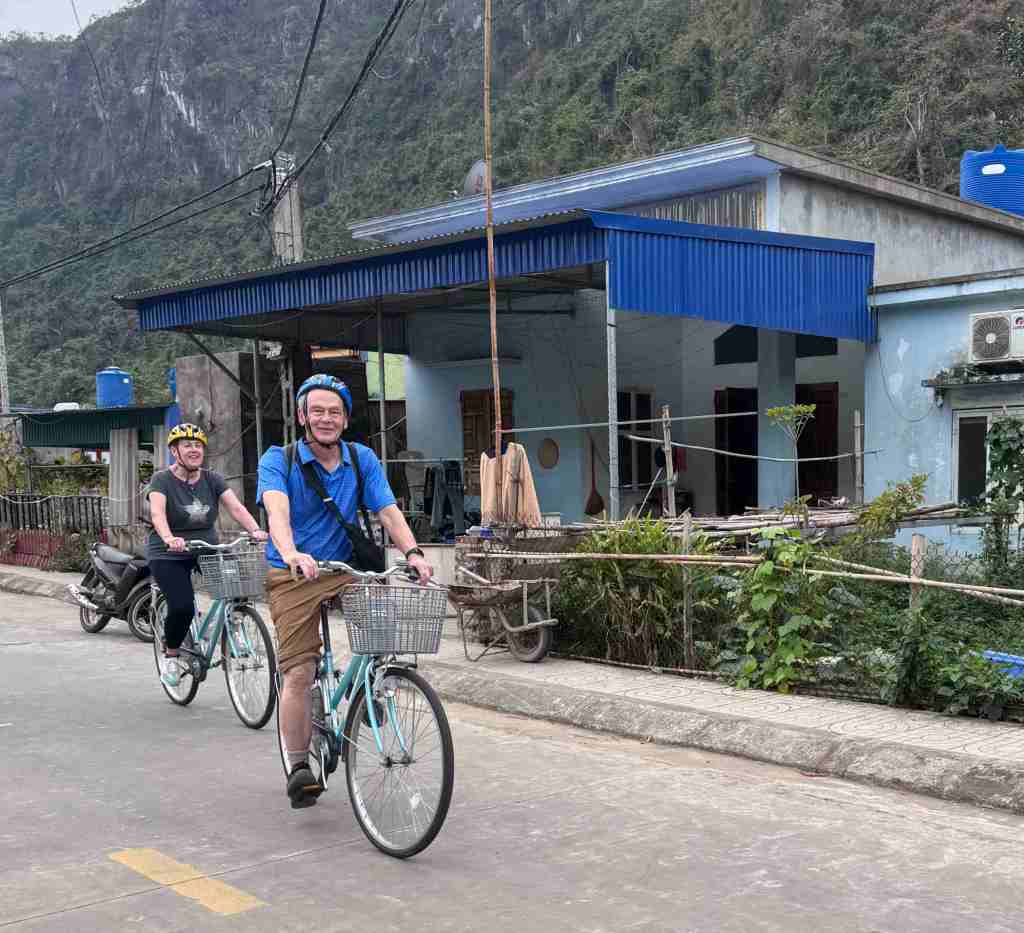
The village featured the typical touristic attractions, such as traditional handicrafts for sale and visits with farmers at work in the communal gardens. Our guide admitted those locals were staging this as a photo op, since they performed their real work in the morning. Bina did enjoy a cooking demonstration, where she learned how to make Bánh Cuõnk, or pork rolls in pancakes.
Later that evening, on the Au Co, the bartender presided over a tasting session with several varieties of Vietnamese rice wines, whose alcohol content can soar to 25%. Luckily we didn’t find any of them tasty enough to drink more than a sip!
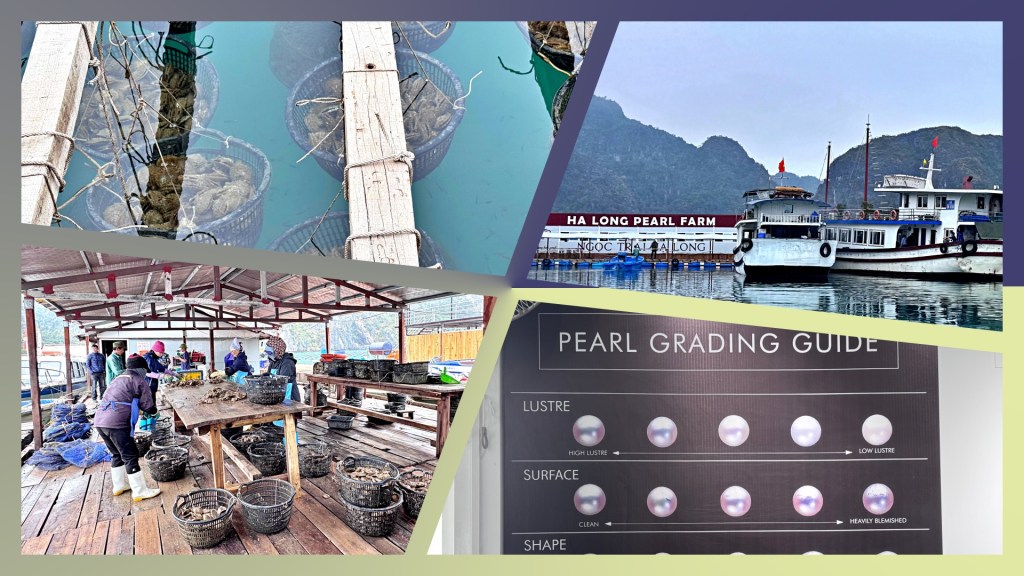
Our excursions on the second day included a morning visit to a pearl farm, a large platformed structure built over the water on stilts from which nets are hung. The oysters cultivated here take six-to-eight years to produce natural pearls, so this is a business that requires cheap labor and lots of patience.
In the afternoon, we visited the Cua Van Floating Village, where the houses are also built on stilts over the water. Bina and I enjoyed a peaceful paddle around these structures in a kayak, away from the larger group, who rode on a barge-like boat paddled by a local.
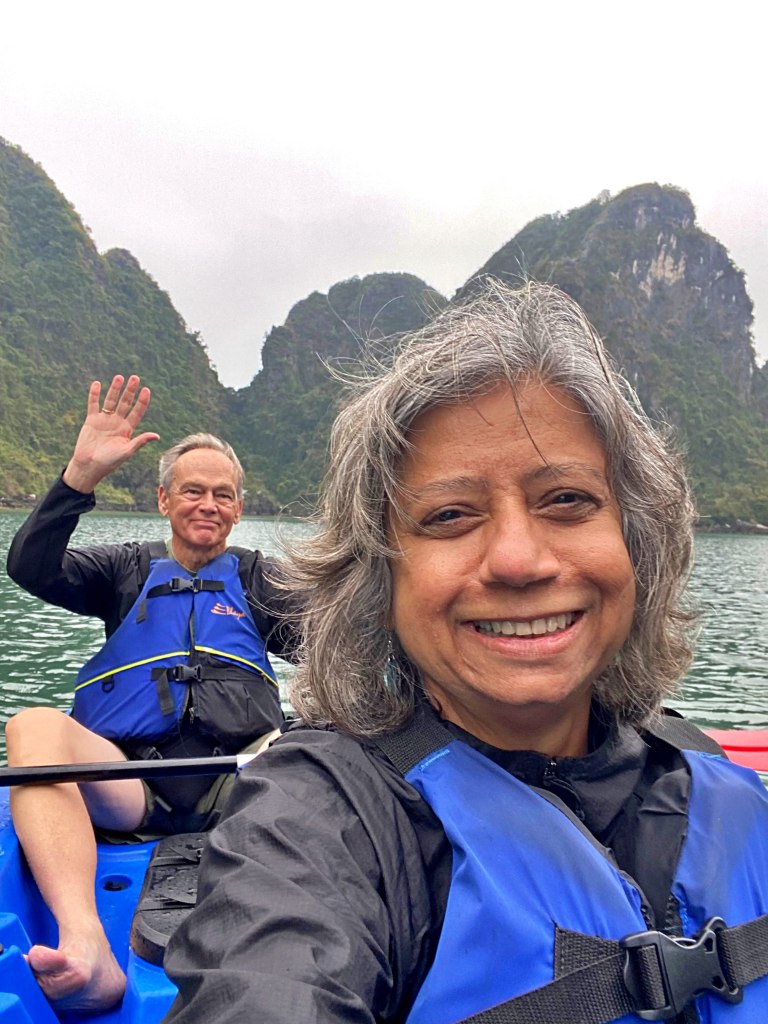
After this excursion, we returned to the Au Co for much needed hot showers; the afternoon temps had been a tad chilly and you can’t kayak without getting a little wet. Then, it was upstairs for a cooking demonstration featuring Mei, or fried spring rolls. Bina, who went up front to participate, says the secret is in how you roll the pancakes while filling them.
On the last morning of our three days aboard ship, we rose before 6 a.m. to participate in a Tai Chi class, the only passengers willing to get up that early! We found it a near-mystical experience doing the slow motion exercises as the Au Co passed by the mist-shrouded rocks in the bay.
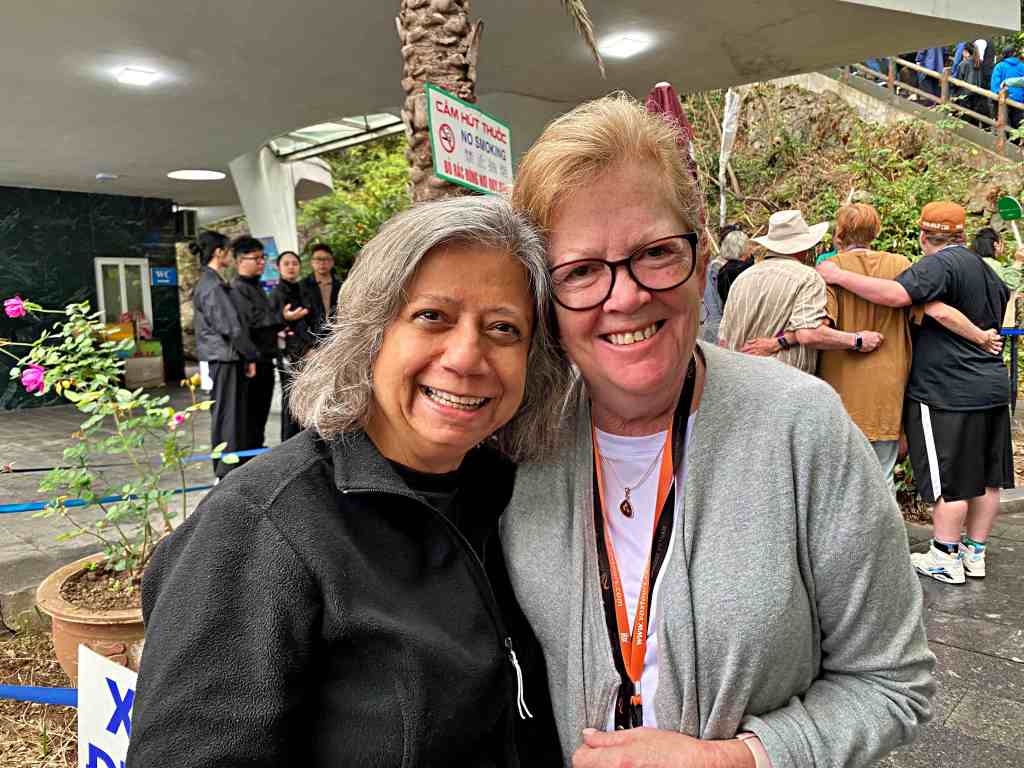
An excursion later that morning found us standing in line with several hundred other people waiting to enter Sung Sot Cave, the largest in the bay. All the cruise boats, it seemed, had disgorged their passengers at once to enter the cave when it opened, at 8 a.m. Suddenly, a voice called to us from further ahead in line. This turned out to be Mary Higginbotham, a former neighbor and long-time friend from Atlanta!
We knew Mary was traveling in Vietnam and, in fact, had planned to meet her for dinner that evening in Hanoi. But encountering her like this in the middle of Halong Bay came as a total and most welcome surprise.
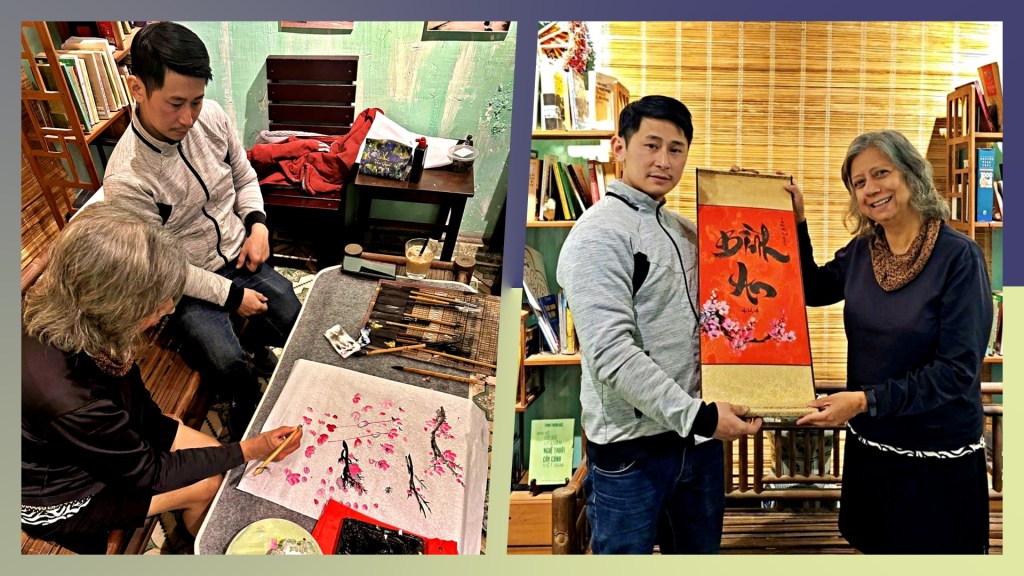
Boating in Halong Bay unquestionably provided the highlight of our Vietnam trip, but we did enjoy some activities in Hanoi. The best for Bina was a watercolor painting class held at a cafe near our hotel. The instructor, a young artist named Linh, showed her the techniques of rendering flowers in the traditional Vietnamese style. It is very different from any other watercolor painting style that Bina has learned before, very delicate and lovely.
While Lihn spoke no English, he communicated though a female translator named Mai. As an added bonus for Bina, she was the only person to sign up for that day’s class, so she had Linh’s undivided attention.
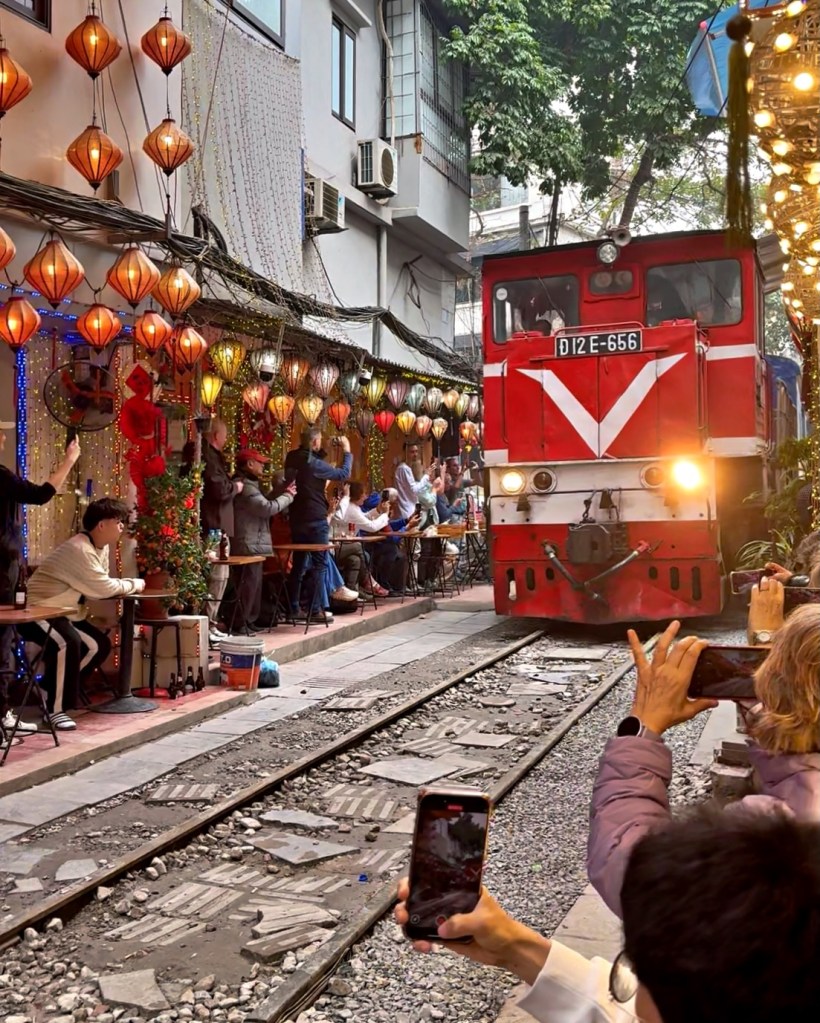
Another highlight of Hanoi was participating in the phenomenon known here as “Train Street.” This is a stretch of railroad track where the train passes in a narrow lane within a few feet of neighboring shops and houses.
What’s the appeal? Because tourists can enjoy the thrill of sitting alongside those tracks within a foot or two of the passing trains. Neighboring cafes do a thriving business setting out tables and chairs to serve you coffee or other beverages as you wait.
Needless to say, this is not an officially sanctioned tourist attraction. The city government tried to shut it down a few years ago after some near-fatal accidents but the cafes, which rely on this business, managed to keep the show running. Nowadays, they dispatch employees to police the tracks before the train arrives and make sure everyone is seated far enough back to avoid losing a body part, or worse.
We also took in the show at the Thang Long Water Puppet theatre, where the painted wood puppets play out their roles on an indoor pool of water. The puppeteers control the puppets with bamboo rods and strings hidden beneath the pool’s surface. It’s a wet job as they work from behind a screen standing waist deep in the water.
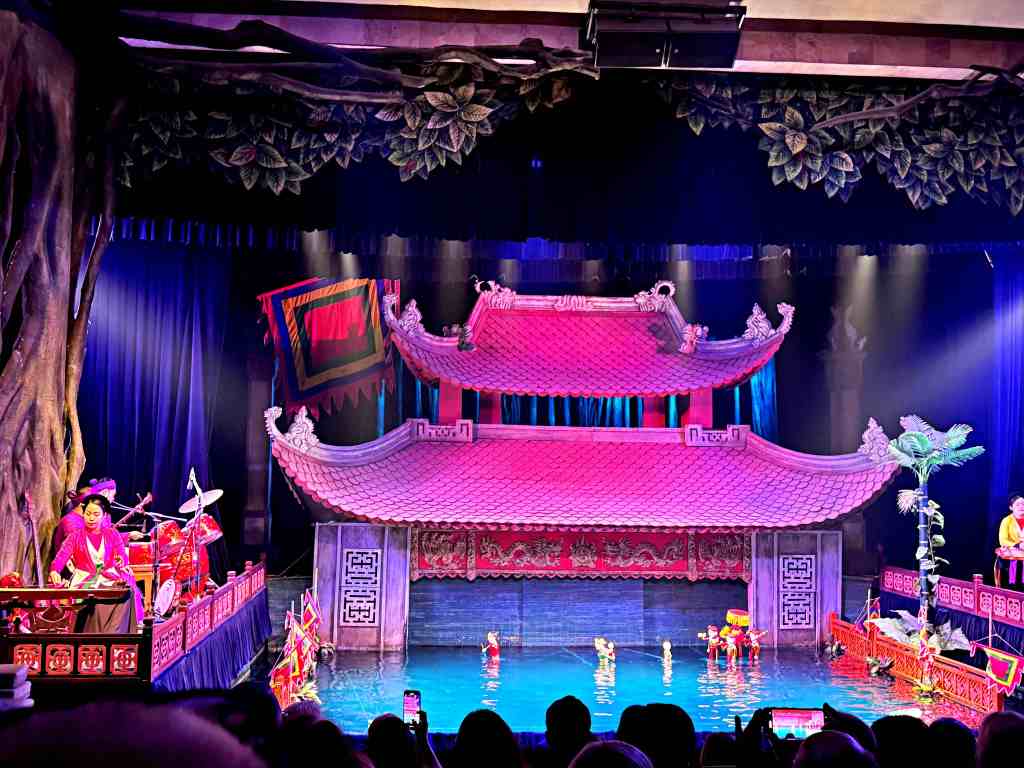
Water puppetry is a traditional art form, nearly a thousand years old, typically focused on ancient Vietnamese mythology and humorous village folk tales, such as an old couple frantically trying to protect their ducks from a marauding fox. Watching this show, combined with Biina’s watercolor painting class, gave us an appreciation for how some Vietnamese strive to preserve elements of their traditional culture.
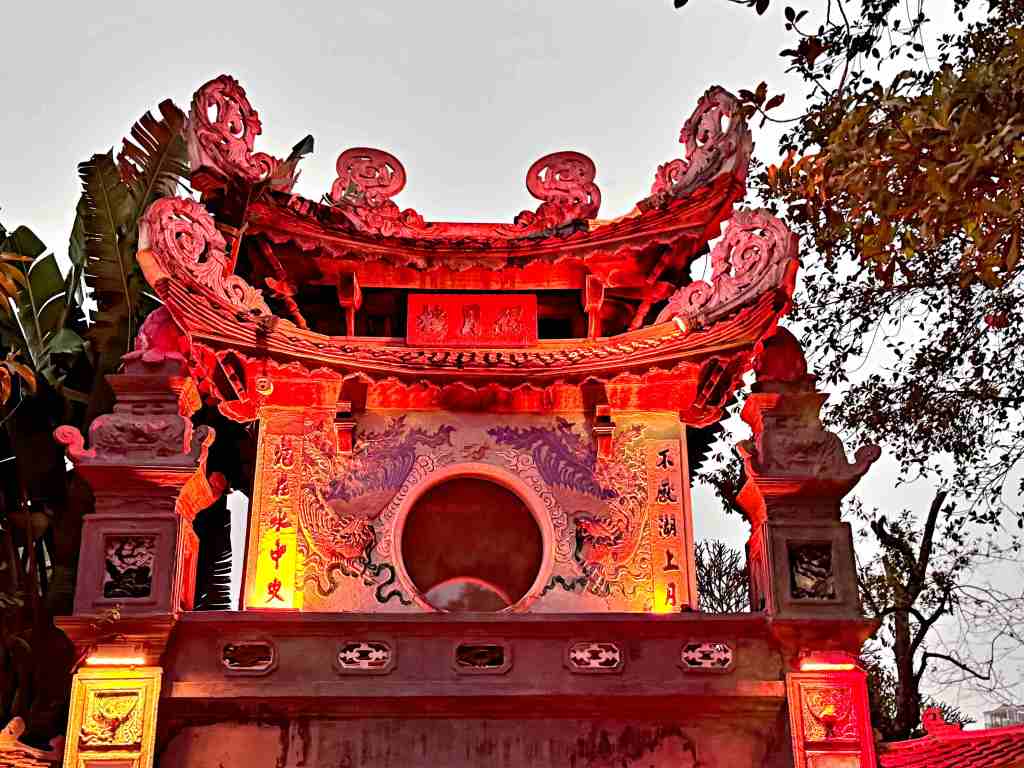
We experienced a similar sentiment visiting the Ngoc Son Temple, which is located in the Hanoi’s iconic Hoan Kiem Lake. Constructed in the 19th century to honor a Taoist god of prosperity, the temple today preserves a touch of elegance and peace in a sea of urban busyness.
Travel Tips: Vietnamese hotels and restaurants are likely to take credit cards, but not smaller shops and cafes. So, you will need a small supply of dong, the local currency. English is scarce, except at a basic level, so expect some frustration trying to communicate complex issues — such as Bina trying to explain her dietary needs (no sugar or carbs). Since we spent most of our time in Hanoi’s old quarter, we mostly got around by walking, but occasionally used the Grab car-hire service for longer distances, which is reliable and inexpensive.
To follow us on future adventures please click here.
 Two Clines Traveling