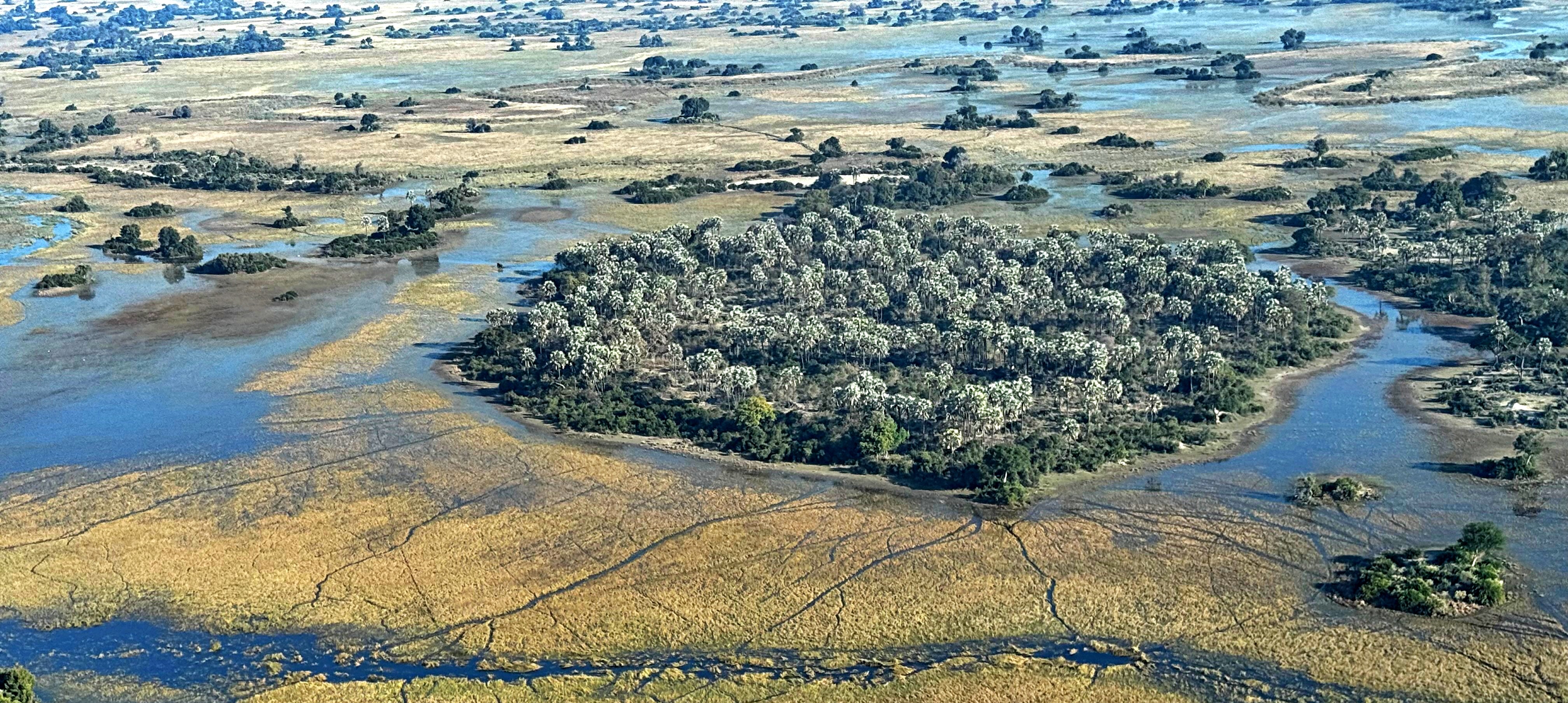
Johannesburg’s international airport is the traditional starting point for safaris in the southern part of Africa. You arrive there to be delivered into the hands of a network of local air lines that then take to your country, region and camp of choice. The size of the plane decreases on each leg of the trip so that you typically arrive in a tiny Cessna, or even a helicopter.
In our case, we spent one night at a hotel near the Jo’burg airport to catch up on much-needed sleep and then returned the next morning to take an Air Links Embraer 195 regional jet to the small airport in Maun, Botswana’s gateway to the Okavango Delta. From there, we boarded the classic bush plane, a Cessna 208 Grand Caravan (14-seater), that took us to a landing strip in the delta.
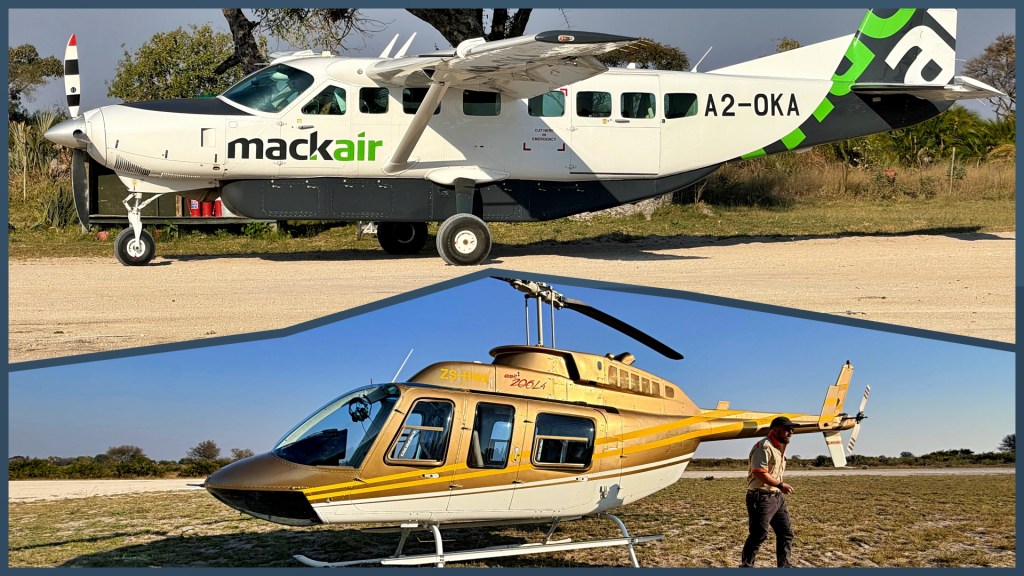
Here we had a bit of a surprise: a helicopter waiting for us. It turned out that the airstrip near our camp, Mopiri, had recently been flooded so we had been re-routed to this one located a bit further away. Mopiri had chartered this helicopter to take us and another customer onward to the camp, thereby avoiding an hour and a half boat ride.
Not for the last time on this trip, we found ourselves in awe of the efficient handoffs in this safari travel network. This included the flights and ground transportation, as well as local representatives meeting us in all of the airports to help us check in for the next flight.
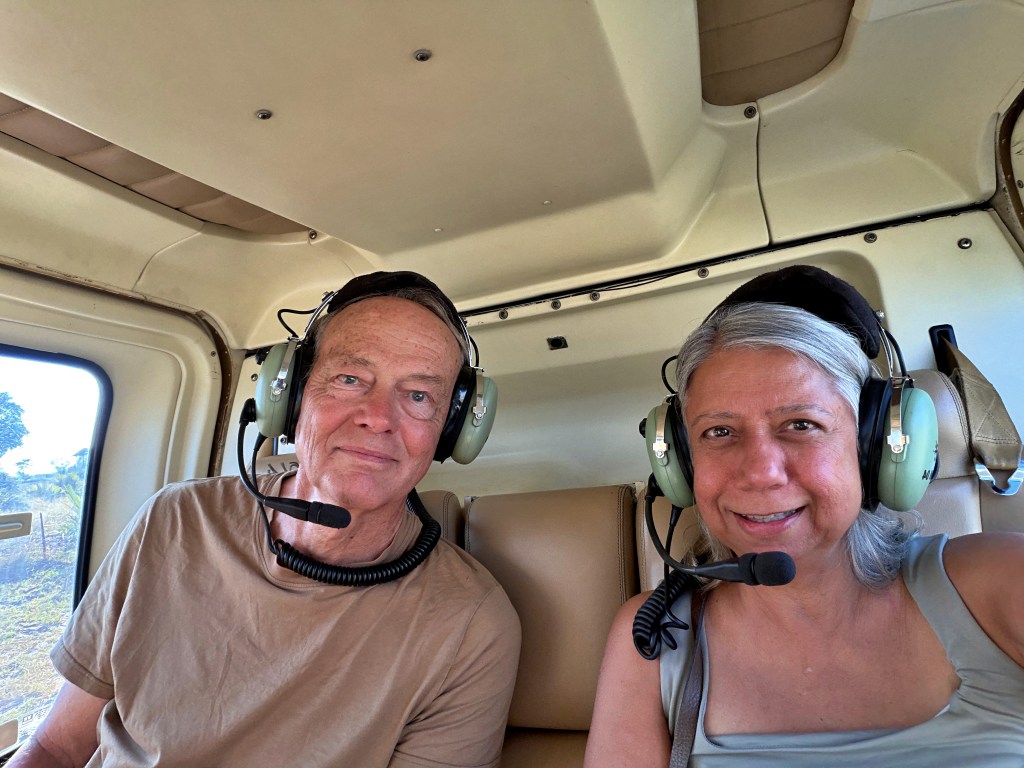
The pilot of this helicopter, a bearded 31-year old Dutchman named Bart, had been trained in the U.S. and spoke fluent “American.” He skimmed low over the terrain, providing us with dramatic views of the delta, to arrive at the camp about 10 minutes later, right about 4 p.m.
The Okavango is the world’s largest inland delta, which means that the water does not flow into an ocean or sea, such as is the case with, say, the Mississippi Delta in the U.S. or the Nile Delta in Egypt. Instead, the water comes down the Okavango River from the highlands of Angola during the summer rains (January to February) to flood into a basin of the Kalahari Desert and then sits there to partially evaporate before the next rainy season.
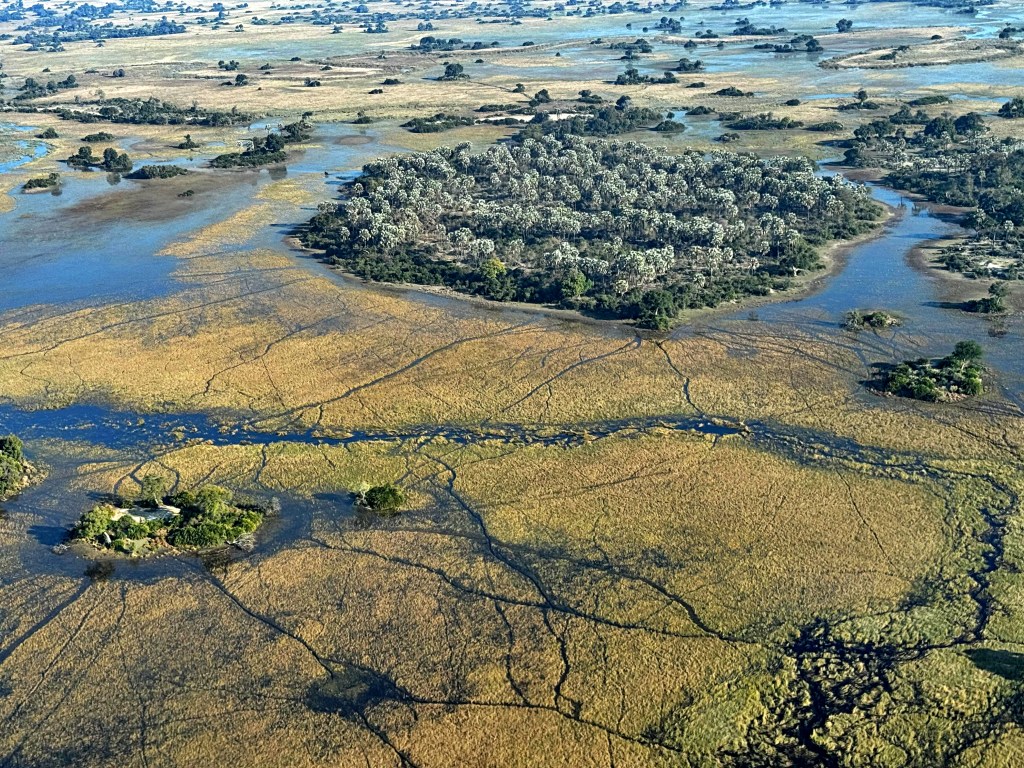
You might liken the Okavango Delta to a vast, overwatered desert oasis. By summer, it has swollen to three times its normal size to attract up to 130 different kinds of mammals and 500 bird species. Arriving in late July enabled us to view this wildlife at its peak.
Since up to 100,000 people visit the delta’s 60 or so camps and lodges during the year, the Botswanan government promotes a high-cost, low environmental impact tourism strategy. You won’t see the traffic jam of safari jeeps common to Tanzania’s Serengeti region or South Africa’s Kruger National Park; most camps can only be reached by small planes, helicopters and boats.
Mopiri Camp, well situated on a large lagoon, consisted of 10 framed tents for lodging (total capacity about 25 guests) and was staffed mostly by people from a nearby village. Meals were good, but we dealt with low-pressure hot water in our tent and no heater. Staying warm during the cool nights — this is the southern hemisphere so July was their winter — meant tucking into bed early in the evening with your “bushbaby,” or hot water bottle.
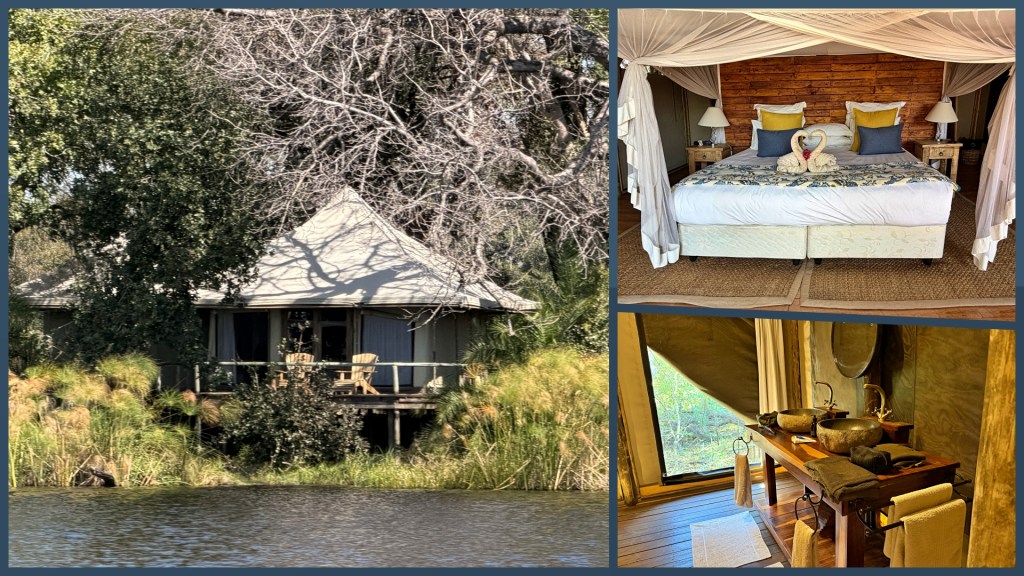
But we didn’t come to Botswana in search of luxurious living. On that first evening, we enjoyed a short “sundowner” cruise with a few other guests, to take photos of the sunset on the water. The next morning, we embarked on a boat ride through the marsh with a larger group of six.
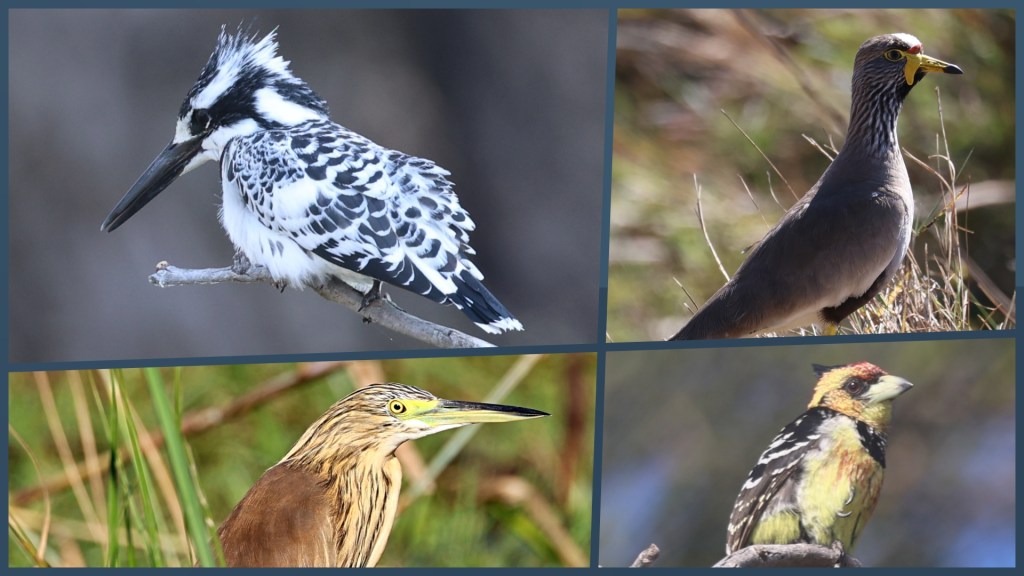
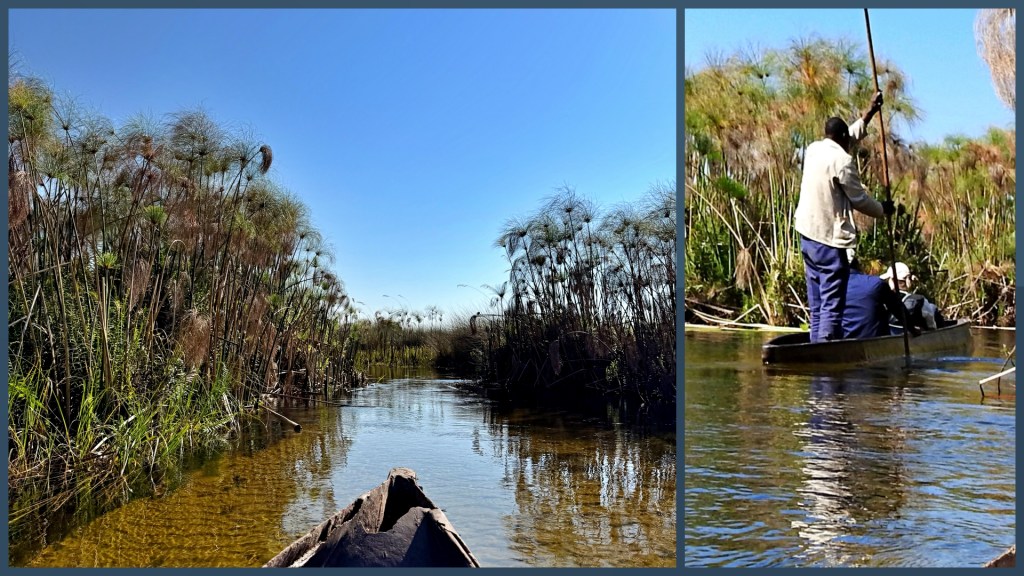
The Okavango Delta is a network of lagoons and small islands linked together by narrow channels through the papyrus reeds. We found it relatively easy to spot birds and other animals on the banks as we drifted along in our shallow-bottomed boat. Getting a clear and focused photo, however, proved difficult given the tangle of reeds and grass.
Most of those channels, by the way, were created by hippos, the “engineers of the Delta,” whose massive heads pop up out of the water everywhere. Spending most of the day lolling about in the water to protect their sensitive hides from the sun, these vegetarian mammals trample down the papyrus reeds between islands in order to clear a path to reach solid ground for grazing.
At one point in our journey, we stopped at a place where locals were waiting for us with mokoros. This is the native term for the local wooden dugout, although nowadays a mokoro is more likely to be a fibreglass canoe. Our group piled into several of them, two in each, as a local poled away in the back. Ours told us to call him “Jack, after Jack Daniels, the whiskey.”
With its very shallow draft and lack of propeller, the mokoro enabled us to enter smaller channels. Sand, the driver and guide in our excursion boat, had frequently fouled his propeller in the broken reeds and other vegetation that gets bunched up in the channels.
Altogether, we did five boat excursions during our time at Mopiri Camp, the mornings in a speedboat, and the evening sundowners on a slower paced, double-decker pontoon boat. We saw many interesting bird species, including herons, kingfishers and an African fish eagle, as well as many hippos, elephants and crocodiles, the latter typically sleeping on the banks.
Our 2026 African safari was off to a good start.
Travel tips: Any time you go on safari in this part of southern Africa, carry with you a couple of hundred U.S. dollars in small denominations. It’s customary to tip the people you work with directly, such as guides, and also contribute to a tip box for the rest of the staff. Dollars are easy for locals to exchange, more so than the euro, and you don’t have to bother about converting to local currencies.
Botswana itself, from what little we saw, struck us as a friendly and welcoming place. Prior to this trip, Bina and I knew nothing about the country beyond its role as the setting for Alexander McCall Smith’s stories about the No. 1 Ladies Detective Agency. Smith, by the way, occasionally leads luxury safaris into the Okavango Delta, a work he does for charity.


Glad the Zambezi post mentioned it was the third; somehow I’d missed Okavango. Went to the website and found it. Okavango took care of a couple of my questions, too. One was the handoffs. I’d probably have wondered whether somebody was going to meet us as scheduled each time. Also wondered about heat, as it’s a consideration in the U.S. and Europe. But you were there in “winter”. Nice mix of sightseeing and science, as usual! Thanks.
LikeLiked by 1 person
Yes, it was remarkable how we had assistance and help at every step of the way. At each point in the transit from one airport to another, there was a local rep from either Roots & Journeys in Botswana or Green Safaris in Zambia. There were also two drivers, as I mentioned in the Victoria Falls piece, getting us across the border from Botswana to Zambia, one on each side. These handoffs all went quite smoothly and the local reps we met were friendly and helpful.
As for weather, it was short sleeve-hot during the day but need-jacket cool at night. Lots of sun during the day.
LikeLike