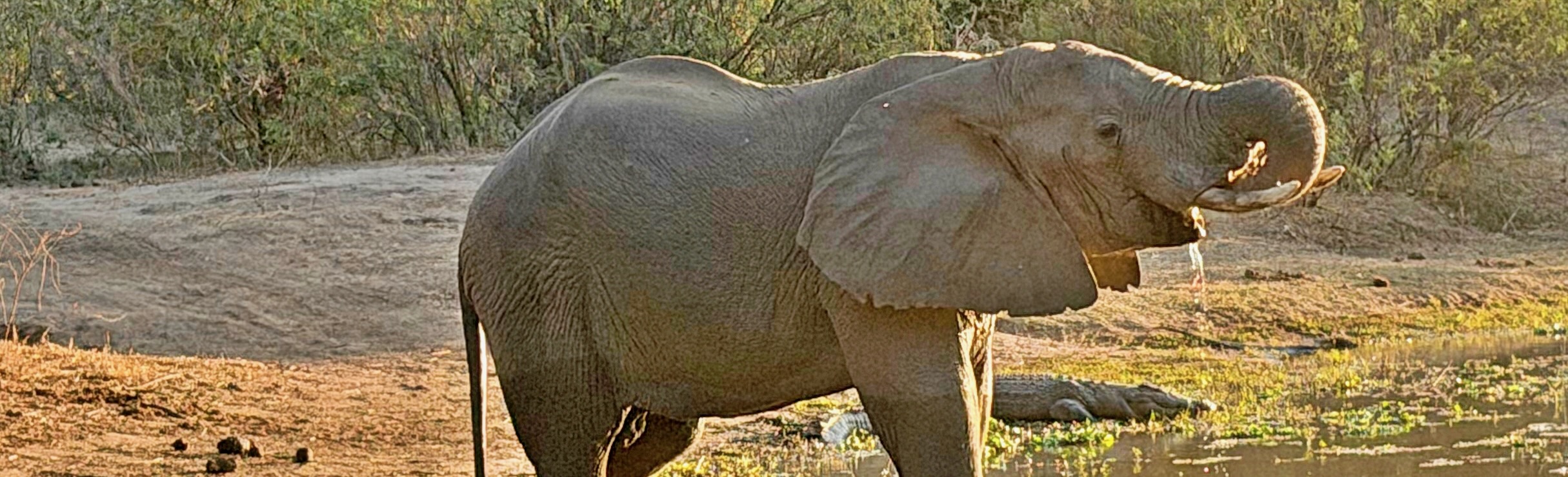
The third and last stop on our 2026 African safari was Potato Bush Camp, located on the lower stretches of the Zambezi River, about 700 km (435 miles) northeast of Victoria Falls. This is very isolated country, similar to the Okavango Delta in Botswana.
Our trip began after lunch, when Phixion drove us to the airport at Livingstone, the largest Zambian town near Victoria Falls. Here we boarded a British Aerospace Jetstream 41, a turboprop operated by Proflight, a private Zambian airline. The hour-long flight to Zambia’s capital at Lusaka was uneventful — until we tried to land.
Our plane came in noticeably fast, waddled a bit on the runway, and then abruptly surged skyward, a/k/a an aborted landing. The stewardess blamed a strong tailwind; Bina and I had noticed the airport wind sock sticking straight out. But the consensus opinion among us nervous passengers blamed the pilot for excessive speed.
We did manage to land on the second loop around the airport, where we gratefully disembarked. A young woman from Green Safaris met us in the terminal and guided us to the international flights area, where we had lunch and waited for the second flight. This turned out to be a five-passenger Cessna Grand Caravan, also operated by Proflight and piloted by a young woman with a male co-pilot. No problems this time and I gave the woman a thumbs-up when we landed at Royal Airstrip, which serves as the gateway to the Lower Zambezi National Park.
Two employees of Potato Bush Camp met us at the landing strip, including Alex, who would be our guide for the next two days. Alex drove us in an open safari jeep to a park office by the river, where we then boarded a speed boat to take us to the camp, about an hour’s ride away, arriving at 5:30.
As at Tongabezi and Mopiri, Bina consulted with the chef (Andrew) about her dietary restrictions and we checked into our lodging, which was tented, as at Mopiri. The quality here was a bit higher, however, with more space and good water pressure. After a dinner of lamb cutlets in the restaurant area, we settled into our room by about 9 to wind down for the evening and ready ourselves for a boat excursion with Alex the next morning.
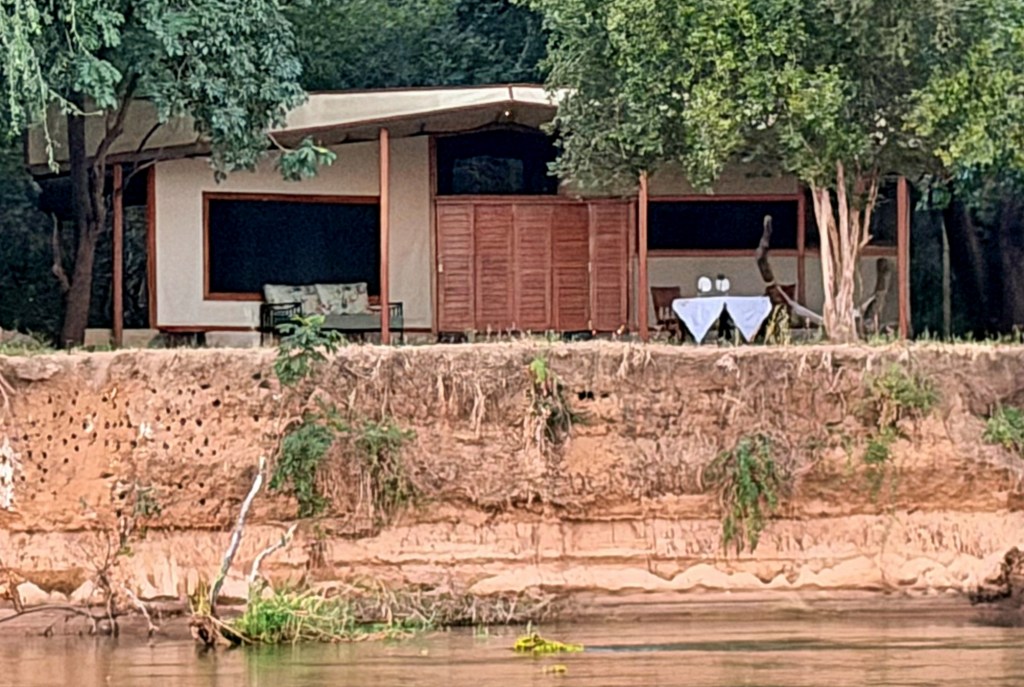
One thing we noticed immediately, trying to sleep, was the noise volume. The hippos and elephants were much louder, and seemed closer, than at Mopiri and Tongebezi. Hippos, particularly, tend to grunt and honk all night long as if suffering from upset tummies. It’s quite distracting until you get used to it.
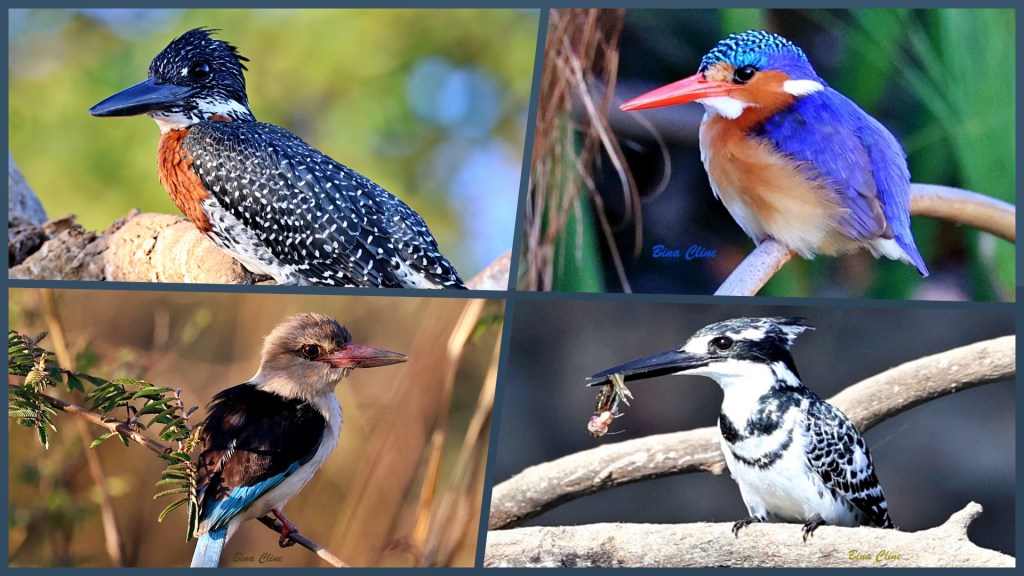
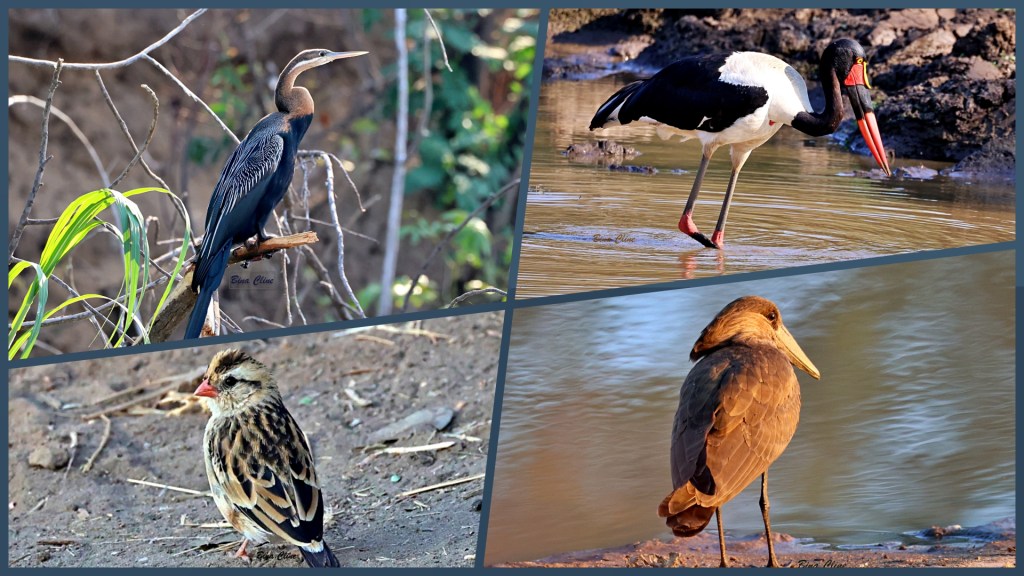
Our day began at 6 a.m. when Monnix, our assigned valet, came by to deliver hot coffee to help us get moving. We were at breakfast by 6:30 to begin our boat excursion on the Zambezi by 7. Our guide Alex, 47, quickly impressed us with his knowledge and experience. He had been in the business for 20 years and knew his birds. On this first trip with him, we got our best close-in photos of the Giant Kingfisher, which we had only seen at a distance at Mopiri and Tongabezi.
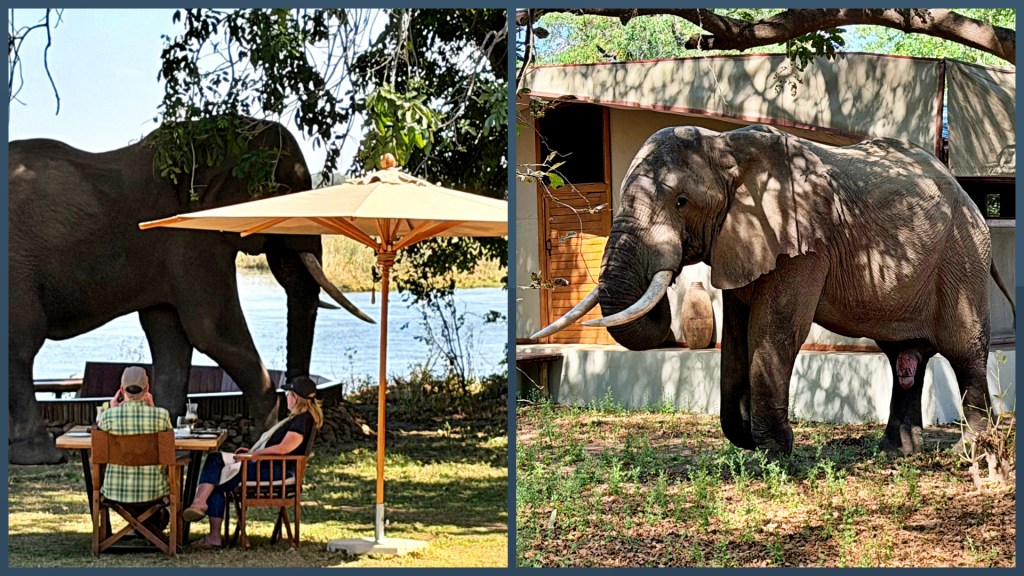
Later, after lunch, we had a bit of excitement when an elephant showed up to nose around our tent for seed pods that he pulled down from the nearby winter thorn tree. It was amusing to watch him step, ever so gingerly, over the wooden walkway. The camp manager, Thembi, said that he visited virtually every day. And in fact, the next day, he lumbered through the restaurant area while we were sitting down to lunch. Some staff members sat down next to us, guarding us, I suppose, in case the pachyderm headed our way. But he continued on to his favourite tree near our tent.
At 6 p.m. on the first day, Alex also took us on a night safari drive accompanied by another guide whose job it was to hold the flashlight. It’s a creepy experience to drive through the jungle and see luminescent eyes staring back at you from the bush. In this case, most of those eyes belonged to impalas, who come out into the open at night to graze when they feel safer from predators. Locals refer to impalas as the “McDonalds of the bush,” meaning they are available to eat in great numbers and on every corner.
Our area did include leopards and lions, which we never saw. But we did spot a cat-like genet, which feeds on smaller mammals.
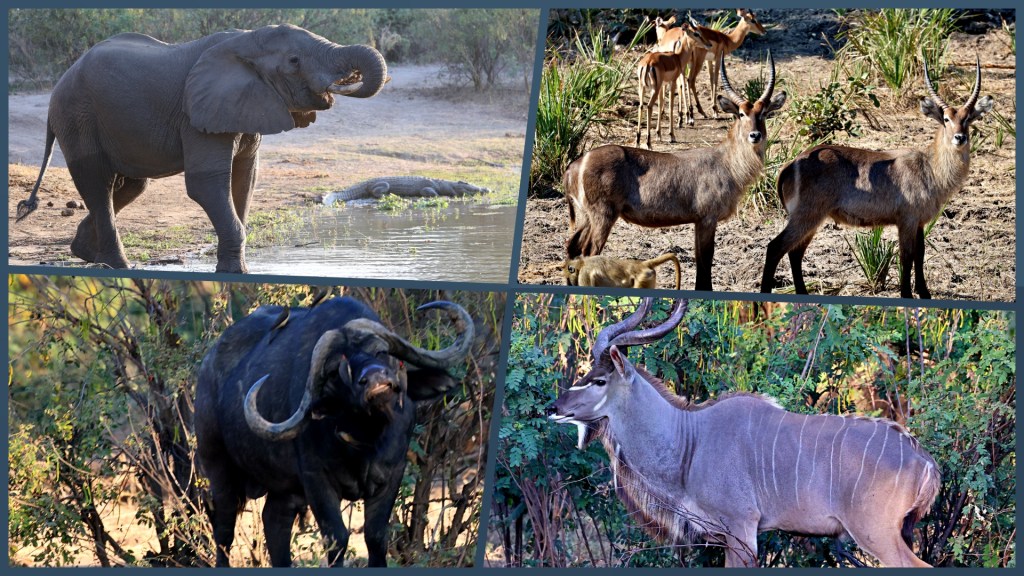
Following the night drive, Alex surprised us by dropping us off at a picnic dinner in the bush that Green Safaris had set up for guests at their two camps in the area, Potato Bush and Sausage Tree. We enjoyed a meal of chicken or beef curry, rice, shima (a local maize dish), salads and chocolate brownie as an elephant strolled by. A couple of honey badgers also came nosing around looking for table scraps. Never a dull moment in the bush.
On the next day, we reversed the order of our trips and did the land-based safari ride in the morning and the boat excursion in the late afternoon. On this drive, Alex alerted us that a guide driving guests from Sausage Tree had sighted a leopard a few kilometres away; did we want to join them? We declined the offer because we wanted to focus this trip on birds and had already seen leopards in Tanzania. Also, the leopard was moving around and there was no guarantee of a clear photo opportunity.
It was probably just as well, because by 11 a.m. we began dealing with the profoundly annoying presence of tsetse flies, which come out during the day. We were wearing long sleeve shirts and long pants but you can feel their bites, nearly as sharp as a bee’s sting, through your socks when they went for your ankles. And who wants to get sleeping sickness? It was time to head back to the camp for lunch.
Our boat excursion at 4:30 proved a lot more comfortable as we drifted languidly down the river snapping bird photos. But then … up to this point, Aex had proven adept at steering around the hippos who infest the Zambezi. Hippos don’t actually swim, but they can hold their breath for about five minutes, which enables them to walk on or bounce off the bottom of the river before returning to the surface for air.
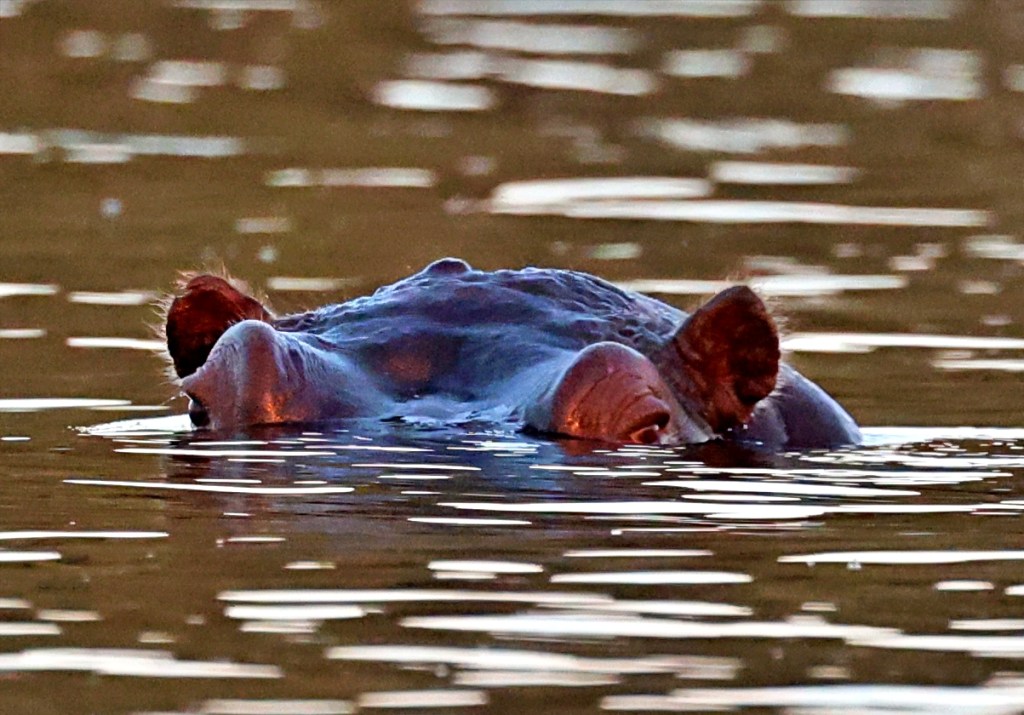
At one spot, Alex must have driven too close to a submerged hippo because we suddenly heard an enraged roar behind us. Not more than a few yards astern, a hippo head complete with open jaw and ferocious front tusks came surging out of the water. On his downward motion, he plopped his front feet in a tremendous splash, as if galloping after us. Submerging, he immediately rose to repeat the movement — clearly chasing us.
I had just managed to grab my camera and was about to hit the shutter button when the hippo plopped down a third time, not to re-emerge. And that’s our “we wuz attacked by a giant hippo” story.
We later learned that these fat, roly-poly curiosities are actually the most dangerous large mammals in Africa, more hazardous to humans than lions, elephants or leopards. Being very territorial, they don’t like anyone or anything to intrude into their space and kill about 500 people a year, mostly by swamping boats. Somehow we missed that memo, which was probably just as well for our peace of mind!
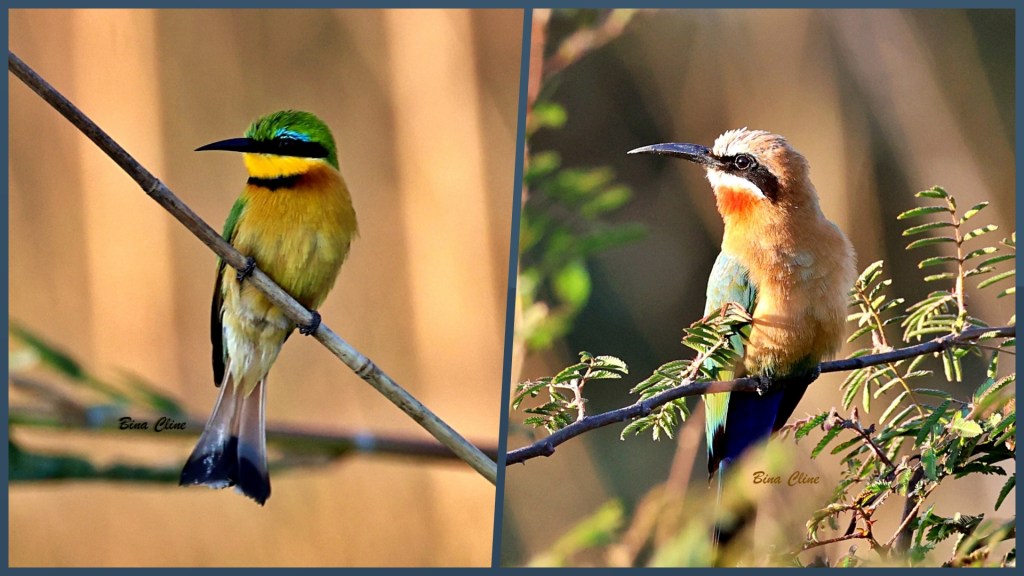
And so ended our second African safari, a successful trip from our standpoint. By Bina’s calculations, we had observed 80 bird species in Zambia (at Tongebezi Lodge and Potato Bush Camp) and 36 in Botswana’s Okavango Delta, bringing our “Life List” of bird sightings to 353 on the eBird app.
Travel tips:
One thing Bina and I have learned about African safaris is that the camp staff make your stay as safe as possible by providing clean water, hygienic surroundings and trained guides to keep you out of trouble with the wildlife. It’s a massive effort on their part, particularly considering the isolation of these camps. All supplies to Mopiri and Potato Bush, for example, have to be brought in by boat.
We were lucky that we suffered no ill-effects from the food or the water while we were at any of the camps. We both got food poisoning at a restaurant in Lusaka airport, on our very last day traveling back to Portugal, but this occurred outside the safari “cocoon.”


The detail in the Zambezi post gave me my first feel for how much you got off the beaten path this trip, even though you were dealing with tours and guides. Lot of research must have gone into the final result — a safari you deemed a success. Africa just seems to keep on giving, as the posts and pictures do. Glad we could come along.
LikeLiked by 1 person
Thanks, Clint. We did research at a high level — which countries to visit and where our focus should be, which was birding. But our planner at Discover Africa, a South African named Dev, came up with the specific camps that we stayed at and the basic itinerary. We reviewed his choices, and even made a few changes, but he was the one who put all this together on short notice and figured out all the plane connections. We were very pleased at the results and would happily recommend this guy to any one who inquires.
LikeLike
a very enjoyable read. Makes me want to go back 😃. Love the hippo photo
LikeLiked by 1 person
Thanks, Anonymous. I’m glad the story brought back good memories for you. And Bina appreciates the comment on the hippo photo!
LikeLike