Our departure from Mopiri began as we had arrived — by helicopter. Bart, the Dutch pilot who had been hanging around the camp, flew us and another passenger to the air strip at Jao, one of the other safari camps in the Okavango Delta. There we waited for a Mack Air Cessna Grand Caravan, piloted by a South African named Chris, to take us to an airport in the town of Kasane in the northwestern part of Botswana that is known as the gateway to the Chobe National Park.
This park is famous for its herds of elephants, about 120,000 of them, the largest concentration on earth. From the plane’s window we could watch the gradual transition from the Okavango Delta’s snake-like waterways and termite-built islands to the dry, flat scrub land of Chobe. And we did see some elephants below us before we landed.
In the Kasane airport, we were met by a young Botswanan named “OG,” short for a much longer African name, who escorted us out of the terminal and then drove us in a van about a half hour to the Zambezi River border crossing where Botswana intersects with Zambia, Zimbabwe and Namibia. There is a spot on the bridge where you can see bits of all four countries.
The border control building is a friendly, efficient place, with Botswana employees on one side and Zambian on the other. OG escorted us to each side to get our passports stamped and then turned us over to Anson, a young Zambian man who took us on an hour-long drive to our next accommodation at Tongabezi Lodge, near Victoria Falls.
Driving into the well-manicured, garden-like grounds of Tongabezi took us into an entirely different world from Mopiri, with fixed structures rather than tents, and very elegant ones at that. Our cottage had a front deck overlooking the Zambezi River and an attached bathroom with shower and tub. No problems with water pressure here.
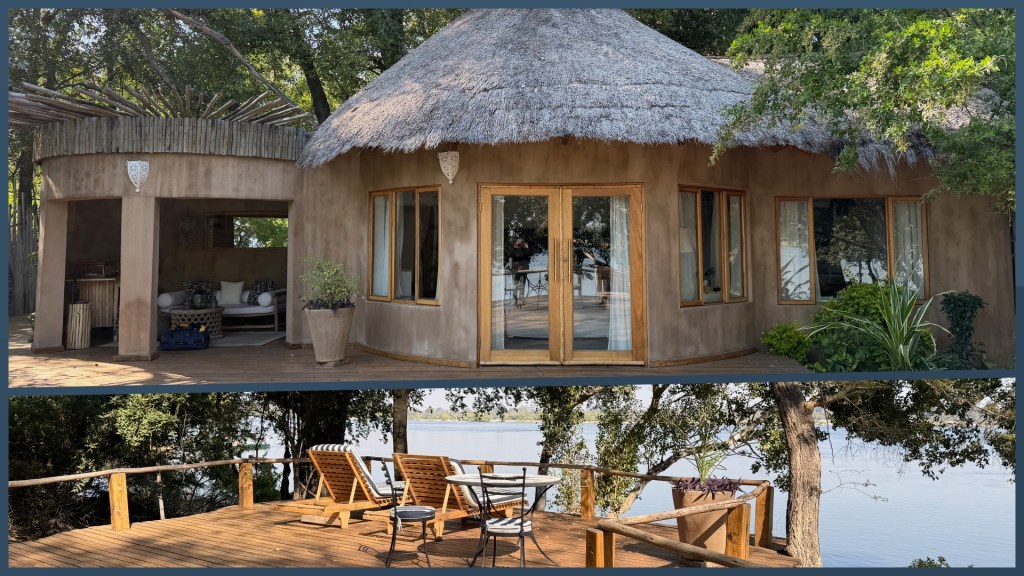
We were even assigned a personal butler, an attentive young man named Aggrey, who took us to another building overlooking the river where we could have a private lunch. At Bina’s request, he brought the chef over, a man named Emmanuel, to consult about her dietary restrictions.
We always find this necessary when we travel because most chefs, and kitchen help generally, don’t understand how sugar, which aggravates diabetes, is contained in a vast array of carbohydrates that Bina must therefore avoid. Emmanuel listened attentively and prepared a lunch of lamb kebabs in yogurt sauce that worked perfectly for her.
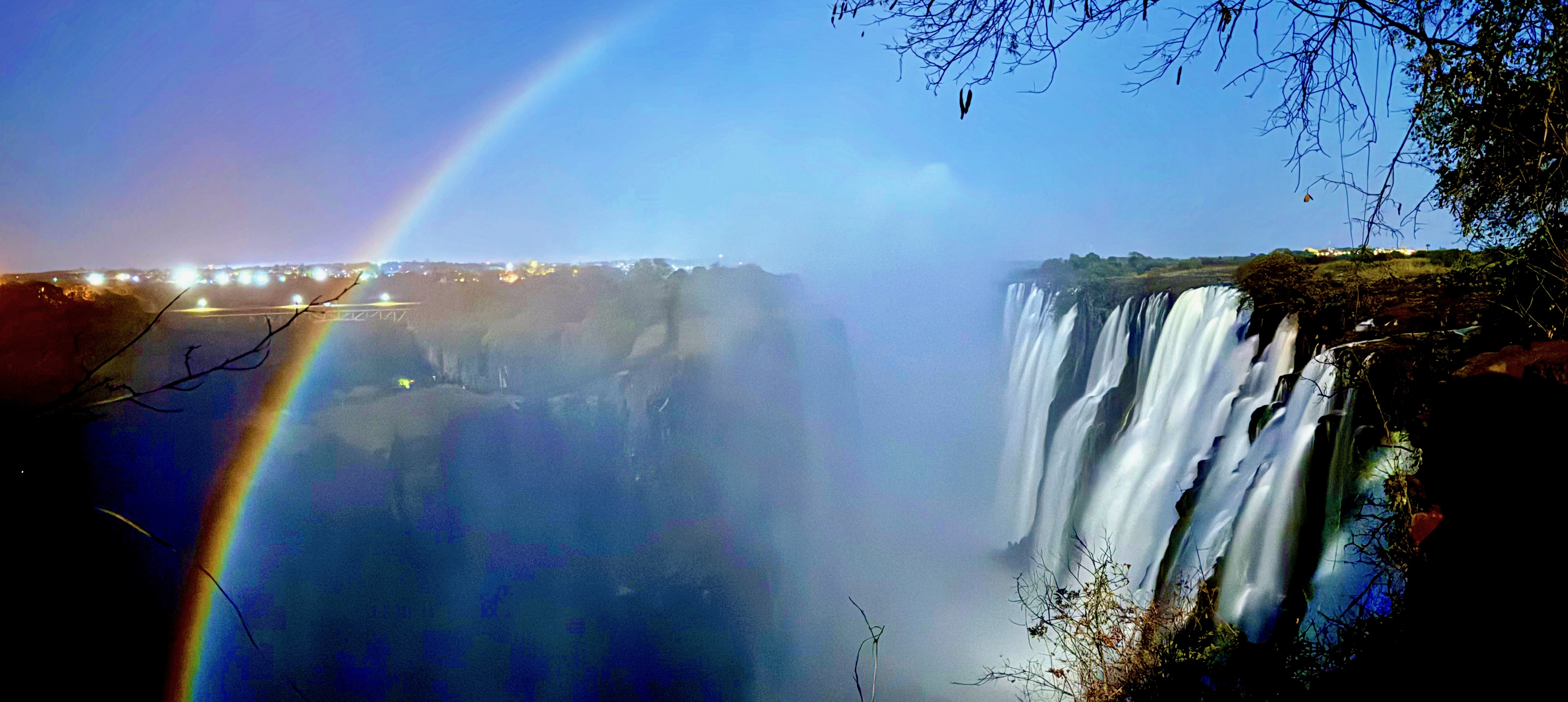
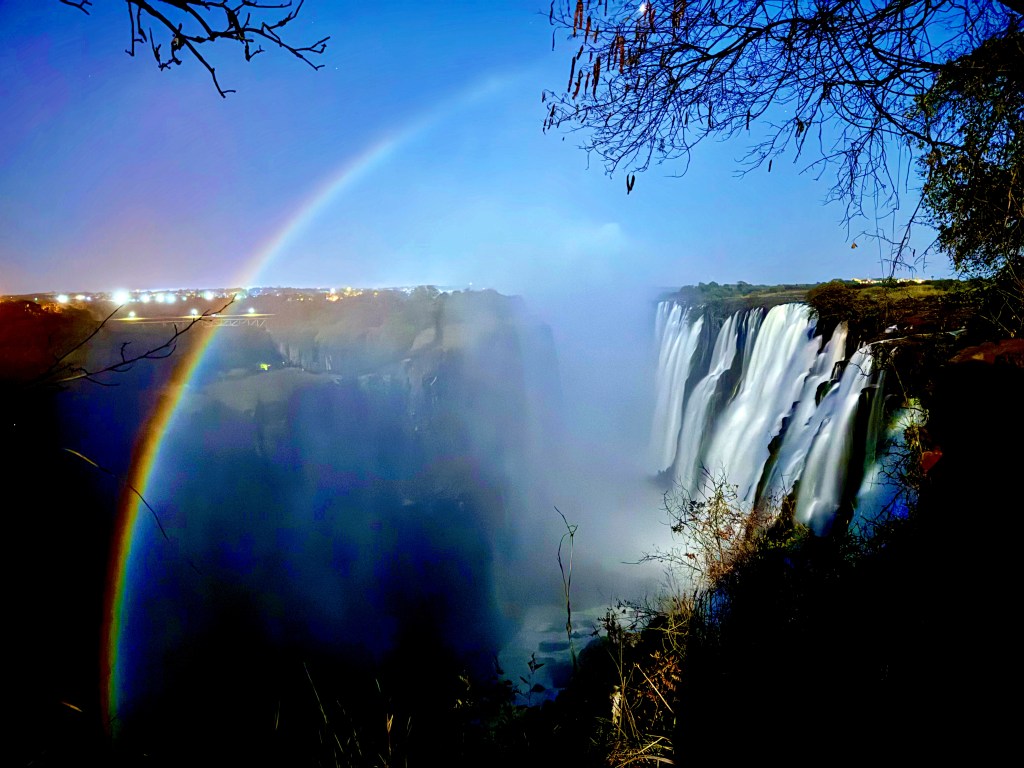
For our excursions at Tongabezi, the key person was Phixion, the guide assigned to work with us. For our first adventure, we asked him to take us to Victoria Falls that evening to see the “moonbow.” Also known as a “lunar rainbow,” this is an extremely rare visual phenomenon that can be seen in only a few places in the world, including Victoria Falls and Cumberland Falls in Kentucky, and then only during a full moon and clear sky.
Bina deserves credit for spotting this opportunity for us by noticing that Tongabezi Lodge advertised something called a “moonbow dinner.” What was that? She followed up to learn about moonbows and how our visit to this area happened to coincide with a full moon. Phixion drove us to the Victoria Falls park around 7 p.m. and took us to the spot offering the best view.
On our way back to Tongabezi, we learned why you often see “elephant crossing” signs on roads here, as the traffic in both directions halted for about 15 minutes to enable a family of five elephants to shuffle from one side of the road to the other. In the glare of vehicle headlights, it was like watching space aliens emerging from the dark.
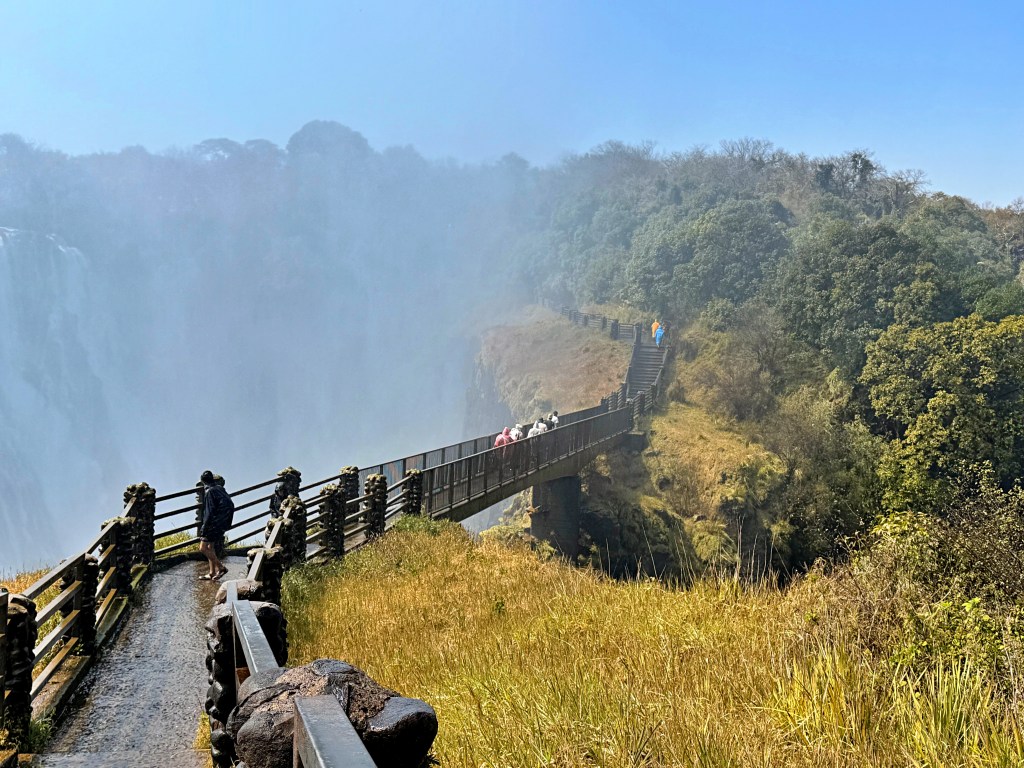
We returned to the Falls the next morning to walk around the rim and get some daytime photos. While not the highest or widest waterfall on earth, Victoria Falls does feature the largest single curtain of continuous falling water, spanning 1,708 meters (5,604 feet) wide and dropping 108 meters (354 feet) deep into the Zambezi River between Zambia and Zimbabwe. Note, however, that there’s not much to see on the Zambian side during the peak of the dry season (October and November) because the river channels the reduced water flow mostly to the Zimbabwean side.
At the current high river level, all that water vapour contributed to producing both the moonbow at night and a “double rainbow” during the day. This latter effect occurs when sunlight is reflected twice in the water droplets to create a second, fainter arc with reversed colors.
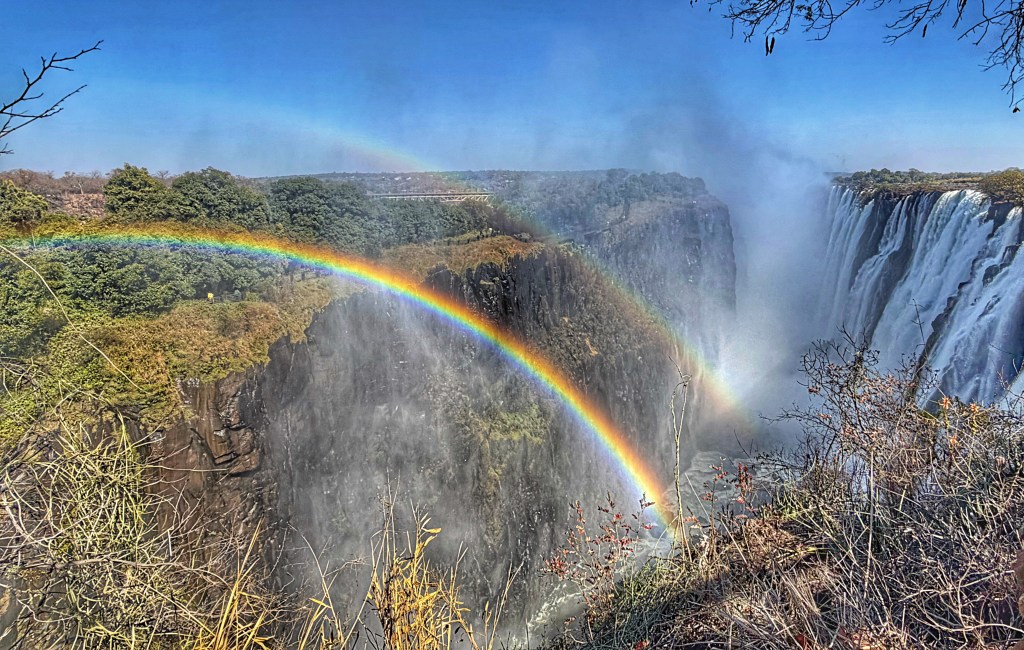
We also ventured onto the rim’s “wet trail,” where Phixion provided us with rainproof ponchos to walk through areas inundated with mist from the cascading falls. Ponchos or not, we were well soaked by the time we finished and welcomed the towels that he had also brought for us.
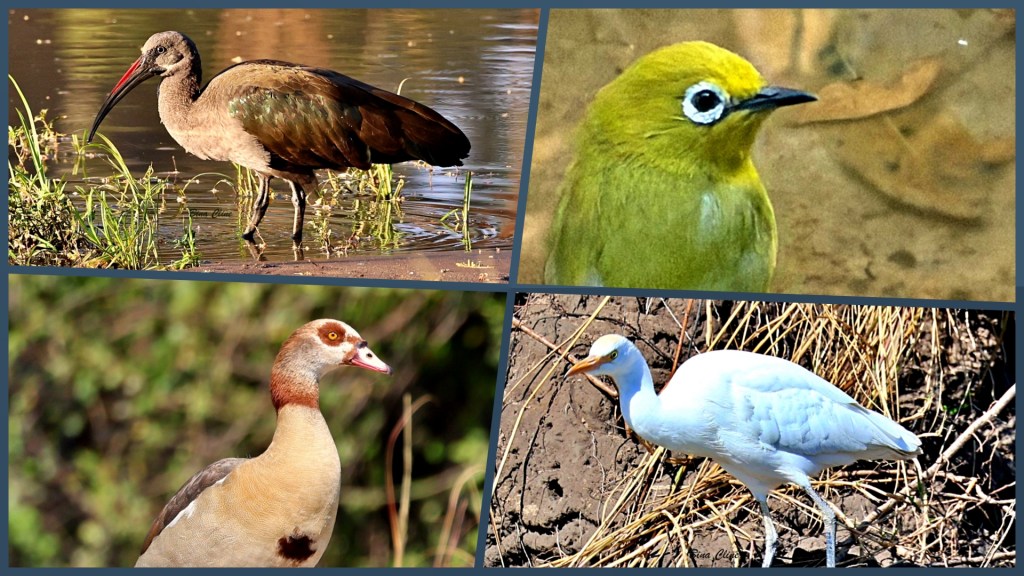
Phixion had been very helpful on these Victoria Falls excursions, but he also proved his value on the birding trips we took by boat on the Zambezi River downstream from the Falls, demonstrating both keen spotting skills and in-depth knowledge of the bird varieties. And compared to the Okavango Delta, where photography proved difficult because of all the dense marsh foliage, we were able to catch more birds in the open here.
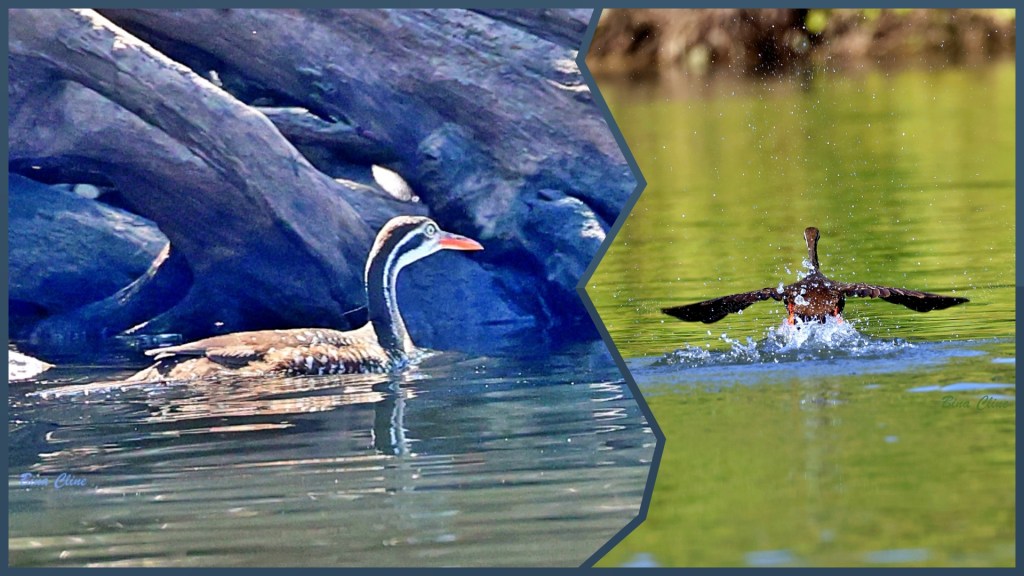
The highlight for us was finding the African Finfoot, an extremely elusive duck-like creature with a bright orange-red bill and fleshy lobes on its feet that resemble fish fins. Phixion spotted the bird, hidden in the tangled roots of some trees along the bank of an island in the middle of the river. A juvenile female, the finfoot was so well hidden that it took Bina and me a while to detect what Phixion was pointing at.
We were finally rewarded when the finfoot made an abrupt beeline across the open water to the opposite shore, which happened to be on the Zimbabwe side of the river. She moved fast, her fin-like feet paddling furiously behind her as Phixion revved his engine to keep up.
The finfoot disappeared for good upon reaching the heavily wooded other bank. We were heartened later to read in Google AI that sighting an African Finfoot is considered “a rare badge of honour for birdwatchers” because they “hide quickly at the slightest disturbance.” No kidding!
In addition to the boat excursions, Phixion took us in a safari jeep to view white rhinoceroses at a nearby park. There are only 11 of them in Zambia and nine of them live in this park, protected from poachers 24/7 by a team of armed rangers. Once inside the park, Phixion drove us to a spot where we met two of these rangers, who then escorted us on foot into the bush to an open area where three of the animals were nibbling away at some grass.
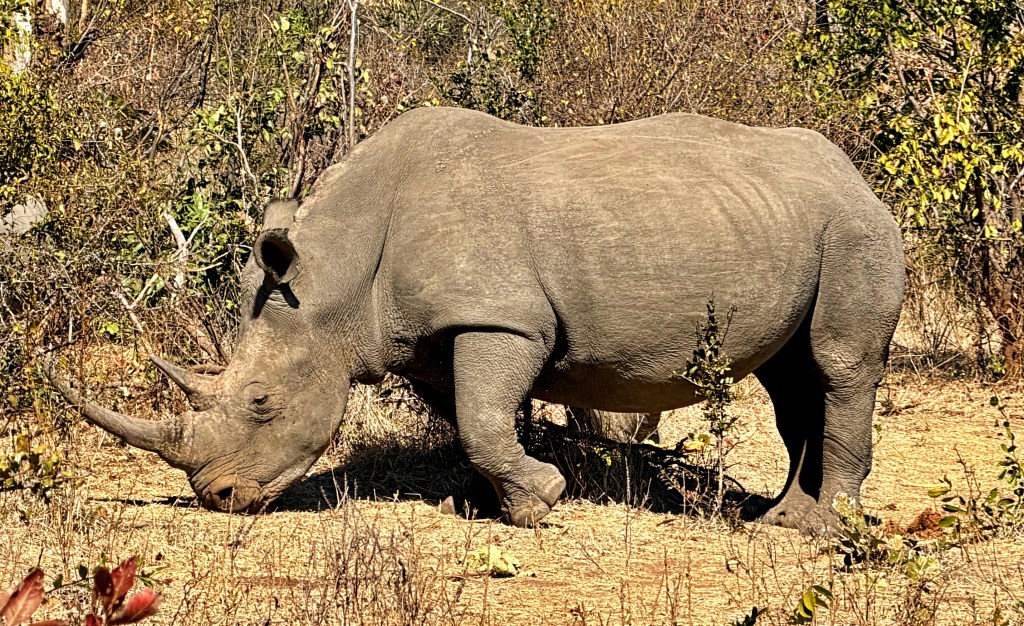
Fun fact: white rhinoceroses are not white, but of greyish hue. A linguistic error by English settlers in translating the Afrikaans word for “wide” (a description of its wide mouth) came out as “white,” a name that then stuck. For Bina and myself, seeing these rhinos up close made up for our experience in Tanzania, where we could only view one at a football field’s length away.
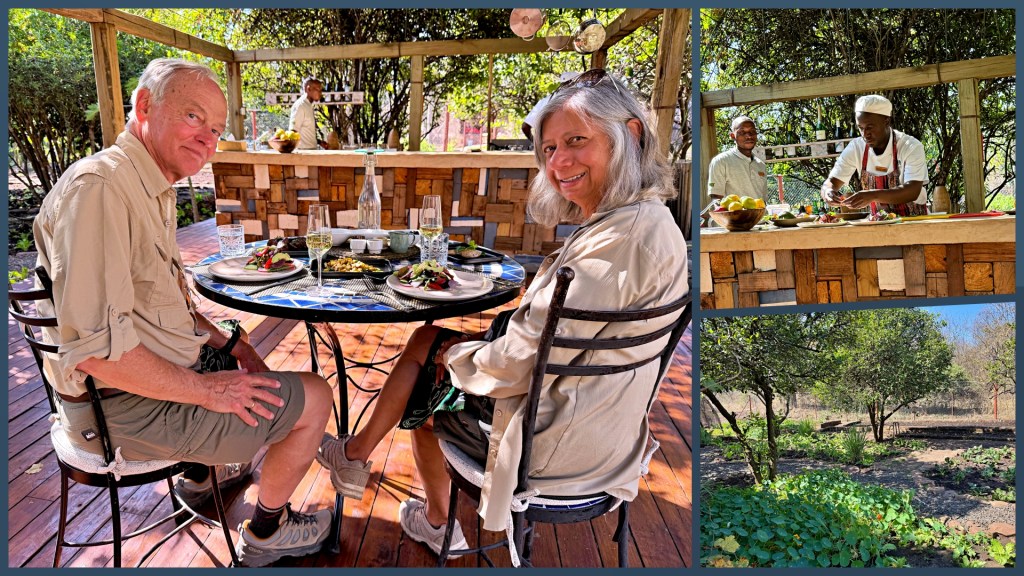
Our appreciation of the excellent personal service we enjoyed at Tongabezi includes the effort they took in helping us celebrate Bina’s birthday. We had returned to the lodge after the Victoria Falls double rainbow excursion expecting only the normal lunch at the restaurant facility. But Aggrey, meeting us in the parking lot, directed us instead to the lodge’s garden, which actually supplies most of the restaurant’s fresh herbs and vegetables.
A gardener named Harrison then led us through the garden to pick components for the meal they planned to prepare for us. We ended up enjoying a true open air, farm-to-table experience with salad, a spinach soup and a mixed chicken/beef grill prepared by chef Francis at the garden’s rancho, or outside cooking facility.
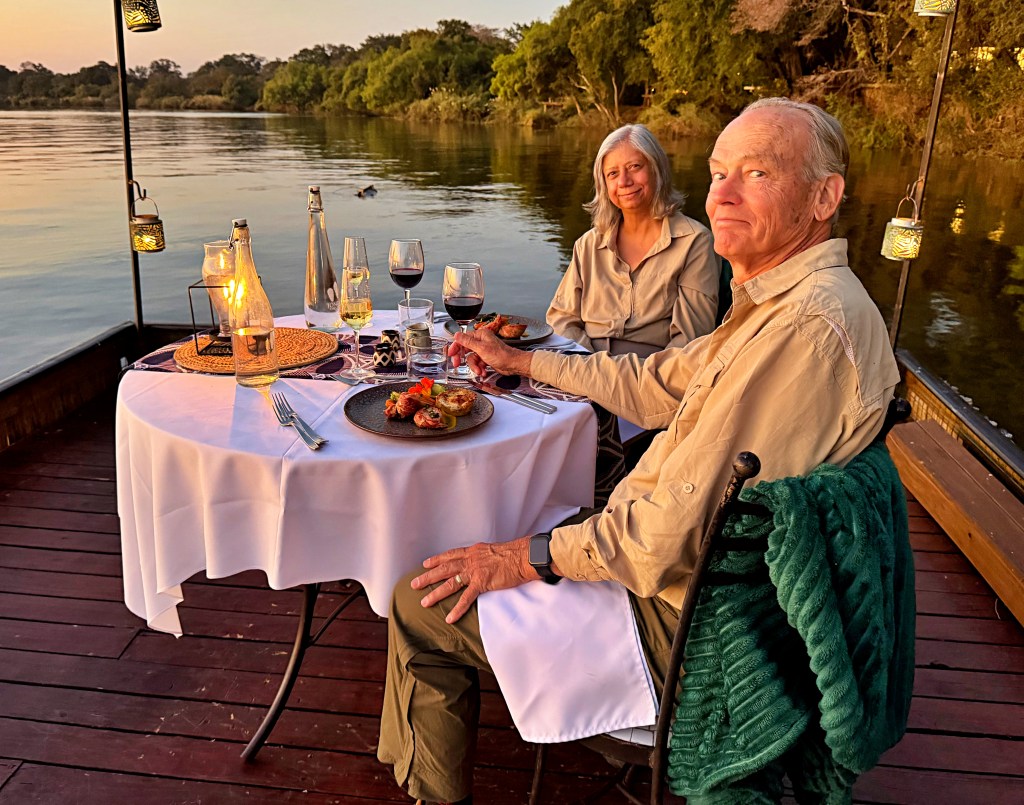
And if that wasn’t enough, we returned from a 45-minute sunset cruise that evening to find a small platform near the dock with a table covered with a white tablecloth and dinnerware, surrounded by candles, for the evening’s meal. Tongabezi labels this their “sampan dinner,” as you literally dine right on the river.
We enjoyed a delicious meal accompanied by a South African Cabernet and concluding with a chocolate cake made specially by Chef Emmanuel from almond flour, which is diabetes-friendly. As a final treat, a group of a cappella singers who work at the lodge (most from the grounds staff) came by to serenade Bina happy birthday with their perfectly synchronised harmonies woven into African rhythms, a memorable ending to a memorable day.
Travel tips: Tongabezi Lodge was unquestionably the highlight of our African safari from an accommodations and culinary standpoint. And thanks to Phixion, the birding was great as well. While the Victoria Falls area hosts many fine lodgings, both on the Zambia and Zimbabwe sides of the river, it’s hard to go wrong at the Tongebazi Lodge if you’re celebrating a special occasion.
We also liked what we saw of Zambia, which has won a reputation as one of the most stable democracies in Africa. It currently ranks eighth in the list of 10 most peaceful African countries (Botswana is number two), with low levels of civil unrest and violent crime. The country’s main problem is public debt ($32 billion) that equaled 93% of gross domestic product in 2025, but at least is below the 112% recorded in 2021.


Loving your adventure and looking forward to more posts and photos.
LikeLiked by 1 person
Thank you, Anonymous. One more coming after Victoria Falls.
LikeLike
This may be the best post I can remember in terms of writing and photos simultaneously. Both outstanding. The subject doesn’t hurt, of course. We’ve all been waiting for your take on Africa for sensitive but sensible people.
The moonbow photos are raising the bar! Don’t know how I’m going to be able to compete with that. Dang you, Bina! 😉 And the story made me want to cheer that you got to see a Finfoot.
Good job getting a couple of photos of yourselves. I travel alone and it’s difficult, as I’m not willing to hand my phone to just anyone (maybe my Airbnb host). Anyway, keep it up. Good to see you. I’m going to try harder to get myself in something I can post.
LikeLiked by 1 person
Bina and I thank you for your kind words, as usual, Clint. I’m glad you enjoyed the moonbow photo and finfoot story. We spent about 45 minutes going back and forth in our boat trying to get photos of that little rascal! As for getting photos of yourself, restaurant people are usually good at that. A good tactic is to offer to help a couple by taking a photo for them and then asking if they’ll return the favour. And there’s always the selfie, of course. I look forward to seeing your posts during your upcoming visit to Potsdam, Germany. And I encourage all our readers to check out your superb blog about that country at https://sitesinsights.com. Best wishes.
LikeLike
What a fabulous trip – and great photographs. I am most envious! Penny Rector
LikeLiked by 1 person
Thanks, Penny. We very much appreciate your kind comments!
LikeLike