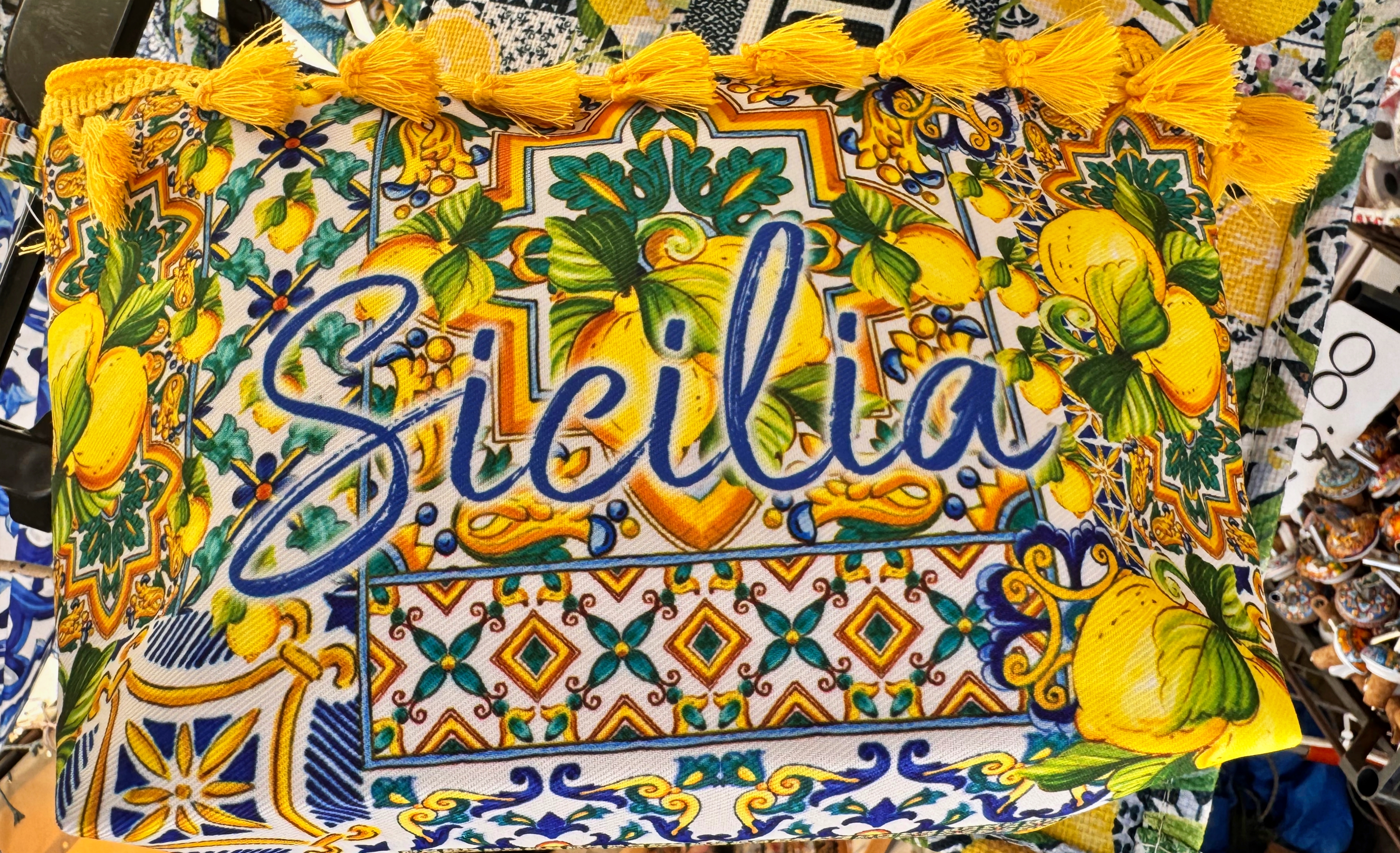
When Americans hear the name “Syracuse,” they’re likely to associate it with the city in central New York state. But the world famous Syracuse, the one celebrated in ancient times (and after which Syracuse, NY, is named) is the one in Sicily. The Italian name is “Siracusa,” pronounced with a rising accent on the final “a.”
Although the area around Siracusa has been inhabited for at least 8,000 years, the city itself traces its origins to 733 B.C., when Greek colonists arrived from Corinth. They settled on the island of Ortigia, just offshore, which is now the center of Siracusa’s old town. Over the centuries, Siracusa grew into one of the most prominent cities in the Greek Mediterranean world.
Athens suffered a catastrophic defeat here in 413 B.C., during the Peloponnesian War (Athens vs. Sparta), from which it never recovered. Nearly 200 years later, during another siege of the town, Roman soldiers killed Archimedes, one of the great scientists and inventors of the Hellenistic Age. The story goes that Archimedes was so absorbed with solving a mathematical problem that he ignored a solider’s order to accompany him.
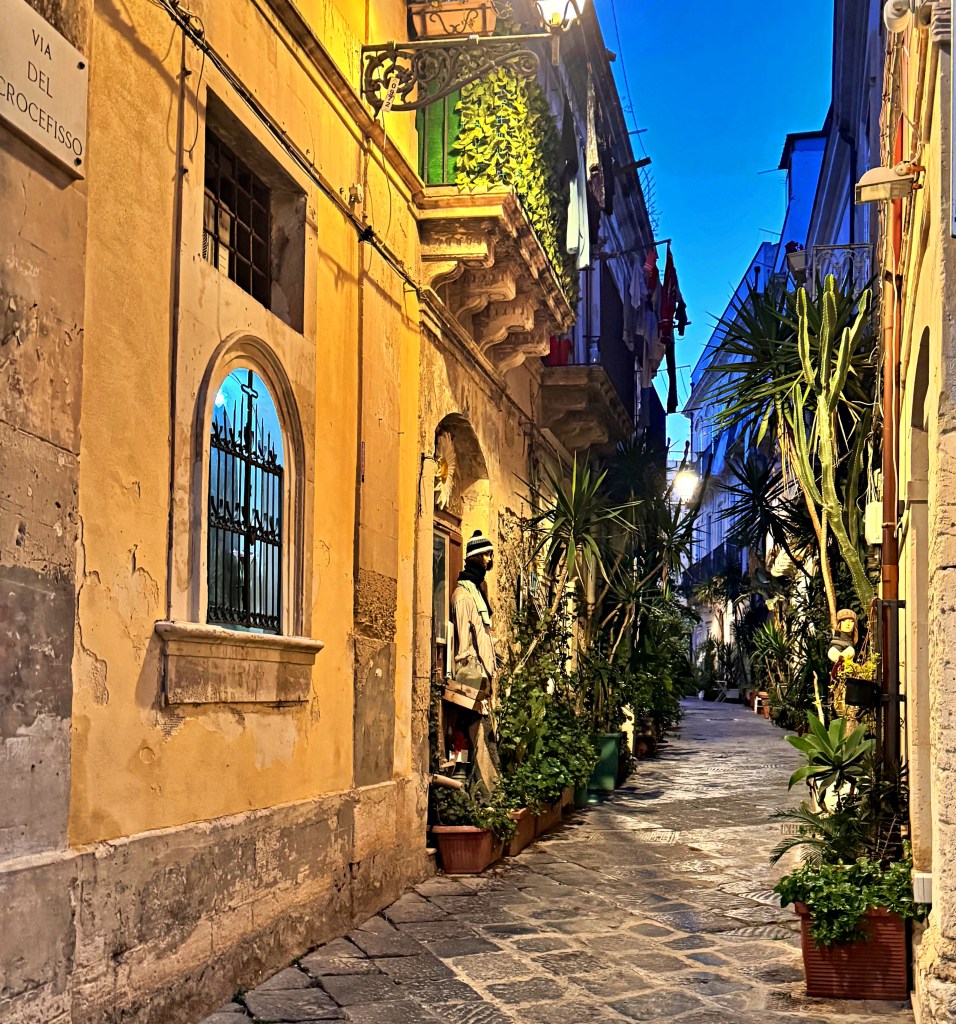
Like most visitors to Siracusa, Bina and I based ourselves in Ortigia, which can be a crowded and noisy place during the tourist season. Fortunately, the apartment we rented for three nights was tucked away on a quiet pedestrian lane. Since the entire island of Ortigia is only one square kilometre in size, we could reach every place of interest within a ten-minute walk.
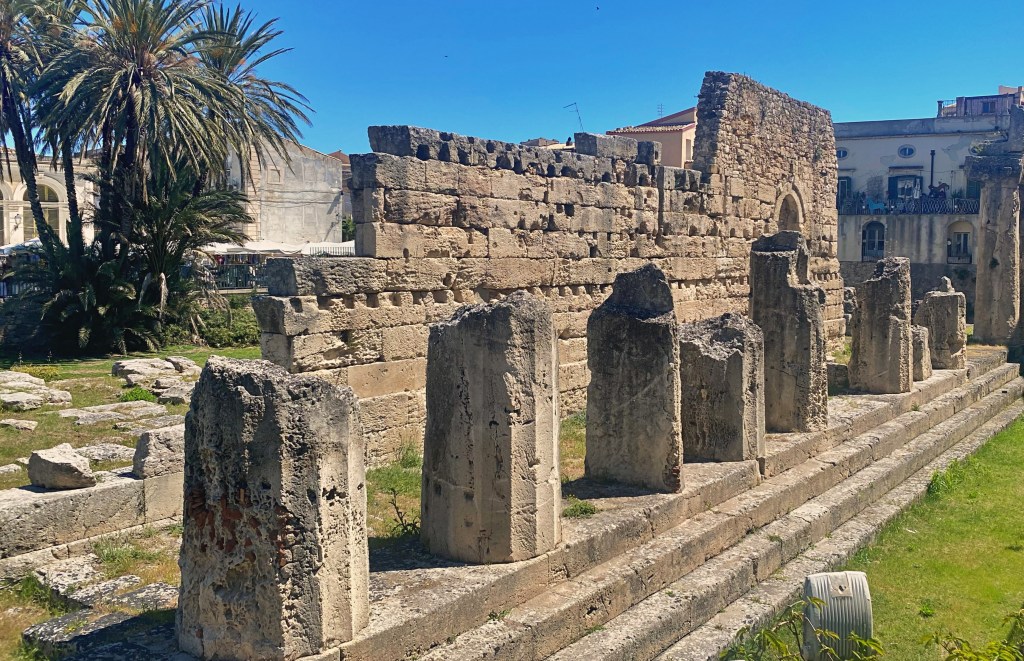
That included the ruins of the temple of Apollo. Built in the ancient Greek “Doric” style (as opposed to Ionic or Corinthian), this structure dates to the 6th century B.C. and survived much subsequent repurposing — Byzantine church, Islamic mosque, and Spanish military barracks — before being restored to its classical Greek appearance in the late 19th century.
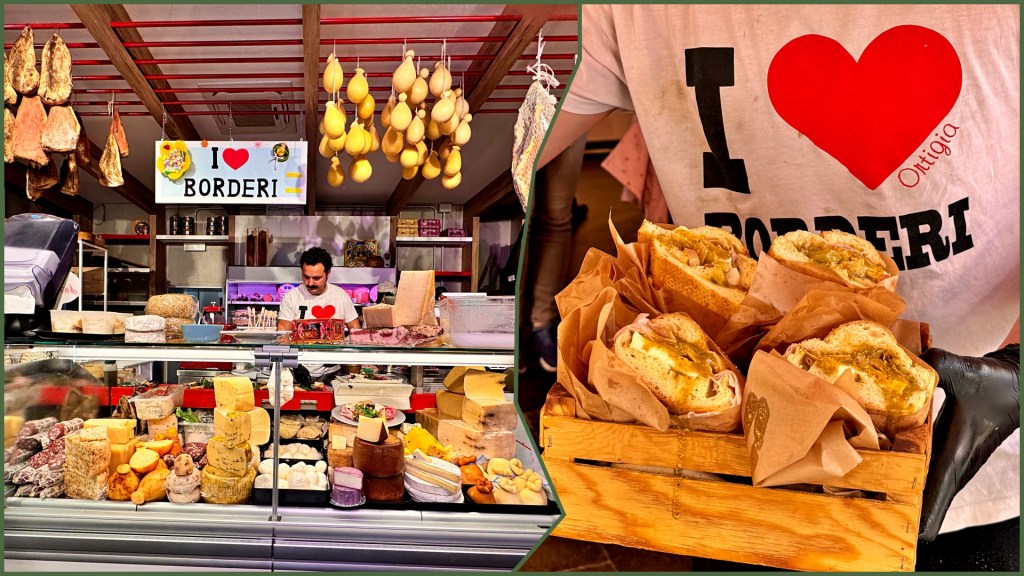
Just around the corner from the temple is the Ortigia street market, a pedestrian lane lined with purveyors of farm produce and artisanal food items along with many small restaurants specialising in the local cuisine. This is where you can pick out fresh fish to be cooked on a grill — if you’re lucky enough to snag a table amid the crowds.
One famous restaurant we could not afford to miss was Borderi, which serves probably the largest sandwich you’ve ever seen, crammed with fresh prosciutto or salami, mozzarella, sun dried tomatoes and arugula. Bina and I shared half of one and, even then, failed to finish it all.
Food has to be a major theme for any visit to Sicily. We enjoyed one of our best meals on the island at the Taberna Russo. The meal began with two starters, carponata and a veal carpaccio, followed by a main dish of mixed grilled meat. All this was accompanied by a local wine made of two Sicilian grapes, Nerella Mascalese and Nocera. We couldn’t resist finishing up with a chocolate lava cake. Afterward, the manager treated us to small glasses of Amaroe liquor as a digestif.
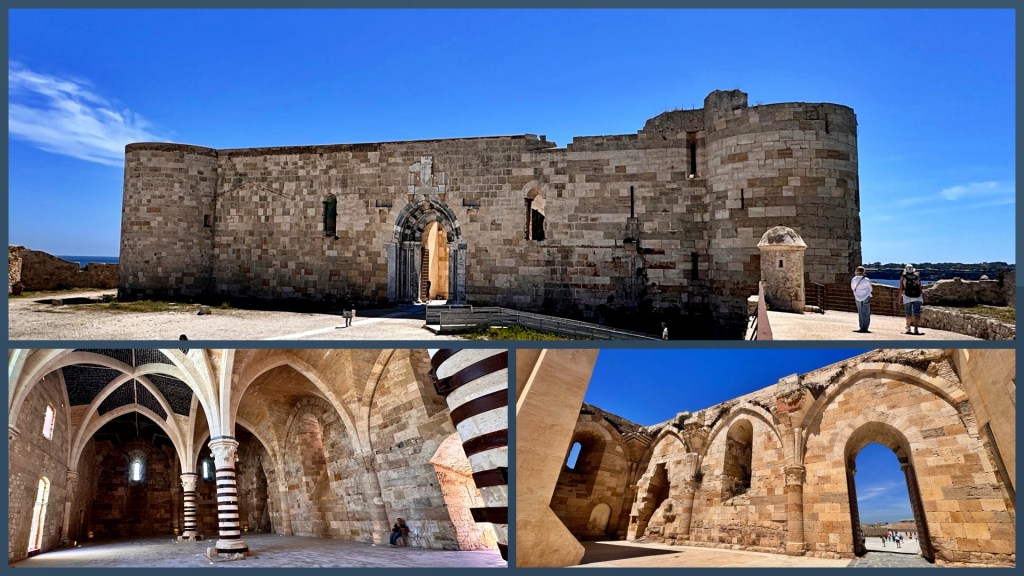
At the tip of Ortigia’s promontory sits the Castello Maniace, named for a Byzantine general* who began the process of winning Sicily back from the Muslims in the 11th century. While the Byzantines built a small fort on the site, the structure you see today was constructed two centuries later by a German emperor whose domains included Sicily. A visit here is worthwhile mainly for the views you get from walking along the fortress ramparts.
While tourism in Siracusa is inevitably focused on Ortigia, the mainland part of the city features one must-see site: the Neapolis Archaeological Park, a fenced-in area spanning 35 hectares that contains both a Greek theatre and Roman amphitheater, or Colosseum.
The theatre is one of the largest in the Greek world and notable for being cut directly from the limestone of its surrounding hillside. While the original structure might have been built as early as the 5th century B.C., the current layout dates from the Hellenistic period, 200 years later, when Siracusa was a major power in the Mediterranean.
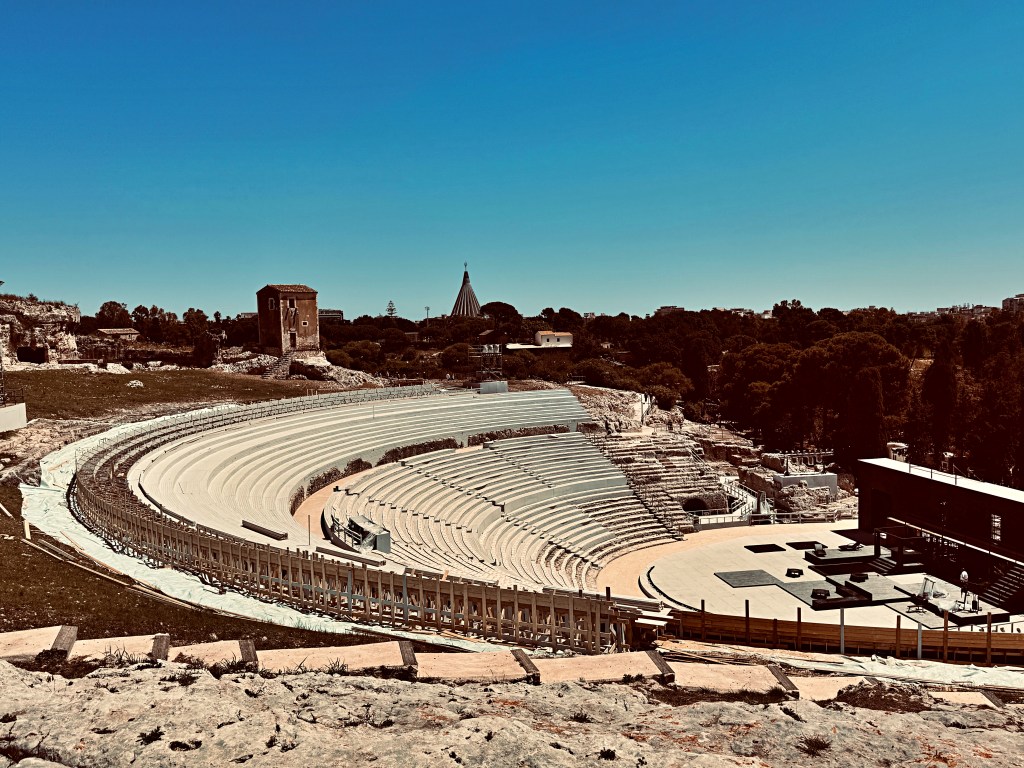
The installation of modern seating and a backdrop on the site enables the theatre to be used during the summer months for the production of plays and other theatrical events. The performances begin at sunset and don’t require modern audio enhancement because of the excellent acoustics provided by the limestone enclosure. Bina and I hope to return someday for a live performance here.
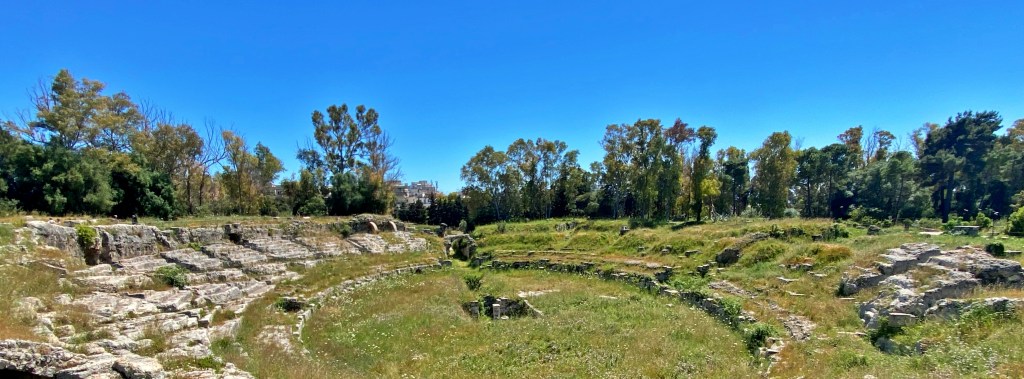
The other major structure in the park is the Roman Colosseum, which likely dates to the first century. The extent of the structure is impressive but compares poorly with other Roman amphitheatres we have visited in Rome itself and Merida, Spain. The foundations are overgrown with weeds and lack informational signs; the park authorities clearly devote most of their budget to the theatre.
Any tour of the archaeological park wouldn’t be complete without peering into the “Ear of Dionysus,” a cave entrance shaped very much like a human ear. The name comes from the Italian Renaissance painter Caravaggio, who was inspired by old legends that Dionysus I, an ancient Greek tyrant ruler of Syracuse, held prisoners in the cave so that his guards could utilise its perfect acoustics to eavesdrop on their conversations.
We can indeed testify that any little hoot or clap that you make in this space will instantly echo back to you.
- This battlefield successes of this Byzantine general, George Maniaces, stand as a remarkable exception to Byzantium’s military decline during the 11th century. I was interested in seeing the castle because I wrote an article about Maniaces in 2014 for the magazine Medieval Warfare that I can email to anyone with an interest.


Now I know how to begin a visit to Syracuse — the first one. 😉 Thanks!
LikeLiked by 1 person
Well, I’m sure Syracuse, N.Y., is a nice place but …
LikeLike