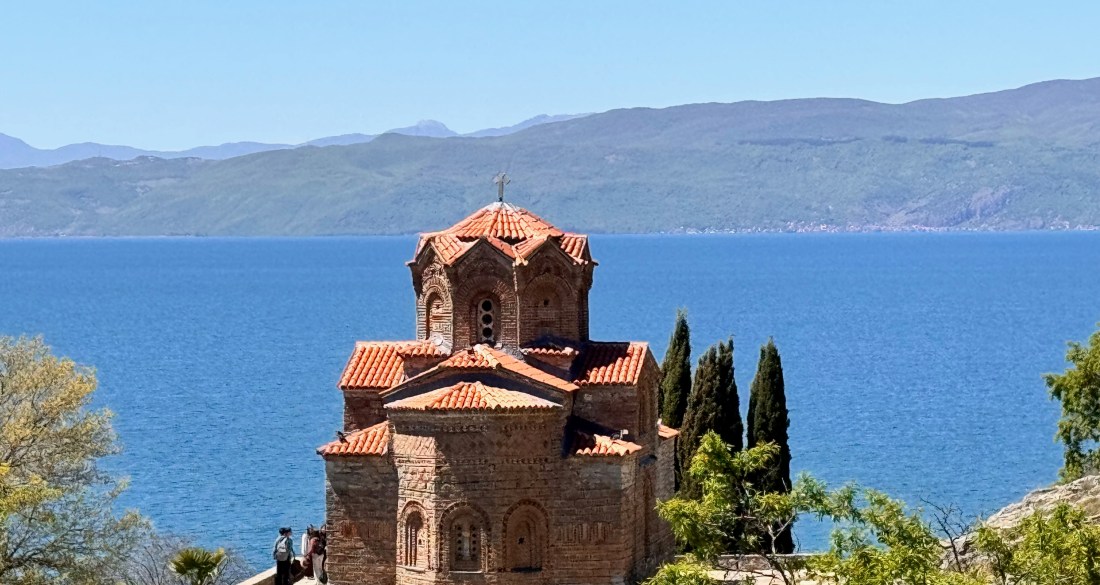
The town of Ohrid, on North Macedonia’s southeastern border with Albania, is all about the lake — at least insofar as tourists are concerned. That’s Lake Ohrid, the second largest in the Balkans (358 sq. km) after Lake Skadar (530 sq. km), which straddles the border between Albania and Montenegro. The blue water surrounded by green forest reminded us of Slovenia’s Lake Bled, which we had visited in 2024.
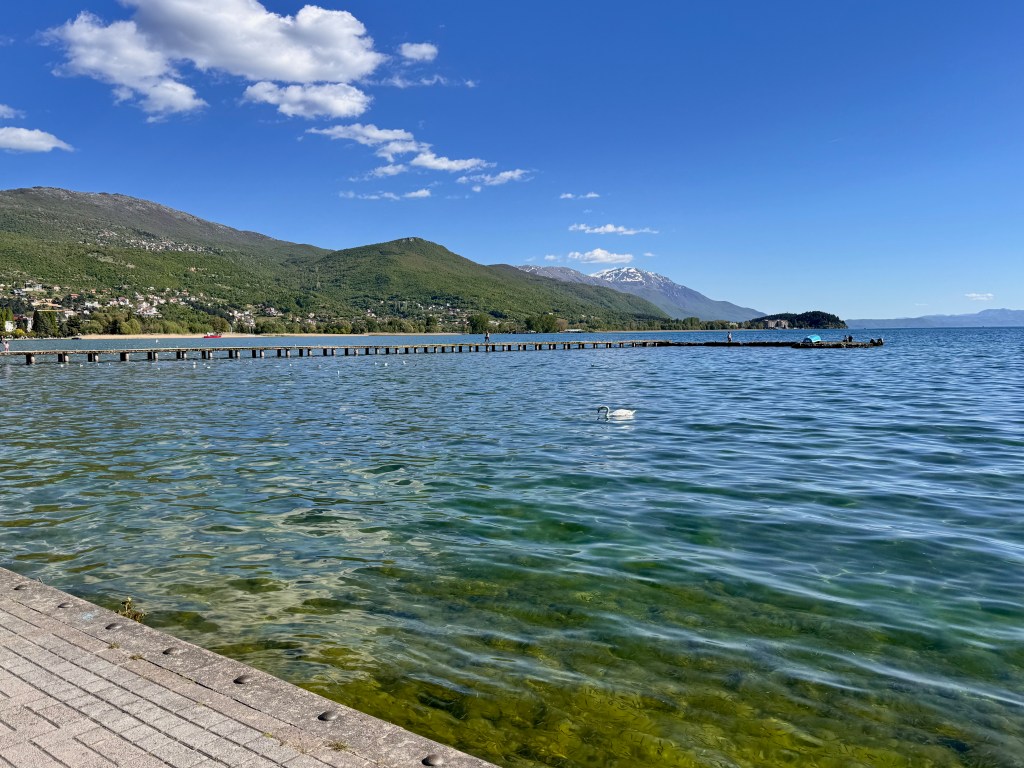
The town of Ohrid itself, which is only a half hour drive across the border, has origins that stretch back 2,400 years. At its peak, during the Middle Ages, Ohrid was a center of Slavic culture, religious life and political power. The combination of stunning lake with historic town have earned this area a UNESCO World Heritage Site designation.
During our two-night stay in Ohrid, we rented an apartment located in a quiet residential neighbourhood about a 20-minute walk from the old town. After Max, our Albanian driver, dropped us off around 3 p.m., we still had time to walk to the waterfront area to enjoy a late lunch at a restaurant table overlooking the lake. Relaxing with a couple of glasses of local white wine to accompany eggplant moussaka and local trout grilled in a truffle sauce seemed like a good way to begin our visit.
The next morning, we took a waking tour through the old town in a small group led by a guide named Apostolis, a personable fellow who had been born in Ohrid and earned a degree in hotel management from a university in Greece. He began the tour with a stop at the St. Sophia church, which dates back to the 10th century.
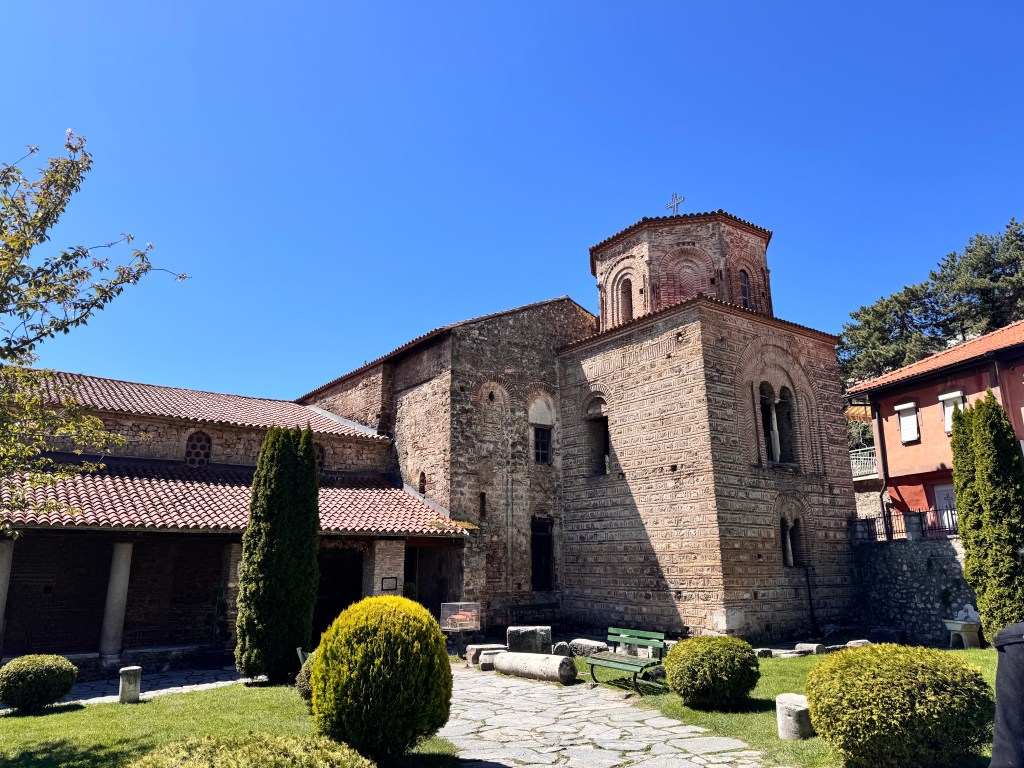
Between the 9th and 14th centuries, Ohrid became famous for its church building, with the total reaching 365, one for each day of the year. The town became known during that period as the “Jerusalem of the Balkans.” Many of these structures were destroyed or converted into mosques during the Ottoman period (1395-1912) but we can be thankful for the outstanding examples that remain.
Going further back even further in historical time, Apostolis took us to the ruins of an ancient Greek theatre, built in 200 B.C., which was later repurposed by the Romans for their gladiator games. We also admired some mosaics dating from the Hellenistic period that were unearthed in a recent archaeological dig.
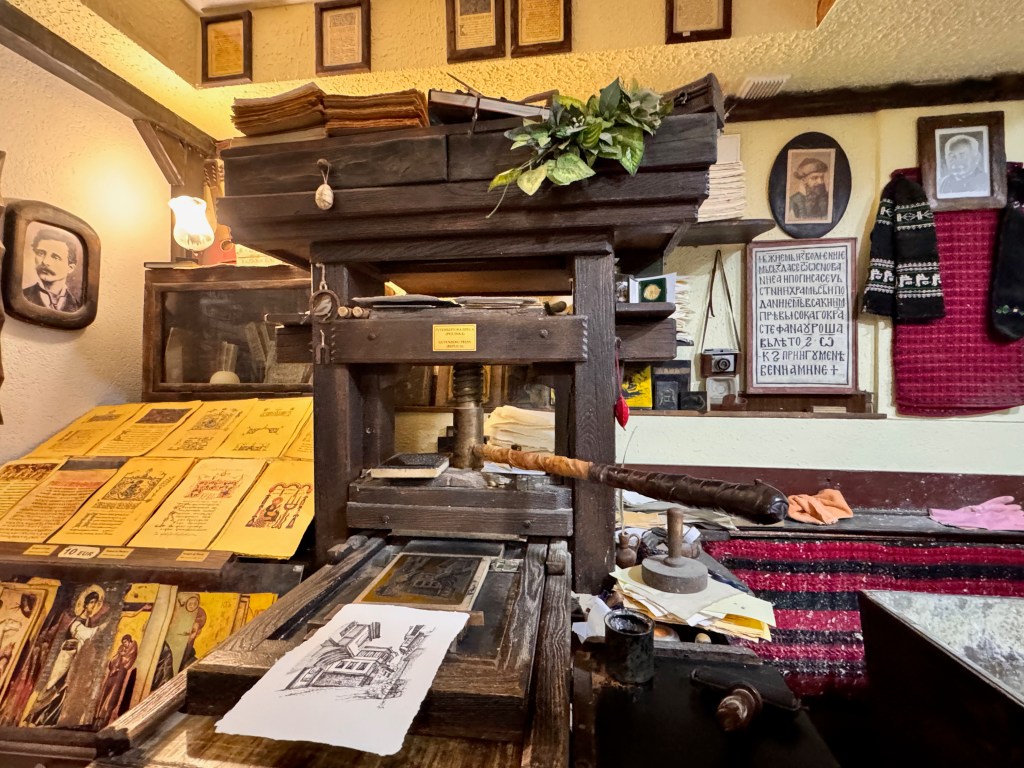
Another attraction in Ohrid’s old town is traditional artisanal crafts. In one shop, we viewed a replica of the Gutenberg Press (one of only three existing in the world today) which is used to print on traditional hand-made paper based on tree fibres. The owner of another shop hand carves mostly traditional religious designs in the local walnut wood. And numerous shops and stalls around the St. Sophia church sell jewellery utilising the “Ohrid Pearl,” an artificial gem made from the crushed shells of mollusks and the scales of a fish that lives only in Lake Ohrid.
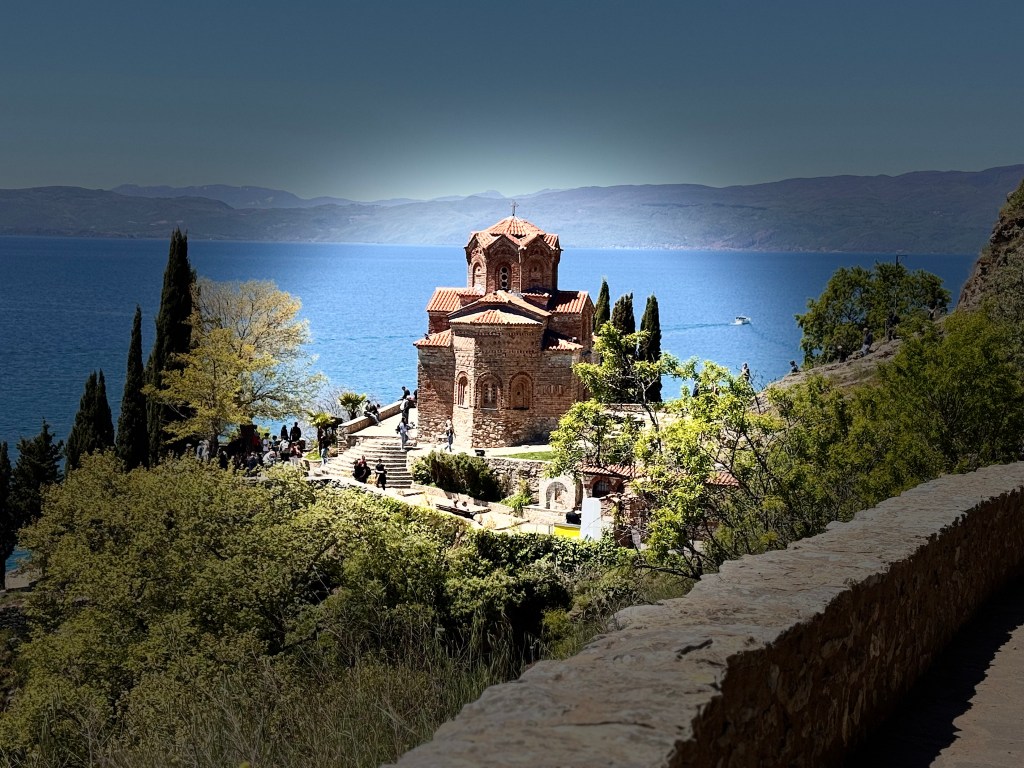
We finished our walk at the St. John church in Kaneo, which is former fishing village just outside of Ohrid. While this church does contain some faded medieval frescoes, like St. Sophia, its main attraction is its photogenic hilltop location overlooking the lake.
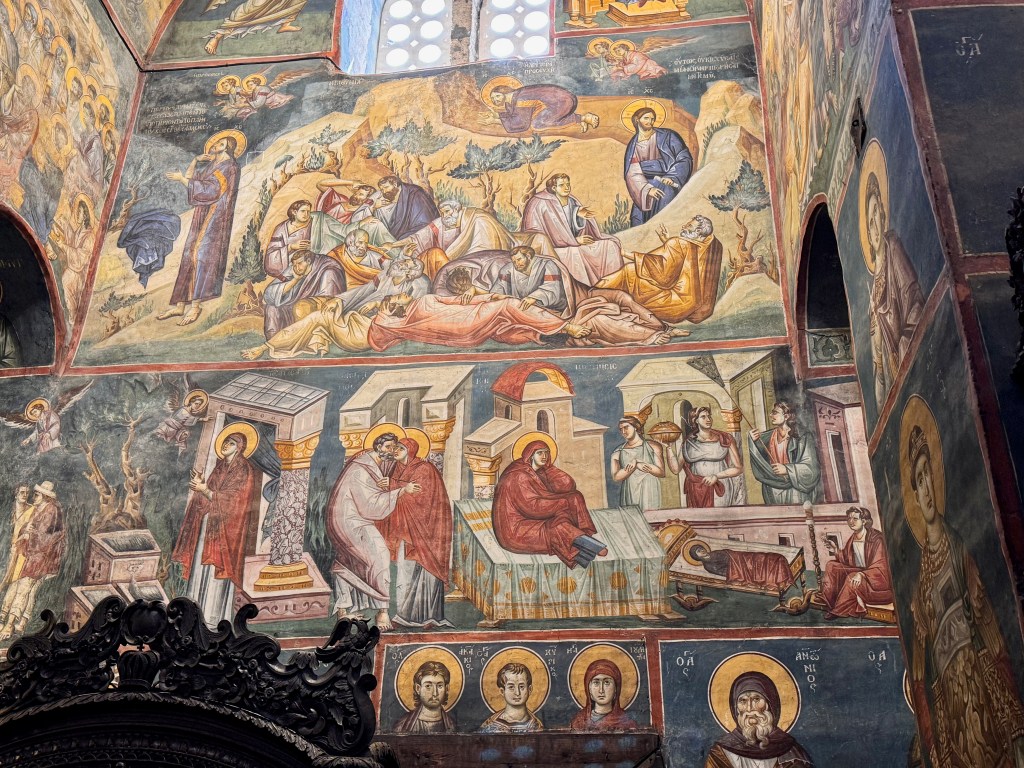
Apostolis left us with a useful tip: for the best medieval frescoes in town, check out the 13th century Church of the Blessed Virgin Mary, which is located on a hill overlooking the town itself. We did that the following day and found these well-preserved wall paintings to be truly stunning.
That same day, we also joined an hour-long lakefront cruise with a guide named Demitry, who lives in North Macedonia’s capital of Skopje but works in Ohrid during the tourist season. Dimitry steered us along the waterfront to view the beaches —quiet now, but packed with people during the summer months. We also passed by a villa built for former Yugoslavian dictator Josef Tito and now used by the current president of North Macedonia.
Dimitry said much of this waterfront property is being grabbed illegally by private developers despite UNESCO historical district restrictions that supposedly reserve the land for public use. It’s a gradual encroachment. One year, a fence appears, the next year year you see evidence of excavations, and then, suddenly, a building materialises on the site as the authorities turn a blind eye. High level corruption is a problem throughout the Balkans.
Max, our Albanian driver, returned to Ohrid later that afternoon to take us to the airport back in Tirana. On the way out, he stopped at the 16th century St. Naum Monastery on the southern side of the lake, which is considered Ohrid’s second most scenic church after St. John’s. We didn’t have time to go inside but did snap a few photos from the lakeside.
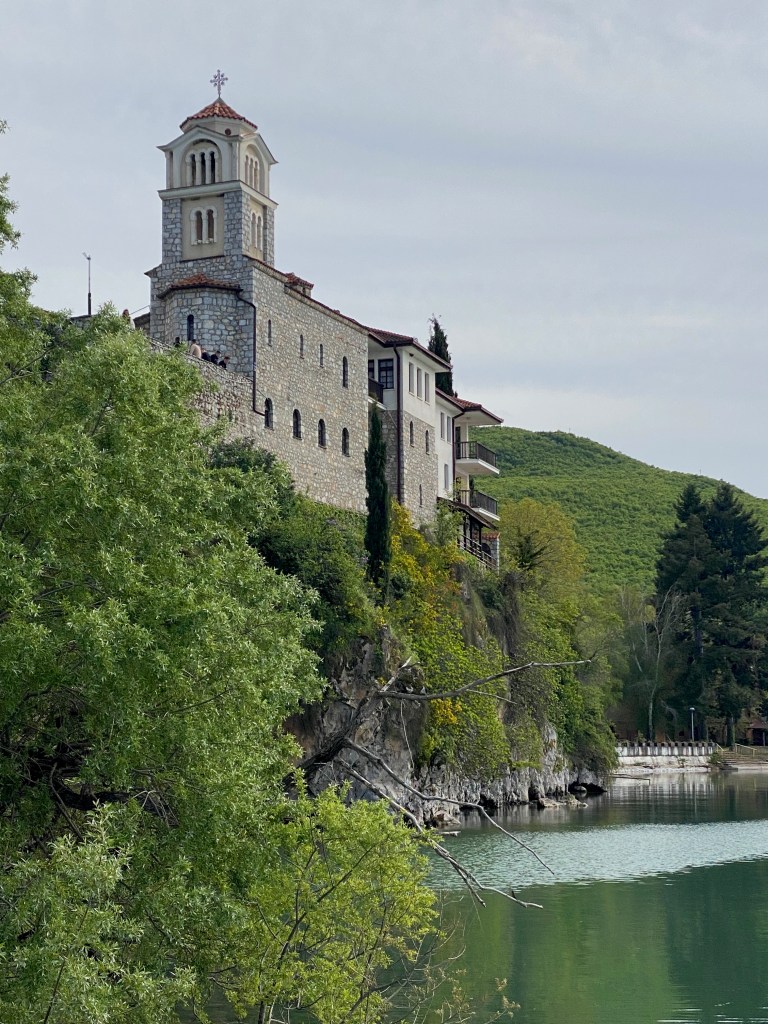
The St. Naum monastery is named after a priest who, along with a fellow cleric, St. Clement, founded a school in Ohrid in the 9th century to teach the Bible in Slavic languages.* Both Naum and Clement were students of Saints Cyril and Methodius, the two brothers who invented the Cyrillic alphabet and helped spread Orthodox Christianity through the Balkans.
Ohrid may be valued by modern visitors mostly for its beaches and scenic splendour, but back in the day it was more about the churches.
Travel tips: We can’t generalise too much about North Macedonia (pop. 1.8 million), having seen only a small slice of the country. But we can say that the Lake Ohrid district is comfortable and hospitable for modern travellers. It helps that English is widely spoken and even used on road signs, along with Macedonian and Albanian. While North Macedonia has its own currency, the denar, most restaurants and hotels in Ohrid take credit cards. You only need to keep a few denars on hand for small shops and taxi rides.
- Macedonian itself is considered to be a separate language within the “South Slav” group that includes Bulgarian, Slovene and Serbo-Croatian. It has a high degree of similarity to Bulgarian, reflecting the fact that this territory was incorporated into Bulgarian territory between the 7th and 14th centuries. Ohrid was actually the capital of the First Bulgarian Empire at the turn of the 11th century, with Bulgarian Tsar Samuel building the castle that now overlooks the town. This connection has caused problems in modern times. Bulgaria is blocking North Macedonia’s entry into the EU because of a dispute over how many Bulgarians should be given official status as a “minority” population within North Macedonia. Greece and North Macedonia also had a long argument about the right to claim the name “Macedonia” (half of Greece consists of a region going by that name), which is why this country had to add “North” to its name. Only then would Greece agree to accept it into the EU. In the Balkans, ethnic disputes are everything.

