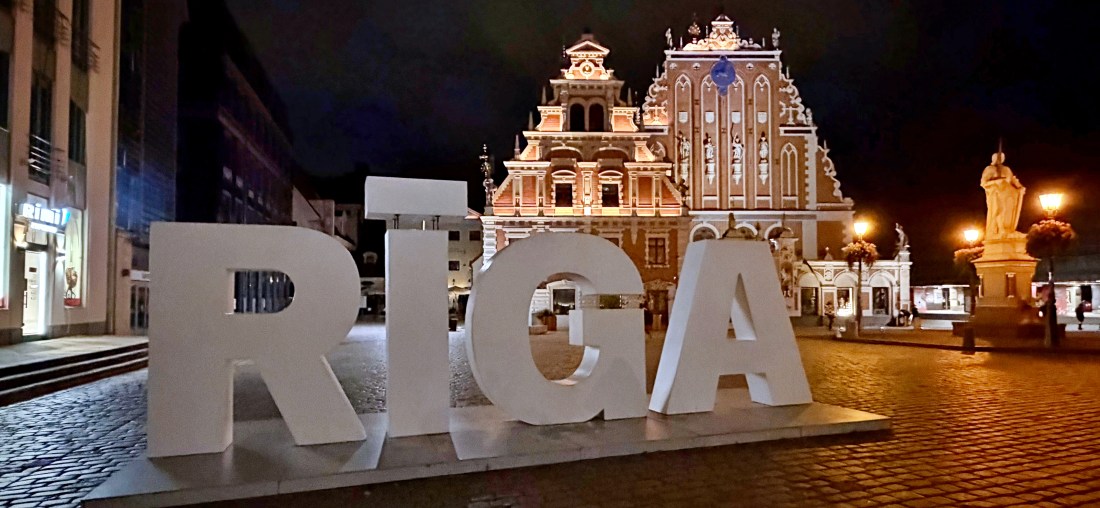
Riga is where the Baltic States’ famously fickle weather caught up with us.
We had been dodging rain forecasts throughout our trip but had so far managed to escape with only a minor shower here and there. That good luck ran out in Riga, where our one full day in the city was so rainy we found no point in joining a walking tour. We just had to hunker down and make the best of it.
The afternoon we arrived, when the skies still showed lots of blue, we immediately went for a walk around the old town to get a general feeling for the place. The next day, the rainy one, we ventured out a few times when the rain briefly eased.
Between the two days, we patched together an overview of Riga’s major sites. It helped a lot that the old town, like the one in Tallinn, is very compact, covering only 94 hectares, the smallest among the Baltic States’ capital cities. We benefited from our hotel being only a few blocks away, so we could scurry back when the rain became too much. It also helped that we could access good restaurants close by.
On our first evening, for example, we had dinner at the Milda Restaurant, which specializes in traditional Latvian food. Bina and I shared a large appetizer plate packed with various cheeses, pates, pickled cucumber, cold herring, pork lard (surprisingly tasty) and garlic bread. The latter was quite different from the baguette-style garlic bread you find in Italian restaurants; here, they take dark rye bread cut into strips, bake until crispy and then rub with fresh garlic and salt – delicious!
One must-see attraction in Riga is the House of the Black Heads, a 14th century guild hall for merchants that exuberantly combines medieval Gothic and Flemish Renaissance architecture. The ostentatious beauty of the building underscores the wealth flowing into the city between the 13th and 15th centuries. As a member of the Hanseatic League of trading cities, Riga became the primary port for connecting Russia with western Europe for the trade in wax, fur, timber, flax and amber.
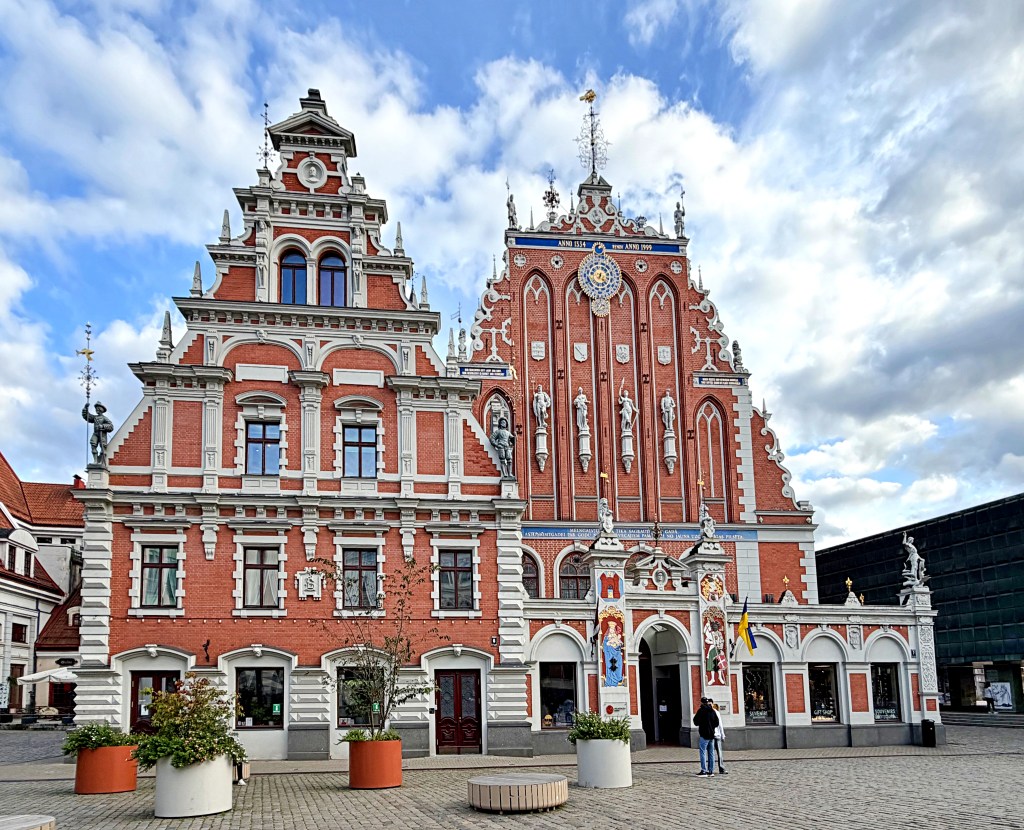
As for the building’s name … the merchants adopted St. Maurice as their patron protector; he was an officer in the Roman army of the third century martyred for his Christian beliefs. Since Maurice came from Egypt — mauricius in Latin translates as “like a Moor,” or “dark-skinned” — he is typically portrayed in medieval European art as a black man, hence “house of the black heads.”
The building you see today, however, is a complete reconstruction done about 30 years ago, which is why it looks so well preserved. Only the foundations, the ruins of which can be seen in the basement, remain from the original structure. Everything above ground was heavily damaged during World War II and then demolished by the Communist era government in 1948.
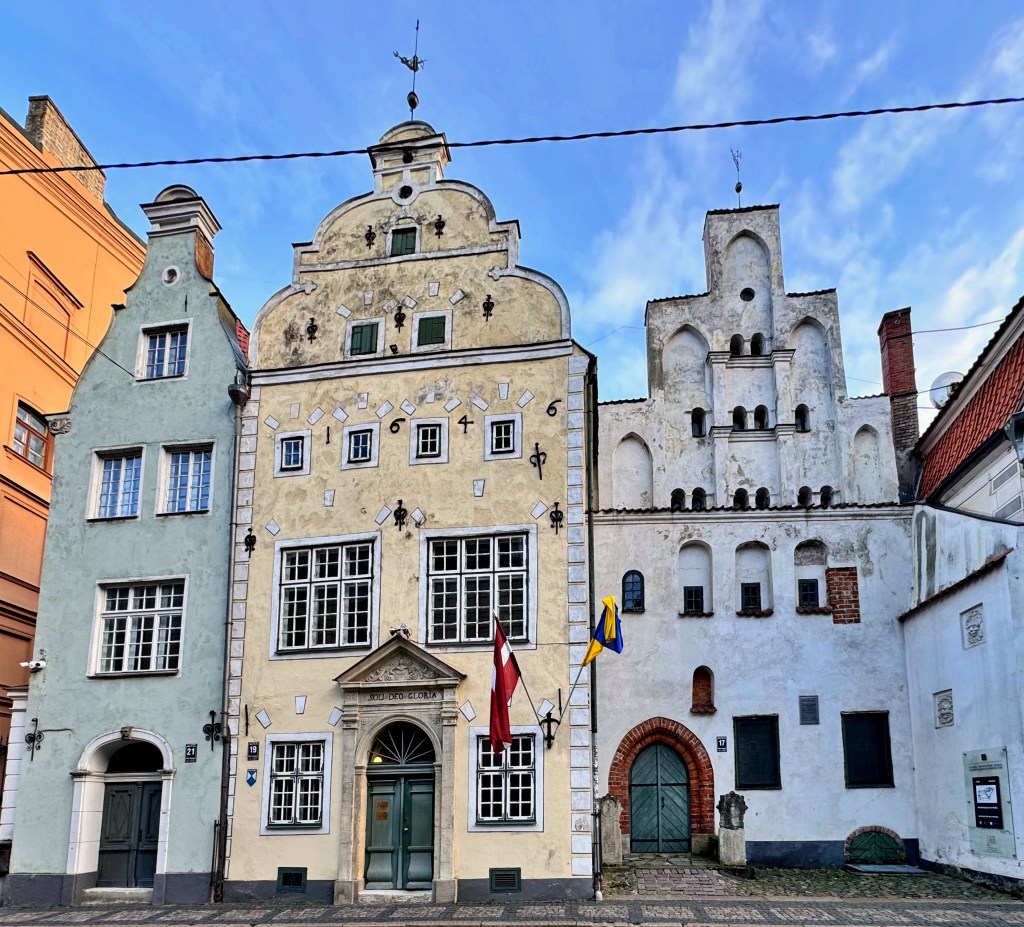
The Houses of the Three Brothers, another top landmark, survived the centuries fundamentally intact, with some restoration work done in the 1950s. These three adjoining buildings form the oldest residential building complex in Riga, showcasing the evolution of domestic architecture from the Middle Ages to the late 17th century, spanning Gothic to Baroque.
Riga’s second period of architectural splendour occurred during the late 19th and early 20th centuries when it was part of the Russian empire at a time of rapid growth and industrialisation.* Much of the wealth created during this economic boom shows up in a plethora of buildings in the then-popular Art Nouveau style, of which Riga has more than any other city in the world.
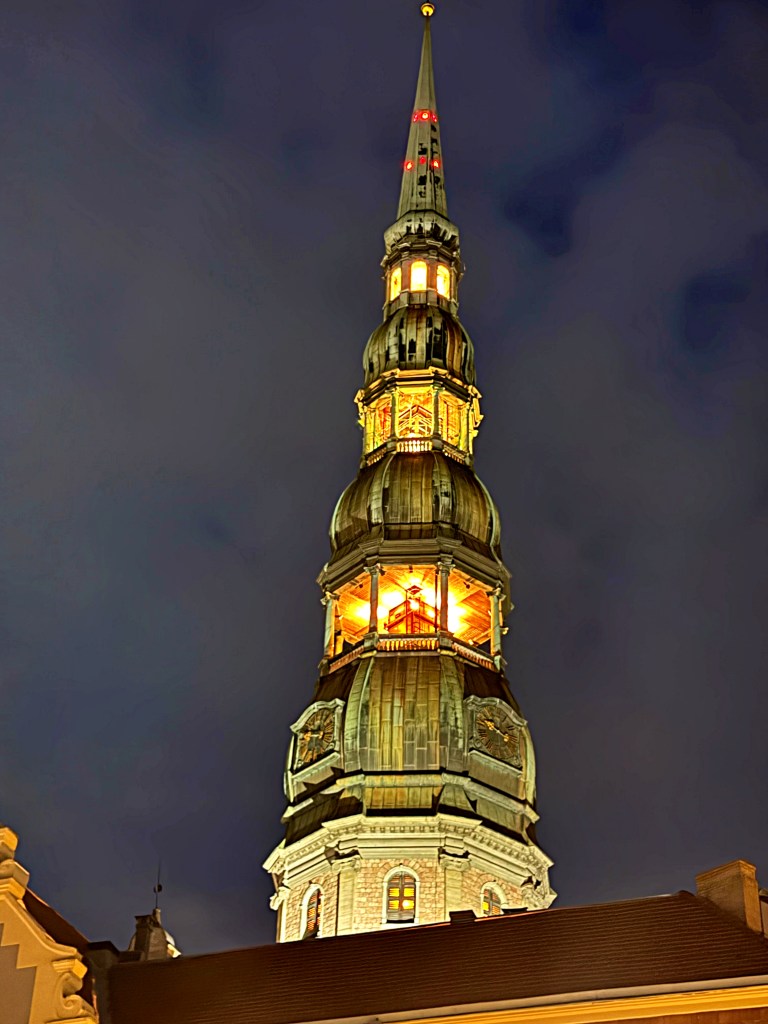
The church spires dominating the Riga skyline are Lutheran rather than Catholic — similar to Tallinn but very different from Baroque Vilnius. Riga Cathedral, also known as the Church of the Dome, is the largest Lutheran church in the Baltic States. Our personal favourite is St. Peter’s, built by the Catholics in the 13th century but taken over by Lutherans in the 16th. The tower of this church is the tallest in the old town (123 m., or 403 ft.) and provides a most photogenic beacon when lit up at night.
* Tallinn had also been a member of the Hanseatic League, so both cities thrived during the late Middle Ages. But Riga outpaced Tallinn in the 19th century because of its location at the mouth of the Daugava River, a vast waterway that reaches deep into the interior of eastern Europe and can be used for transporting goods. The Russians also built a railroad to Riga. Tallinn, by contrast, has a great port but no easy access to the interior and so lapsed in importance.
Viewed over time, proximity to Russia has proved both a boon and a curse to the Baltic States. All three capitals enjoyed periods of great wealth as conduits for the trade between east and west. But once Russia got its act together and became an aggressive, expansionist power in the 18th century, the curse aspect came more to the fore.

